Mengxue He , Chin-Ping Tan , Yong-Jiang Xu , Yuanfa Liu
{"title":"Gut microbiota-derived trimethylamine-N-oxide: A bridge between dietary fatty acid and cardiovascular disease?","authors":"Mengxue He , Chin-Ping Tan , Yong-Jiang Xu , Yuanfa Liu","doi":"10.1016/j.foodres.2020.109812","DOIUrl":null,"url":null,"abstract":"<div><p>Cardiovascular disease (CVD) is a serious disease that endangers human health and is one of the leading causes of death. Recent studies have reported that gut microbiota plays an important role in the development of CVD, especially its metabolite trimethylamine-N-oxide (TMAO). Dietary precursors, such as choline, <em>L</em>-carnitine, phosphatidylcholine and betaine were metabolized to trimethylamine (TMA) under the action of gut microbiota, and subsequently oxidized by hepatic flavin monooxygenases (FMOs) to form TMAO. Dietary fat is one of three major nutrients in food, has been found to have a positive or negative effect on the development of CVD. Multiple clinical and experimental evidences suggested that dietary fatty acids (FAs) can affect TMAO production through gut microbiota and/or FMO3 enzyme activity. This article summarizes the existing gut microbiota-mediated reduction of TMA, discusses the molecular mechanism of dietary FAs in the pathobiology of CVD from the view of TMAO. Therefore, this review provides new insight into the association of dietary FAs and CVD, paving the way for dietary FAs therapy for CVD.</p></div>","PeriodicalId":323,"journal":{"name":"Food Research International","volume":"138 ","pages":"Article 109812"},"PeriodicalIF":8.0000,"publicationDate":"2020-12-01","publicationTypes":"Journal Article","fieldsOfStudy":null,"isOpenAccess":false,"openAccessPdf":"https://sci-hub-pdf.com/10.1016/j.foodres.2020.109812","citationCount":"13","resultStr":null,"platform":"Semanticscholar","paperid":null,"PeriodicalName":"Food Research International","FirstCategoryId":"97","ListUrlMain":"https://www.sciencedirect.com/science/article/pii/S0963996920308371","RegionNum":1,"RegionCategory":"农林科学","ArticlePicture":[],"TitleCN":null,"AbstractTextCN":null,"PMCID":null,"EPubDate":"","PubModel":"","JCR":"Q1","JCRName":"FOOD SCIENCE & TECHNOLOGY","Score":null,"Total":0}
引用次数: 13
Abstract
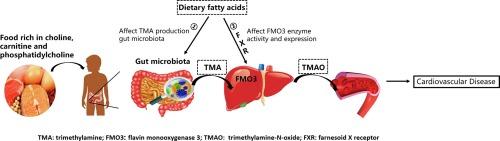
Cardiovascular disease (CVD) is a serious disease that endangers human health and is one of the leading causes of death. Recent studies have reported that gut microbiota plays an important role in the development of CVD, especially its metabolite trimethylamine-N-oxide (TMAO). Dietary precursors, such as choline, L-carnitine, phosphatidylcholine and betaine were metabolized to trimethylamine (TMA) under the action of gut microbiota, and subsequently oxidized by hepatic flavin monooxygenases (FMOs) to form TMAO. Dietary fat is one of three major nutrients in food, has been found to have a positive or negative effect on the development of CVD. Multiple clinical and experimental evidences suggested that dietary fatty acids (FAs) can affect TMAO production through gut microbiota and/or FMO3 enzyme activity. This article summarizes the existing gut microbiota-mediated reduction of TMA, discusses the molecular mechanism of dietary FAs in the pathobiology of CVD from the view of TMAO. Therefore, this review provides new insight into the association of dietary FAs and CVD, paving the way for dietary FAs therapy for CVD.
心血管疾病(CVD)是危害人类健康的严重疾病,是导致死亡的主要原因之一。最近的研究报道肠道微生物群在CVD的发展中起重要作用,特别是其代谢物三甲胺- n -氧化物(TMAO)。饲料中的胆碱、左肉碱、磷脂酰胆碱和甜菜碱在肠道菌群的作用下代谢为三甲胺(TMA),随后被肝脏黄素单加氧酶(FMOs)氧化形成TMAO。膳食脂肪是食物中的三大营养素之一,已被发现对心血管疾病的发生有积极或消极的影响。多项临床和实验证据表明,膳食脂肪酸(FAs)可通过肠道菌群和/或FMO3酶活性影响氧化三甲胺的产生。本文综述了现有肠道微生物介导的TMA还原,并从TMAO的角度探讨了膳食FAs在CVD病理生物学中的分子机制。因此,本综述为膳食脂肪酸与心血管疾病的关系提供了新的认识,为膳食脂肪酸治疗心血管疾病铺平了道路。
期刊介绍:
Food Research International serves as a rapid dissemination platform for significant and impactful research in food science, technology, engineering, and nutrition. The journal focuses on publishing novel, high-quality, and high-impact review papers, original research papers, and letters to the editors across various disciplines in the science and technology of food. Additionally, it follows a policy of publishing special issues on topical and emergent subjects in food research or related areas. Selected, peer-reviewed papers from scientific meetings, workshops, and conferences on the science, technology, and engineering of foods are also featured in special issues.



 京公网安备 11010802042870号
京ICP备2023020795号-1
京公网安备 11010802042870号
京ICP备2023020795号-1

 分享
分享
 求助内容:
求助内容: 应助结果提醒方式:
 扫码关注我们
