Fatih Altintoprak, Enis Dikicier, Yusuf Arslan, Taner Ozkececi, Gokhan Akbulut, Osman Nuri Dilek
{"title":"Comparision of the Limberg flap with the V-Y flap technique in the treatment of pilonidal disease.","authors":"Fatih Altintoprak, Enis Dikicier, Yusuf Arslan, Taner Ozkececi, Gokhan Akbulut, Osman Nuri Dilek","doi":"10.4174/jkss.2013.85.2.63","DOIUrl":null,"url":null,"abstract":"<p><strong>Purpose: </strong>In this study, we investigated whether there is a factor that can aid determi nation of the preferred technique by comparing the early and late results of two different surgical techniques for the treatment of pilonidal sinus.</p><p><strong>Methods: </strong>The medical records of 176 patients in whom the Limberg flap (LF) or V-Y flap techniques were applied for reconstruction after the excision were evaluated retrospectively.</p><p><strong>Results: </strong>The development rates of postoperative hematoma, wound separation, wound infection, and seroma were 2.8%, 5.1%, 5.6%, and 6.3%, respectively, while total flap necrosis was not observed in any patient. Return to daily activities was achieved after a mean of 17.1 days (13 to 21 days) days in the LF group and 32.7 days (18 to 47 days) in the V-Y flap group. During the average follow-up of 65 months (36 to 110 months), nine patients (5.1%) developed recurrent disease. There was no difference between the two groups with respect to early surgical complications (P = 0.286) or disease recurrence (P = 0.094), whereas the resumption of daily activities was longer in patients with a V-Y flap (P < 0.001).</p><p><strong>Conclusion: </strong>The early postoperative and long-term results of the LF and V-Y flap techniques for the treatment of pilonidal sinus were similar. Because the resumption of daily activities at work is achieved later in patients undergoing the V-Y flap compared with the LF technique, patients' employment (or position in working life) must be considered when determining the most appropriate surgical technique.</p>","PeriodicalId":49991,"journal":{"name":"Journal of the Korean Surgical Society","volume":"85 2","pages":"63-7"},"PeriodicalIF":0.0000,"publicationDate":"2013-08-01","publicationTypes":"Journal Article","fieldsOfStudy":null,"isOpenAccess":false,"openAccessPdf":"https://sci-hub-pdf.com/10.4174/jkss.2013.85.2.63","citationCount":"27","resultStr":null,"platform":"Semanticscholar","paperid":null,"PeriodicalName":"Journal of the Korean Surgical Society","FirstCategoryId":"1085","ListUrlMain":"https://doi.org/10.4174/jkss.2013.85.2.63","RegionNum":0,"RegionCategory":null,"ArticlePicture":[],"TitleCN":null,"AbstractTextCN":null,"PMCID":null,"EPubDate":"2013/7/25 0:00:00","PubModel":"Epub","JCR":"","JCRName":"","Score":null,"Total":0}
引用次数: 27
Abstract
Purpose: In this study, we investigated whether there is a factor that can aid determi nation of the preferred technique by comparing the early and late results of two different surgical techniques for the treatment of pilonidal sinus.
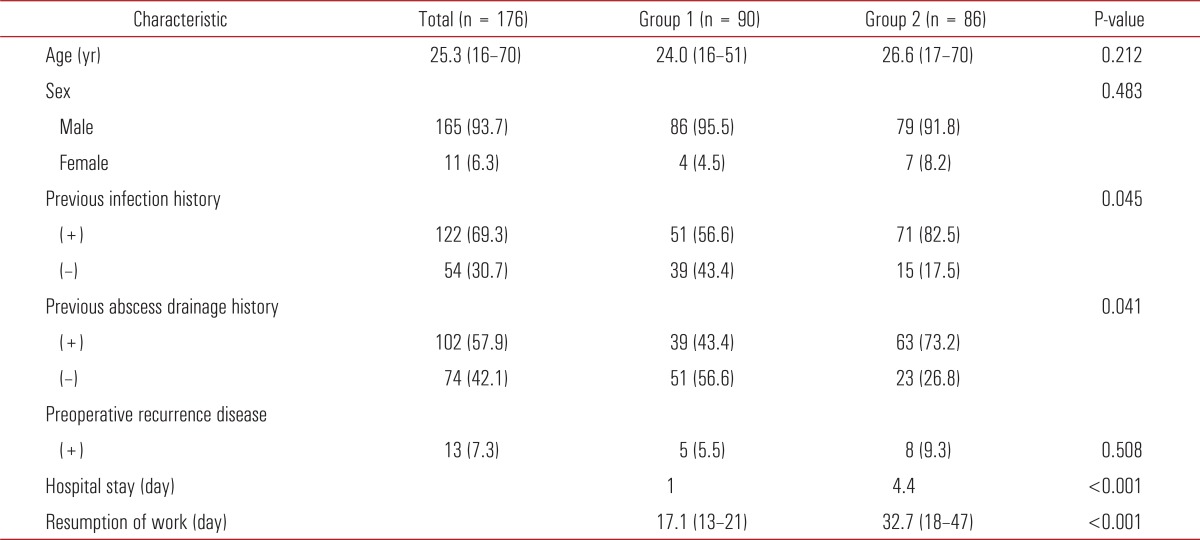
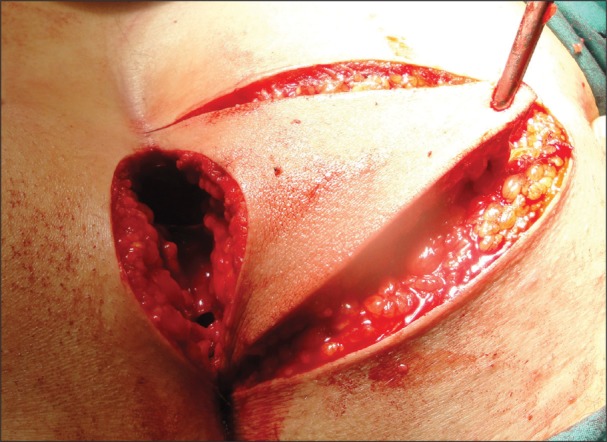
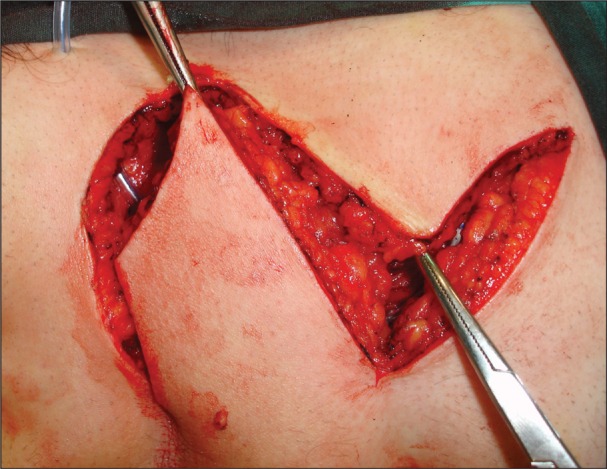
Methods: The medical records of 176 patients in whom the Limberg flap (LF) or V-Y flap techniques were applied for reconstruction after the excision were evaluated retrospectively.
Results: The development rates of postoperative hematoma, wound separation, wound infection, and seroma were 2.8%, 5.1%, 5.6%, and 6.3%, respectively, while total flap necrosis was not observed in any patient. Return to daily activities was achieved after a mean of 17.1 days (13 to 21 days) days in the LF group and 32.7 days (18 to 47 days) in the V-Y flap group. During the average follow-up of 65 months (36 to 110 months), nine patients (5.1%) developed recurrent disease. There was no difference between the two groups with respect to early surgical complications (P = 0.286) or disease recurrence (P = 0.094), whereas the resumption of daily activities was longer in patients with a V-Y flap (P < 0.001).
Conclusion: The early postoperative and long-term results of the LF and V-Y flap techniques for the treatment of pilonidal sinus were similar. Because the resumption of daily activities at work is achieved later in patients undergoing the V-Y flap compared with the LF technique, patients' employment (or position in working life) must be considered when determining the most appropriate surgical technique.



 京公网安备 11010802042870号
京ICP备2023020795号-1
京公网安备 11010802042870号
京ICP备2023020795号-1

 分享
分享
 求助内容:
求助内容: 应助结果提醒方式:
 扫码关注我们
