New wide band gap π-conjugated copolymers based on anthra[1,2-b: 4,3-b': 6,7-c''] trithiophene-8,12-dione for high performance non-fullerene polymer solar cells with an efficiency of 15.07 %
Mukhamed L. Keshtov , Igor O. Konstantinov , Alexei R. Khokhlov , Sergei A. Kuklin , Vladimir G. Alekseev , Ilya E. Ostapov , Yingping Zou , Rahul Singhal , Hemraj Dahiya , Ganesh D. Sharma
{"title":"New wide band gap π-conjugated copolymers based on anthra[1,2-b: 4,3-b': 6,7-c''] trithiophene-8,12-dione for high performance non-fullerene polymer solar cells with an efficiency of 15.07 %","authors":"Mukhamed L. Keshtov , Igor O. Konstantinov , Alexei R. Khokhlov , Sergei A. Kuklin , Vladimir G. Alekseev , Ilya E. Ostapov , Yingping Zou , Rahul Singhal , Hemraj Dahiya , Ganesh D. Sharma","doi":"10.1016/j.polymer.2022.124892","DOIUrl":null,"url":null,"abstract":"<div><p><span><span>Developing efficient wide-bandgap copolymer donor materials to match with narrow bandgap non-fullerene acceptors is continuously ongoing for </span>polymer solar cells. Herein, two new D-A copolymers are designed and synthesized by embedding the same anthra[1,2-b:4,3-b':6,7-c\"] trithiophene-8,12-dione (A3T) acceptor unit and different donor units, i.e., BDTTZ (</span><strong>P126</strong>) and BDTTh (<strong>P127</strong><span>). These copolymers showed broad absorption from 350 to 680 nm and deeper HOMO energy level. We have used these two copolymers as donors and a narrow bandgap non-fullerene acceptor Y6 to prepare bulk heterojunction polymer solar cells (PSCs). After the optimization, </span><strong>P126</strong>:Y6 and <strong>P127</strong>:Y6 attained overall power conversion efficiency of 15.07% and 12.27%, respectively. The higher PCE for the <strong>P126</strong> than <strong>P127</strong><span> is associated with the more efficient photon harvesting and photogenerated excitons, balanced charge transport, and low energy loss. Our results may help to design new polymers with a deeper highest occupied molecular orbital level that will be well-matched with non-fullerene acceptors.</span></p></div>","PeriodicalId":405,"journal":{"name":"Polymer","volume":"251 ","pages":"Article 124892"},"PeriodicalIF":4.5000,"publicationDate":"2022-06-03","publicationTypes":"Journal Article","fieldsOfStudy":null,"isOpenAccess":false,"openAccessPdf":"","citationCount":"3","resultStr":null,"platform":"Semanticscholar","paperid":null,"PeriodicalName":"Polymer","FirstCategoryId":"92","ListUrlMain":"https://www.sciencedirect.com/science/article/pii/S0032386122003809","RegionNum":2,"RegionCategory":"化学","ArticlePicture":[],"TitleCN":null,"AbstractTextCN":null,"PMCID":null,"EPubDate":"","PubModel":"","JCR":"Q2","JCRName":"POLYMER SCIENCE","Score":null,"Total":0}
引用次数: 3
Abstract
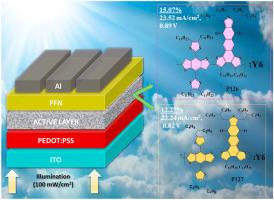
Developing efficient wide-bandgap copolymer donor materials to match with narrow bandgap non-fullerene acceptors is continuously ongoing for polymer solar cells. Herein, two new D-A copolymers are designed and synthesized by embedding the same anthra[1,2-b:4,3-b':6,7-c"] trithiophene-8,12-dione (A3T) acceptor unit and different donor units, i.e., BDTTZ (P126) and BDTTh (P127). These copolymers showed broad absorption from 350 to 680 nm and deeper HOMO energy level. We have used these two copolymers as donors and a narrow bandgap non-fullerene acceptor Y6 to prepare bulk heterojunction polymer solar cells (PSCs). After the optimization, P126:Y6 and P127:Y6 attained overall power conversion efficiency of 15.07% and 12.27%, respectively. The higher PCE for the P126 than P127 is associated with the more efficient photon harvesting and photogenerated excitons, balanced charge transport, and low energy loss. Our results may help to design new polymers with a deeper highest occupied molecular orbital level that will be well-matched with non-fullerene acceptors.
期刊介绍:
Polymer is an interdisciplinary journal dedicated to publishing innovative and significant advances in Polymer Physics, Chemistry and Technology. We welcome submissions on polymer hybrids, nanocomposites, characterisation and self-assembly. Polymer also publishes work on the technological application of polymers in energy and optoelectronics.
The main scope is covered but not limited to the following core areas:
Polymer Materials
Nanocomposites and hybrid nanomaterials
Polymer blends, films, fibres, networks and porous materials
Physical Characterization
Characterisation, modelling and simulation* of molecular and materials properties in bulk, solution, and thin films
Polymer Engineering
Advanced multiscale processing methods
Polymer Synthesis, Modification and Self-assembly
Including designer polymer architectures, mechanisms and kinetics, and supramolecular polymerization
Technological Applications
Polymers for energy generation and storage
Polymer membranes for separation technology
Polymers for opto- and microelectronics.



 京公网安备 11010802042870号
京ICP备2023020795号-1
京公网安备 11010802042870号
京ICP备2023020795号-1

 分享
分享
 求助内容:
求助内容: 应助结果提醒方式:
 扫码关注我们
