Arpit Malik , Shankar G. Aggarwal , Bhagawati Kunwar , Dhananjay Kumar Deshmukh , Kritika Shukla , Rishu Agarwal , Khem Singh , Daya Soni , Puna Ram Sinha , Sho Ohata , Tatsuhiro Mori , Makoto Koike , Kimitaka Kawamura , Yutaka Kondo
{"title":"Physical and chemical properties of PM1 in Delhi: A comparison between clean and polluted days","authors":"Arpit Malik , Shankar G. Aggarwal , Bhagawati Kunwar , Dhananjay Kumar Deshmukh , Kritika Shukla , Rishu Agarwal , Khem Singh , Daya Soni , Puna Ram Sinha , Sho Ohata , Tatsuhiro Mori , Makoto Koike , Kimitaka Kawamura , Yutaka Kondo","doi":"10.1016/j.scitotenv.2023.164266","DOIUrl":null,"url":null,"abstract":"<div><p>Considering the significance of PM<sub>1</sub> aerosol in assessing health impacts of air pollution, an extensive analysis of PM<sub>1</sub> samples collected at an urban site in Delhi is presented in this study. Overall, PM<sub>1</sub> contributed to about 50 % of PM<sub>2.5</sub> mass which is alarming especially in Delhi where particle mass loadings are usually higher than prescribed limits. Major portion of PM<sub>1</sub> consisted of organic matter (OM) that formed nearly 47 % of PM<sub>1</sub> mass. Elemental carbon (EC) contributed to about 13 % of PM<sub>1</sub> mass, whereas SO<sub>4</sub><sup>2−</sup> (16 %), NH<sub>4</sub><sup>+</sup> (10 %), NO<sub>3</sub><sup>−</sup> (4 %) and Cl<sup>−</sup> (3 %) were the major inorganic ions present. Sampling was performed in two distinctive campaign periods (in terms of meteorological conditions and heating (fire) activities), during the year 2019, each spanning two-week time, i.e. (i) September 3<sup>rd</sup>-16<sup>th</sup> (clean days), and (ii) November 22<sup>nd</sup>-December 5<sup>th</sup> (polluted days). Additionally, PM<sub>2.5</sub> and black carbon (BC) were measured simultaneously for subsequent analysis. The 24-h averaged mean concentrations of PM<sub>2.5</sub> and BC during clean days (polluted days) were 70.6 ± 26.9 and 3.9 ± 1.0 μg m<sup>−3</sup> (196 ± 104 and 7.6 ± 4.1 μg m<sup>−3</sup>), respectively, which were systematically lower (higher) than that of the annual mean (taken from studies conducted at same site in 2019) of 142 and 5.7 μg m<sup>−3</sup>, respectively. Changes in characteristic ratios (i.e., organic carbon (OC)/elemental carbon (EC) and K<sup>+</sup>/EC) of chemical species detected in PM<sub>1</sub> show an increase in biomass emissions during polluted days. Increase in biomass emission can be attributed to increase in heating practices (burning of biofuels such as wood logs, straw, and cow-dung cake) in- and around- Delhi because of fall in temperature during second campaign. Furthermore, a significant increase in NO<sub>3</sub><sup>−</sup> fraction of PM<sub>1</sub> is observed during second campaign which shows fog processing of NO<sub>X</sub> due to conducive meteorological conditions in winters. Also, comparatively stronger correlation of NO<sub>3</sub><sup>−</sup> with K<sup>+</sup> during second campaign (<em>r</em> = 0.98 as compared to <em>r</em> = 0.5 during first campaign) suggests the increased heating practices to be a contributing factor for increased fraction of NO<sub>3</sub><sup>−</sup> in PM<sub>1</sub>. We observed that during polluted days, meteorological parameters such as dispersion rate also played a major role in intensifying the impact of increased local emissions due to heating activities. Apart from this, change in the direction of regional emission transport to study site and the topology of Delhi are the possible reasons for the elevated pollution level, especially PM<sub>1</sub> during winter in Delhi. This study also suggests that black carbon measurement techniques used in current study (optical absorbance with heated inlet and evolved carbon techniques) can be used as reference techniques to determine the site-specific calibration constant of optical photometers for urban aerosol.</p></div>","PeriodicalId":422,"journal":{"name":"Science of the Total Environment","volume":"892 ","pages":"Article 164266"},"PeriodicalIF":8.0000,"publicationDate":"2023-09-20","publicationTypes":"Journal Article","fieldsOfStudy":null,"isOpenAccess":false,"openAccessPdf":"","citationCount":"3","resultStr":null,"platform":"Semanticscholar","paperid":null,"PeriodicalName":"Science of the Total Environment","FirstCategoryId":"93","ListUrlMain":"https://www.sciencedirect.com/science/article/pii/S0048969723028875","RegionNum":1,"RegionCategory":"环境科学与生态学","ArticlePicture":[],"TitleCN":null,"AbstractTextCN":null,"PMCID":null,"EPubDate":"2023/5/22 0:00:00","PubModel":"Epub","JCR":"Q1","JCRName":"ENVIRONMENTAL SCIENCES","Score":null,"Total":0}
引用次数: 3
Abstract
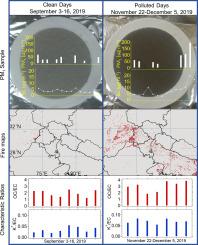
Considering the significance of PM1 aerosol in assessing health impacts of air pollution, an extensive analysis of PM1 samples collected at an urban site in Delhi is presented in this study. Overall, PM1 contributed to about 50 % of PM2.5 mass which is alarming especially in Delhi where particle mass loadings are usually higher than prescribed limits. Major portion of PM1 consisted of organic matter (OM) that formed nearly 47 % of PM1 mass. Elemental carbon (EC) contributed to about 13 % of PM1 mass, whereas SO42− (16 %), NH4+ (10 %), NO3− (4 %) and Cl− (3 %) were the major inorganic ions present. Sampling was performed in two distinctive campaign periods (in terms of meteorological conditions and heating (fire) activities), during the year 2019, each spanning two-week time, i.e. (i) September 3rd-16th (clean days), and (ii) November 22nd-December 5th (polluted days). Additionally, PM2.5 and black carbon (BC) were measured simultaneously for subsequent analysis. The 24-h averaged mean concentrations of PM2.5 and BC during clean days (polluted days) were 70.6 ± 26.9 and 3.9 ± 1.0 μg m−3 (196 ± 104 and 7.6 ± 4.1 μg m−3), respectively, which were systematically lower (higher) than that of the annual mean (taken from studies conducted at same site in 2019) of 142 and 5.7 μg m−3, respectively. Changes in characteristic ratios (i.e., organic carbon (OC)/elemental carbon (EC) and K+/EC) of chemical species detected in PM1 show an increase in biomass emissions during polluted days. Increase in biomass emission can be attributed to increase in heating practices (burning of biofuels such as wood logs, straw, and cow-dung cake) in- and around- Delhi because of fall in temperature during second campaign. Furthermore, a significant increase in NO3− fraction of PM1 is observed during second campaign which shows fog processing of NOX due to conducive meteorological conditions in winters. Also, comparatively stronger correlation of NO3− with K+ during second campaign (r = 0.98 as compared to r = 0.5 during first campaign) suggests the increased heating practices to be a contributing factor for increased fraction of NO3− in PM1. We observed that during polluted days, meteorological parameters such as dispersion rate also played a major role in intensifying the impact of increased local emissions due to heating activities. Apart from this, change in the direction of regional emission transport to study site and the topology of Delhi are the possible reasons for the elevated pollution level, especially PM1 during winter in Delhi. This study also suggests that black carbon measurement techniques used in current study (optical absorbance with heated inlet and evolved carbon techniques) can be used as reference techniques to determine the site-specific calibration constant of optical photometers for urban aerosol.
期刊介绍:
The Science of the Total Environment is an international journal dedicated to scientific research on the environment and its interaction with humanity. It covers a wide range of disciplines and seeks to publish innovative, hypothesis-driven, and impactful research that explores the entire environment, including the atmosphere, lithosphere, hydrosphere, biosphere, and anthroposphere.
The journal's updated Aims & Scope emphasizes the importance of interdisciplinary environmental research with broad impact. Priority is given to studies that advance fundamental understanding and explore the interconnectedness of multiple environmental spheres. Field studies are preferred, while laboratory experiments must demonstrate significant methodological advancements or mechanistic insights with direct relevance to the environment.



 京公网安备 11010802042870号
京ICP备2023020795号-1
京公网安备 11010802042870号
京ICP备2023020795号-1

 分享
分享
 求助内容:
求助内容: 应助结果提醒方式:
 扫码关注我们
