{"title":"Serial dependence in visual perception","authors":"Jason Fischer, David Whitney","doi":"10.1038/nn.3689","DOIUrl":null,"url":null,"abstract":"Visual input is often noisy and discontinuous, even though the physical environment is generally stable. The authors show that the visual system trades off change sensitivity to capitalize on physical continuity via serial dependence: present perception is biased toward past visual input. This bias is modulated by attention and governed by a spatiotemporally-tuned operator, a continuity field. Visual input often arrives in a noisy and discontinuous stream, owing to head and eye movements, occlusion, lighting changes, and many other factors. Yet the physical world is generally stable; objects and physical characteristics rarely change spontaneously. How then does the human visual system capitalize on continuity in the physical environment over time? We found that visual perception in humans is serially dependent, using both prior and present input to inform perception at the present moment. Using an orientation judgment task, we found that, even when visual input changed randomly over time, perceived orientation was strongly and systematically biased toward recently seen stimuli. Furthermore, the strength of this bias was modulated by attention and tuned to the spatial and temporal proximity of successive stimuli. These results reveal a serial dependence in perception characterized by a spatiotemporally tuned, orientation-selective operator—which we call a continuity field—that may promote visual stability over time.","PeriodicalId":19076,"journal":{"name":"Nature neuroscience","volume":"17 5","pages":"738-743"},"PeriodicalIF":20.0000,"publicationDate":"2014-03-30","publicationTypes":"Journal Article","fieldsOfStudy":null,"isOpenAccess":false,"openAccessPdf":"https://sci-hub-pdf.com/10.1038/nn.3689","citationCount":"521","resultStr":null,"platform":"Semanticscholar","paperid":null,"PeriodicalName":"Nature neuroscience","FirstCategoryId":"3","ListUrlMain":"https://www.nature.com/articles/nn.3689","RegionNum":1,"RegionCategory":"医学","ArticlePicture":[],"TitleCN":null,"AbstractTextCN":null,"PMCID":null,"EPubDate":"","PubModel":"","JCR":"Q1","JCRName":"NEUROSCIENCES","Score":null,"Total":0}
引用次数: 521
Abstract
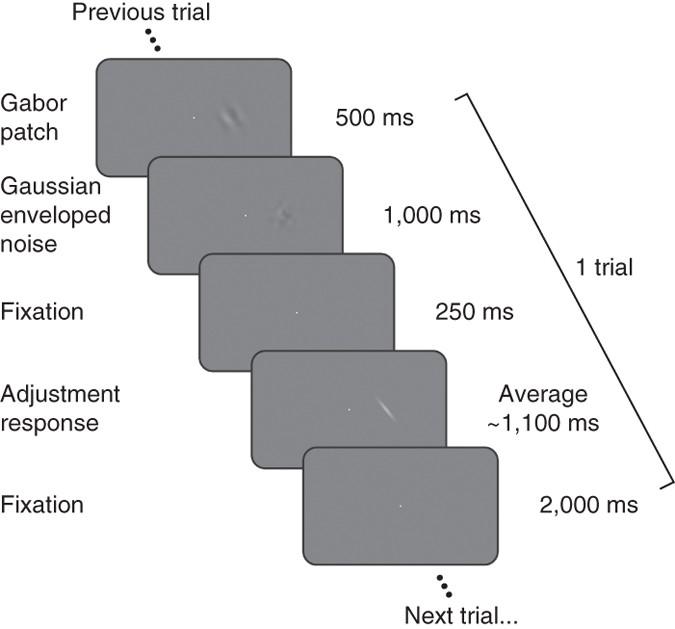
Visual input is often noisy and discontinuous, even though the physical environment is generally stable. The authors show that the visual system trades off change sensitivity to capitalize on physical continuity via serial dependence: present perception is biased toward past visual input. This bias is modulated by attention and governed by a spatiotemporally-tuned operator, a continuity field. Visual input often arrives in a noisy and discontinuous stream, owing to head and eye movements, occlusion, lighting changes, and many other factors. Yet the physical world is generally stable; objects and physical characteristics rarely change spontaneously. How then does the human visual system capitalize on continuity in the physical environment over time? We found that visual perception in humans is serially dependent, using both prior and present input to inform perception at the present moment. Using an orientation judgment task, we found that, even when visual input changed randomly over time, perceived orientation was strongly and systematically biased toward recently seen stimuli. Furthermore, the strength of this bias was modulated by attention and tuned to the spatial and temporal proximity of successive stimuli. These results reveal a serial dependence in perception characterized by a spatiotemporally tuned, orientation-selective operator—which we call a continuity field—that may promote visual stability over time.
期刊介绍:
Nature Neuroscience, a multidisciplinary journal, publishes papers of the utmost quality and significance across all realms of neuroscience. The editors welcome contributions spanning molecular, cellular, systems, and cognitive neuroscience, along with psychophysics, computational modeling, and nervous system disorders. While no area is off-limits, studies offering fundamental insights into nervous system function receive priority.
The journal offers high visibility to both readers and authors, fostering interdisciplinary communication and accessibility to a broad audience. It maintains high standards of copy editing and production, rigorous peer review, rapid publication, and operates independently from academic societies and other vested interests.
In addition to primary research, Nature Neuroscience features news and views, reviews, editorials, commentaries, perspectives, book reviews, and correspondence, aiming to serve as the voice of the global neuroscience community.



 京公网安备 11010802042870号
京ICP备2023020795号-1
京公网安备 11010802042870号
京ICP备2023020795号-1

 分享
分享
 求助内容:
求助内容: 应助结果提醒方式:
 扫码关注我们
