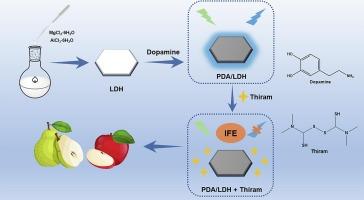
{"title":"A fluorescent turn-off sensor based on polydopamine modified Mg-Al layered double hydroxide for the detection of thiram in apple and pear samples","authors":"Zilin Meng, Ziwei Ju, Jiaxuan Fan, Yujiao Wang, Xingyi Wu, Runhua Lu, Wenfeng Zhou, Haixiang Gao","doi":"10.1016/j.microc.2023.108384","DOIUrl":null,"url":null,"abstract":"<div><p>A low-cost and environmentally friendly polydopamine modified layered double hydroxides (PDA/LDH) was prepared, and a novel fluorescent “turn-off” sensor was established for rapid detection of thiram. The material was characterized using the transmission electron microscope (TEM), Fourier transform-infrared (FT-IR), X-ray diffraction (XRD), X-ray photo-electronic spectroscopy (XPS) and other methods. The electrostatic interaction, hydrogen bonding and S-π interaction between PDA/LDH and thiram were mostly attributed to the sensing of thiram. Through the internal filter effect (IFE), the fluorescence of the PDA/LDH could be effectively quenched by thiram. The limit of detection (LOD) was determined to be 25 μg L<sup>−1</sup> under optimal conditions, while the concentration of thiram in the range of 50–50000 μg L<sup>−1</sup> exhibited a satisfactory relationship with the change in fluorescence intensity. Furthermore, the prepared probes were successfully applied on apple and pear samples, in which the recovery rate could reach 92.06–104.90 %. The synthesis of PDA/LDH was quite simple, and the detection of thiram could be accomplished right away when the sensor and thiram were combined. All the above results demonstrated the high potential of the established method in practical applications.</p></div>","PeriodicalId":391,"journal":{"name":"Microchemical Journal","volume":"187 ","pages":"Article 108384"},"PeriodicalIF":4.9000,"publicationDate":"2023-04-01","publicationTypes":"Journal Article","fieldsOfStudy":null,"isOpenAccess":false,"openAccessPdf":"","citationCount":"1","resultStr":null,"platform":"Semanticscholar","paperid":null,"PeriodicalName":"Microchemical Journal","FirstCategoryId":"92","ListUrlMain":"https://www.sciencedirect.com/science/article/pii/S0026265X23000024","RegionNum":2,"RegionCategory":"化学","ArticlePicture":[],"TitleCN":null,"AbstractTextCN":null,"PMCID":null,"EPubDate":"2023/1/2 0:00:00","PubModel":"Epub","JCR":"Q1","JCRName":"CHEMISTRY, ANALYTICAL","Score":null,"Total":0}
引用次数: 1
Abstract
A low-cost and environmentally friendly polydopamine modified layered double hydroxides (PDA/LDH) was prepared, and a novel fluorescent “turn-off” sensor was established for rapid detection of thiram. The material was characterized using the transmission electron microscope (TEM), Fourier transform-infrared (FT-IR), X-ray diffraction (XRD), X-ray photo-electronic spectroscopy (XPS) and other methods. The electrostatic interaction, hydrogen bonding and S-π interaction between PDA/LDH and thiram were mostly attributed to the sensing of thiram. Through the internal filter effect (IFE), the fluorescence of the PDA/LDH could be effectively quenched by thiram. The limit of detection (LOD) was determined to be 25 μg L−1 under optimal conditions, while the concentration of thiram in the range of 50–50000 μg L−1 exhibited a satisfactory relationship with the change in fluorescence intensity. Furthermore, the prepared probes were successfully applied on apple and pear samples, in which the recovery rate could reach 92.06–104.90 %. The synthesis of PDA/LDH was quite simple, and the detection of thiram could be accomplished right away when the sensor and thiram were combined. All the above results demonstrated the high potential of the established method in practical applications.
期刊介绍:
The Microchemical Journal is a peer reviewed journal devoted to all aspects and phases of analytical chemistry and chemical analysis. The Microchemical Journal publishes articles which are at the forefront of modern analytical chemistry and cover innovations in the techniques to the finest possible limits. This includes fundamental aspects, instrumentation, new developments, innovative and novel methods and applications including environmental and clinical field.
Traditional classical analytical methods such as spectrophotometry and titrimetry as well as established instrumentation methods such as flame and graphite furnace atomic absorption spectrometry, gas chromatography, and modified glassy or carbon electrode electrochemical methods will be considered, provided they show significant improvements and novelty compared to the established methods.



 京公网安备 11010802042870号
京ICP备2023020795号-1
京公网安备 11010802042870号
京ICP备2023020795号-1

 分享
分享
 求助内容:
求助内容: 应助结果提醒方式:
 扫码关注我们
