Effectiveness of a community-based positive prevention intervention for people living with HIV who are not receiving antiretroviral treatment: a prospective cohort study.
Avina Sarna, Stanley Luchters, Eustasius Musenge, Jerry Okal, Matthew Chersich, Waimar Tun, Sabine Mall, Nzioki Kingola, Sam Kalibala
{"title":"Effectiveness of a community-based positive prevention intervention for people living with HIV who are not receiving antiretroviral treatment: a prospective cohort study.","authors":"Avina Sarna, Stanley Luchters, Eustasius Musenge, Jerry Okal, Matthew Chersich, Waimar Tun, Sabine Mall, Nzioki Kingola, Sam Kalibala","doi":"10.9745/GHSP-D-12-00023","DOIUrl":null,"url":null,"abstract":"<p><strong>Background: </strong>We report effectiveness of an HIV-prevention intervention delivered by community health workers (CHWs) in Mombasa, Kenya, to PLHIV who have not initiated or who have discontinued ART-an often difficult-to-reach population because they fall outside the ambit of health care and prevention services.</p><p><strong>Methods: </strong>A 2-arm cohort study assessed a structured risk-reduction intervention involving at least 4 one-to-one counseling sessions and personalized support. The control group received standard prevention services. CHWs recruited treatment-naïve people living with HIV (PLHIV) or those who had previously taken antiretroviral drugs. Data were analyzed using a Propensity Score Matched (PSM)-sample to control for baseline differences between the groups.</p><p><strong>Results: </strong>634 PLHIV were recruited and followed for 6 months. Median age was 35 years, and 74.3% were female. Participants in the intervention group reported reduced risky sexual behaviors both at endline compared with baseline and compared with the control group. At endline, in the PSM analysis, participants in the intervention arm were less likely than participants in the control group to report unprotected sex with a spouse (Odds Ratio [OR] = 0.08, 95% confidence interval [CI] = 0.03-0.24), and they reported fewer unprotected sex acts (12.3% versus 46.0%, respectively; OR = 0.16, 95% CI = 0.09-0.29; P<0.001). Further, 92.4% of participants in the intervention group reported zero unsafe sex acts (with partners of negative or unknown HIV status) compared with 70.8% in the control group (P<0.001), and more participants in the intervention arm were receiving ART (34.3% versus 12.7%, respectively; P<0.001).</p><p><strong>Conclusion: </strong>CHWs effectively reached PLHIV who had never received or who had discontinued ART, and they delivered a risk-reduction intervention that led to declines in reported sexual risk behaviors, as well as to increases in ART uptake. A scaled-up intervention warrants consideration.</p>","PeriodicalId":12692,"journal":{"name":"Global Health: Science and Practice","volume":"1 1","pages":"52-67"},"PeriodicalIF":2.5000,"publicationDate":"2013-03-21","publicationTypes":"Journal Article","fieldsOfStudy":null,"isOpenAccess":false,"openAccessPdf":"https://sci-hub-pdf.com/10.9745/GHSP-D-12-00023","citationCount":"11","resultStr":null,"platform":"Semanticscholar","paperid":null,"PeriodicalName":"Global Health: Science and Practice","FirstCategoryId":"3","ListUrlMain":"https://doi.org/10.9745/GHSP-D-12-00023","RegionNum":3,"RegionCategory":"医学","ArticlePicture":[],"TitleCN":null,"AbstractTextCN":null,"PMCID":null,"EPubDate":"2013/3/1 0:00:00","PubModel":"eCollection","JCR":"Q2","JCRName":"PUBLIC, ENVIRONMENTAL & OCCUPATIONAL HEALTH","Score":null,"Total":0}
引用次数: 11
Abstract
Background: We report effectiveness of an HIV-prevention intervention delivered by community health workers (CHWs) in Mombasa, Kenya, to PLHIV who have not initiated or who have discontinued ART-an often difficult-to-reach population because they fall outside the ambit of health care and prevention services.
Methods: A 2-arm cohort study assessed a structured risk-reduction intervention involving at least 4 one-to-one counseling sessions and personalized support. The control group received standard prevention services. CHWs recruited treatment-naïve people living with HIV (PLHIV) or those who had previously taken antiretroviral drugs. Data were analyzed using a Propensity Score Matched (PSM)-sample to control for baseline differences between the groups.
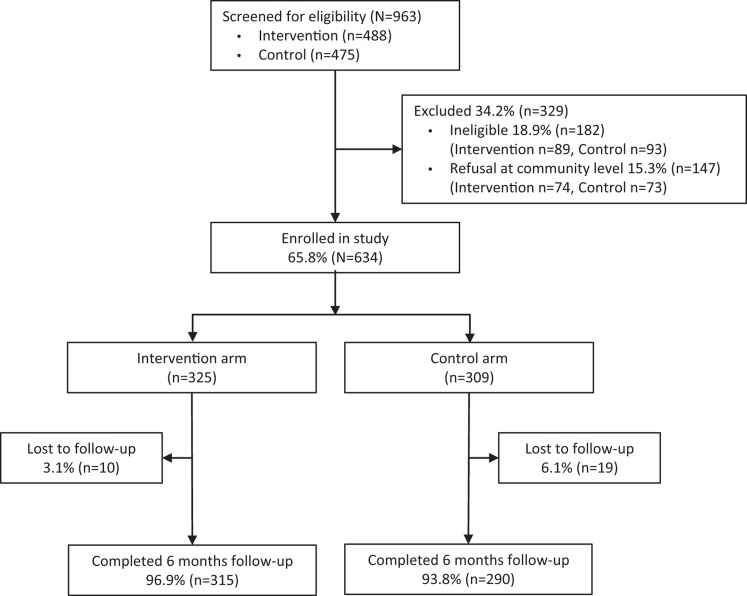
Results: 634 PLHIV were recruited and followed for 6 months. Median age was 35 years, and 74.3% were female. Participants in the intervention group reported reduced risky sexual behaviors both at endline compared with baseline and compared with the control group. At endline, in the PSM analysis, participants in the intervention arm were less likely than participants in the control group to report unprotected sex with a spouse (Odds Ratio [OR] = 0.08, 95% confidence interval [CI] = 0.03-0.24), and they reported fewer unprotected sex acts (12.3% versus 46.0%, respectively; OR = 0.16, 95% CI = 0.09-0.29; P<0.001). Further, 92.4% of participants in the intervention group reported zero unsafe sex acts (with partners of negative or unknown HIV status) compared with 70.8% in the control group (P<0.001), and more participants in the intervention arm were receiving ART (34.3% versus 12.7%, respectively; P<0.001).
Conclusion: CHWs effectively reached PLHIV who had never received or who had discontinued ART, and they delivered a risk-reduction intervention that led to declines in reported sexual risk behaviors, as well as to increases in ART uptake. A scaled-up intervention warrants consideration.
期刊介绍:
Global Health: Science and Practice (GHSP) is a no-fee, open-access, peer-reviewed, online journal aimed to improve health practice, especially in low- and middle-income countries. Our goal is to reach those who design, implement, manage, evaluate, and otherwise support health programs. We are especially interested in advancing knowledge on practical program implementation issues, with information on what programs entail and how they are implemented. GHSP is currently indexed in PubMed, PubMed Central, POPLINE, EBSCO, SCOPUS,. the Web of Science Emerging Sources Citation Index, and the USAID Development Experience Clearinghouse (DEC).
TOPICS:
Issued four times a year, GHSP will include articles on all global health topics, covering diverse programming models and a wide range of cross-cutting issues that impact and support health systems. Examples include but are not limited to:
Health:
Addiction and harm reduction,
Child Health,
Communicable and Emerging Diseases,
Disaster Preparedness and Response,
Environmental Health,
Family Planning/Reproductive Health,
HIV/AIDS,
Malaria,
Maternal Health,
Neglected Tropical Diseases,
Non-Communicable Diseases/Injuries,
Nutrition,
Tuberculosis,
Water and Sanitation.
Cross-Cutting Issues:
Epidemiology,
Gender,
Health Communication/Healthy Behavior,
Health Policy and Advocacy,
Health Systems,
Human Resources/Training,
Knowledge Management,
Logistics and Supply Chain Management,
Management and Governance,
mHealth/eHealth/digital health,
Monitoring and Evaluation,
Scale Up,
Youth.



 京公网安备 11010802042870号
京ICP备2023020795号-1
京公网安备 11010802042870号
京ICP备2023020795号-1

 分享
分享
 求助内容:
求助内容: 应助结果提醒方式:
 扫码关注我们
