Lin Tan, Lan Tan, Hui-Fu Wang, Jun Wang, Chen-Chen Tan, Meng-Shan Tan, Xiang-Fei Meng, Chong Wang, Jin-Tai Yu
{"title":"Efficacy and safety of atypical antipsychotic drug treatment for dementia: a systematic review and meta-analysis.","authors":"Lin Tan, Lan Tan, Hui-Fu Wang, Jun Wang, Chen-Chen Tan, Meng-Shan Tan, Xiang-Fei Meng, Chong Wang, Jin-Tai Yu","doi":"10.1186/s13195-015-0102-9","DOIUrl":null,"url":null,"abstract":"<p><strong>Introduction: </strong>A wide variety of atypical antipsychotic drugs (risperidone, olanzapine, quetiapine, aripiprazole, ziprasidone and clozapine) are widely used in the management of neuropsychiatric symptoms, which are commonly seen in dementia, but results from randomised controlled trials (RCTs) on the efficacy and safety of these agents are conflicting. We aimed to quantify the efficacy and safety of atypical antipsychotic drugs on neuropsychiatric symptoms in dementia patients.</p><p><strong>Methods: </strong>PubMed, EMBASE, the Cochrane Controlled Trials Register and the Cochrane Database of Systematic Reviews for reports published before August 2014 were searched for eligible randomized controlled trials of atypical antipsychotic drugs therapy in patients with psychotic symptoms of dementia. Two reviewers independently assessed the quality of the trials and extracted information.</p><p><strong>Results: </strong>Overall, 23 relevant RCTs with 5,819 participants were identified. This meta-analysis demonstrated a significant efficacy of atypical antipsychotics on psychiatric symptoms and cognitive functions compared to placebo. In the meta-analysis, the weighted mean differences (WMDs) in change scores for psychiatric symptoms were in favor of aripiprazole (-4.4, 95% confidence interval (CI) - 7.04 to -1.77) and risperidone (-1.48, 95% CI -2.35 to -0.61) compared to placebo. In cognitive effects, WMDs in change scores for the Clinical Global Impression-Change (CGI-C) were in favor of aripiprazole, risperidone, olanzapine and quetiapine which ranged from a -0.30 points mean difference (95% CI:-0.59 to -0.01) in the aripiprazole trials to -0.43 (95% CI:-0.62 to -0.25) in the risperidone group. Patients receiving atypical antipsychotics showed no difference in risk for injuries or falls (P > 0.05), significantly higher risks (P < 0.05) for somnolence, urinary tract infection, edema and abnormal gait. However, there was no significant evidence for death reported.</p><p><strong>Conclusion: </strong>Aripiprazole and risperidone are able to improve psychiatric symptoms and slow decline in cognition function at average 12 weeks in patients with neuropsychiatric symptoms of dementia. However, high adverse events may offset the efficacy of atypical antipsychotics in dementia.</p>","PeriodicalId":7516,"journal":{"name":"Alzheimer's Research & Therapy","volume":"7 1","pages":"20"},"PeriodicalIF":7.6000,"publicationDate":"2015-04-20","publicationTypes":"Journal Article","fieldsOfStudy":null,"isOpenAccess":false,"openAccessPdf":"https://sci-hub-pdf.com/10.1186/s13195-015-0102-9","citationCount":"39","resultStr":null,"platform":"Semanticscholar","paperid":null,"PeriodicalName":"Alzheimer's Research & Therapy","FirstCategoryId":"3","ListUrlMain":"https://doi.org/10.1186/s13195-015-0102-9","RegionNum":1,"RegionCategory":"医学","ArticlePicture":[],"TitleCN":null,"AbstractTextCN":null,"PMCID":null,"EPubDate":"2015/1/1 0:00:00","PubModel":"eCollection","JCR":"Q1","JCRName":"CLINICAL NEUROLOGY","Score":null,"Total":0}
引用次数: 39
Abstract
Introduction: A wide variety of atypical antipsychotic drugs (risperidone, olanzapine, quetiapine, aripiprazole, ziprasidone and clozapine) are widely used in the management of neuropsychiatric symptoms, which are commonly seen in dementia, but results from randomised controlled trials (RCTs) on the efficacy and safety of these agents are conflicting. We aimed to quantify the efficacy and safety of atypical antipsychotic drugs on neuropsychiatric symptoms in dementia patients.
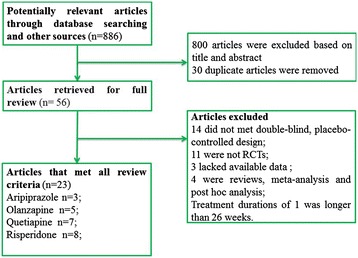
Methods: PubMed, EMBASE, the Cochrane Controlled Trials Register and the Cochrane Database of Systematic Reviews for reports published before August 2014 were searched for eligible randomized controlled trials of atypical antipsychotic drugs therapy in patients with psychotic symptoms of dementia. Two reviewers independently assessed the quality of the trials and extracted information.
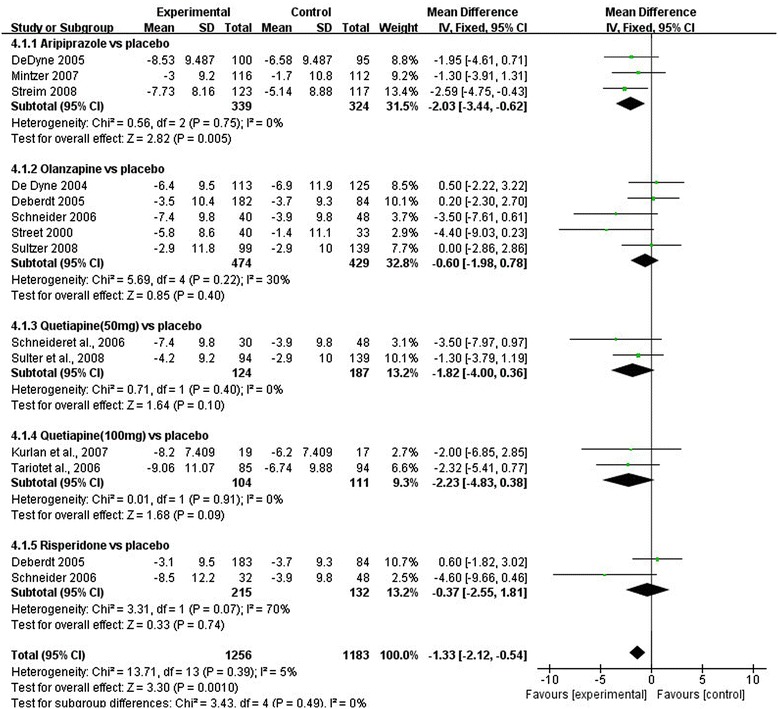
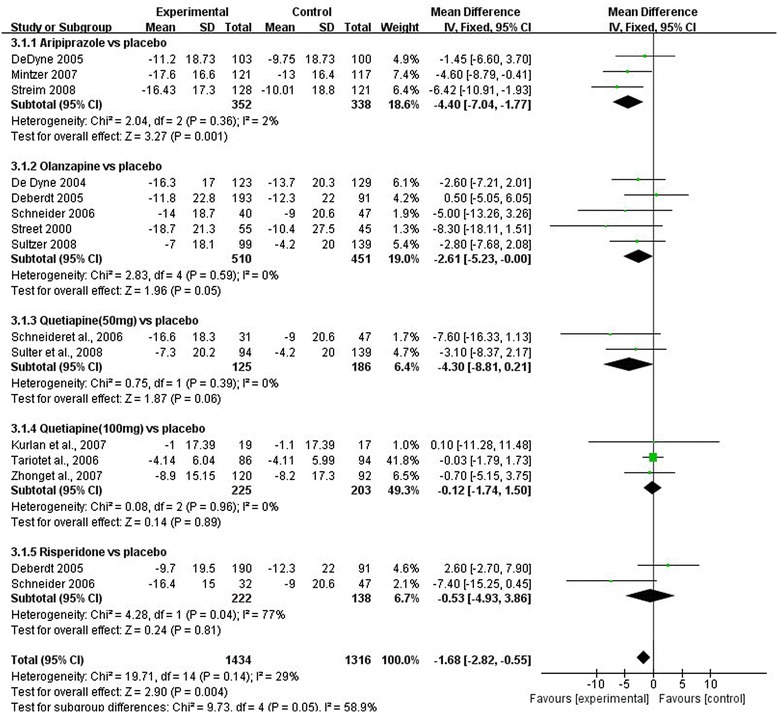
Results: Overall, 23 relevant RCTs with 5,819 participants were identified. This meta-analysis demonstrated a significant efficacy of atypical antipsychotics on psychiatric symptoms and cognitive functions compared to placebo. In the meta-analysis, the weighted mean differences (WMDs) in change scores for psychiatric symptoms were in favor of aripiprazole (-4.4, 95% confidence interval (CI) - 7.04 to -1.77) and risperidone (-1.48, 95% CI -2.35 to -0.61) compared to placebo. In cognitive effects, WMDs in change scores for the Clinical Global Impression-Change (CGI-C) were in favor of aripiprazole, risperidone, olanzapine and quetiapine which ranged from a -0.30 points mean difference (95% CI:-0.59 to -0.01) in the aripiprazole trials to -0.43 (95% CI:-0.62 to -0.25) in the risperidone group. Patients receiving atypical antipsychotics showed no difference in risk for injuries or falls (P > 0.05), significantly higher risks (P < 0.05) for somnolence, urinary tract infection, edema and abnormal gait. However, there was no significant evidence for death reported.
Conclusion: Aripiprazole and risperidone are able to improve psychiatric symptoms and slow decline in cognition function at average 12 weeks in patients with neuropsychiatric symptoms of dementia. However, high adverse events may offset the efficacy of atypical antipsychotics in dementia.
期刊介绍:
Alzheimer's Research & Therapy is an international peer-reviewed journal that focuses on translational research into Alzheimer's disease and other neurodegenerative diseases. It publishes open-access basic research, clinical trials, drug discovery and development studies, and epidemiologic studies. The journal also includes reviews, viewpoints, commentaries, debates, and reports. All articles published in Alzheimer's Research & Therapy are included in several reputable databases such as CAS, Current contents, DOAJ, Embase, Journal Citation Reports/Science Edition, MEDLINE, PubMed, PubMed Central, Science Citation Index Expanded (Web of Science) and Scopus.



 京公网安备 11010802042870号
京ICP备2023020795号-1
京公网安备 11010802042870号
京ICP备2023020795号-1

 分享
分享
 求助内容:
求助内容: 应助结果提醒方式:
 扫码关注我们
