Gentiana Sadikaj, Lance M Rappaport, D S Moskowitz, David C Zuroff, Richard Koestner, Theodore Powers
{"title":"Consequences of interpersonal spin on couple-relevant goal progress and relationship satisfaction in romantic relationships.","authors":"Gentiana Sadikaj, Lance M Rappaport, D S Moskowitz, David C Zuroff, Richard Koestner, Theodore Powers","doi":"10.1037/pspp0000043","DOIUrl":null,"url":null,"abstract":"<p><p>Large fluctuations in a person's interpersonal behavior across situations and over time are thought to be associated with poor personal and interpersonal outcomes. This study examined 2 outcomes, relationship satisfaction and goal progress, that could be associated with individual differences in dispersion of interpersonal behavior (interpersonal spin) in romantic relationships. Need satisfaction and perceived autonomy support for goal pursuit from the partner were examined as mediator variables. Spin was measured using an event-contingent recording (ECR) methodology with a sample of 93 cohabiting couples who reported their interpersonal behavior in interactions with each other during a 20-day period. Relationship satisfaction and goal completion were measured at the end of the ECR procedure (T2) and approximately 7 months after the ECR (T3). Need satisfaction and perceived autonomy support were measured at T2. In both genders, higher spin was associated with lower T2 relationship satisfaction. There was also a decline in relationship satisfaction from T2 to T3 among men with high spin partners. In both genders, higher spin was associated with lower need satisfaction, and lower need satisfaction was associated with a decline in relationship satisfaction from T2 to T3. In both genders, higher spin was associated with lower perceived autonomy support, and lower support was associated with decreased progress in goal completion from T2 to T3. The effects of spin were independent of the effects of mean levels of behavior. These findings extend the understanding of the detrimental consequences of dispersion in interpersonal behavior to the disruption of the person's romantic relationships.</p>","PeriodicalId":16691,"journal":{"name":"Journal of personality and social psychology","volume":"109 4","pages":"722-37"},"PeriodicalIF":6.7000,"publicationDate":"2015-10-01","publicationTypes":"Journal Article","fieldsOfStudy":null,"isOpenAccess":false,"openAccessPdf":"https://sci-hub-pdf.com/10.1037/pspp0000043","citationCount":"28","resultStr":null,"platform":"Semanticscholar","paperid":null,"PeriodicalName":"Journal of personality and social psychology","FirstCategoryId":"102","ListUrlMain":"https://doi.org/10.1037/pspp0000043","RegionNum":1,"RegionCategory":"心理学","ArticlePicture":[],"TitleCN":null,"AbstractTextCN":null,"PMCID":null,"EPubDate":"2015/5/4 0:00:00","PubModel":"Epub","JCR":"Q1","JCRName":"PSYCHOLOGY, SOCIAL","Score":null,"Total":0}
引用次数: 28
Abstract
Large fluctuations in a person's interpersonal behavior across situations and over time are thought to be associated with poor personal and interpersonal outcomes. This study examined 2 outcomes, relationship satisfaction and goal progress, that could be associated with individual differences in dispersion of interpersonal behavior (interpersonal spin) in romantic relationships. Need satisfaction and perceived autonomy support for goal pursuit from the partner were examined as mediator variables. Spin was measured using an event-contingent recording (ECR) methodology with a sample of 93 cohabiting couples who reported their interpersonal behavior in interactions with each other during a 20-day period. Relationship satisfaction and goal completion were measured at the end of the ECR procedure (T2) and approximately 7 months after the ECR (T3). Need satisfaction and perceived autonomy support were measured at T2. In both genders, higher spin was associated with lower T2 relationship satisfaction. There was also a decline in relationship satisfaction from T2 to T3 among men with high spin partners. In both genders, higher spin was associated with lower need satisfaction, and lower need satisfaction was associated with a decline in relationship satisfaction from T2 to T3. In both genders, higher spin was associated with lower perceived autonomy support, and lower support was associated with decreased progress in goal completion from T2 to T3. The effects of spin were independent of the effects of mean levels of behavior. These findings extend the understanding of the detrimental consequences of dispersion in interpersonal behavior to the disruption of the person's romantic relationships.
期刊介绍:
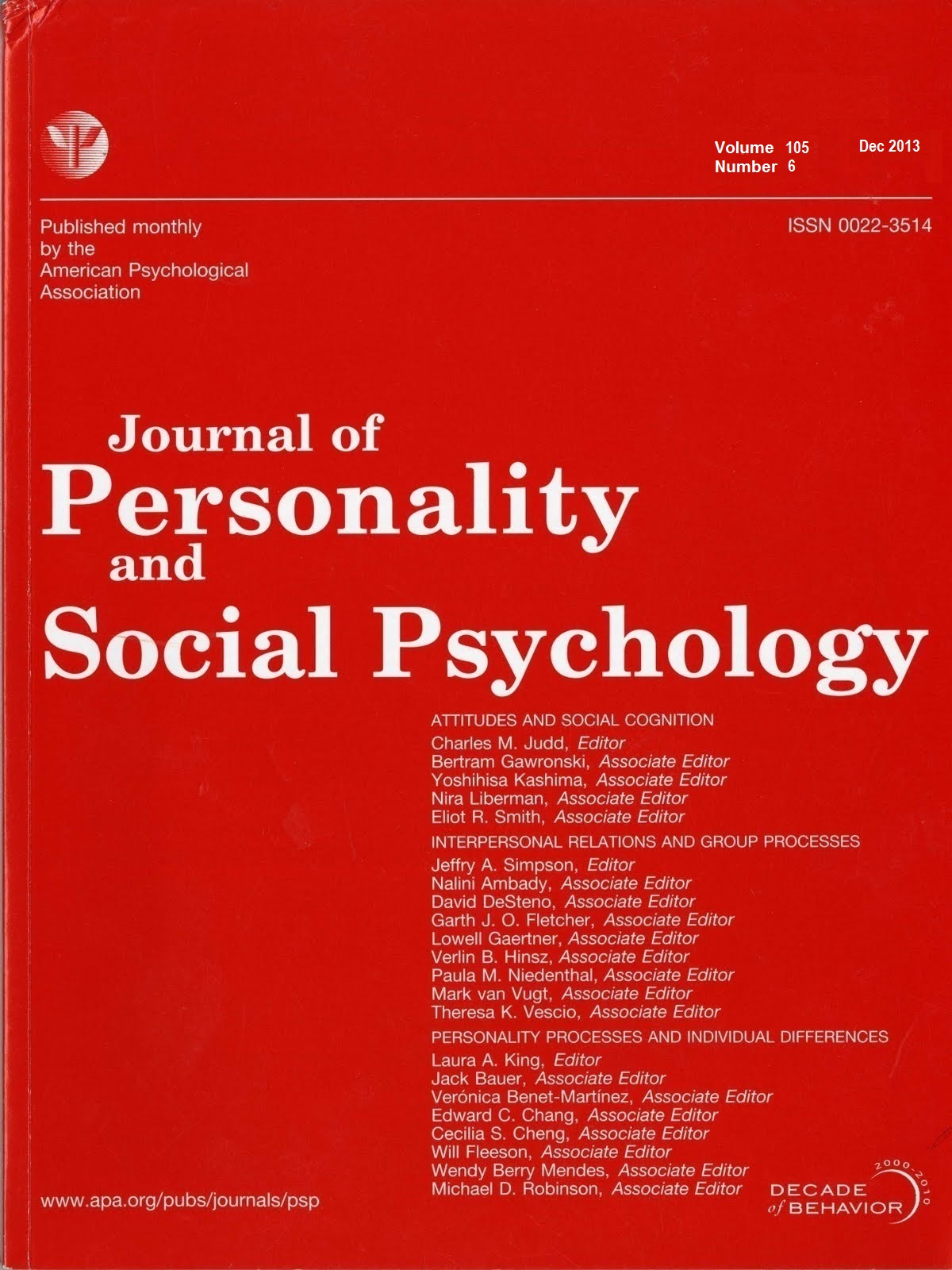
Journal of personality and social psychology publishes original papers in all areas of personality and social psychology and emphasizes empirical reports, but may include specialized theoretical, methodological, and review papers.Journal of personality and social psychology is divided into three independently edited sections. Attitudes and Social Cognition addresses all aspects of psychology (e.g., attitudes, cognition, emotion, motivation) that take place in significant micro- and macrolevel social contexts.



 京公网安备 11010802042870号
京ICP备2023020795号-1
京公网安备 11010802042870号
京ICP备2023020795号-1

 分享
分享
 求助内容:
求助内容: 应助结果提醒方式:
 扫码关注我们
