{"title":"Assessing pesticide wet deposition risk within a small agricultural watershed in the Southeastern Coastal Plain (USA)","authors":"Thomas L. Potter, Alisa W. Coffin","doi":"10.1016/j.scitotenv.2016.11.020","DOIUrl":null,"url":null,"abstract":"<div><p>Pesticide volatilization and deposition with precipitation is widely documented and has been connected to adverse ecological impact. Here we describe a 3-yr study of current use and legacy pesticides in event-based rain samples within a 123-ha agricultural watershed. Crops in farm fields were documented quarterly with data used to estimate target compound use. The median number of pesticide detections in samples was 6. The fungicide, chlorothalonil which was used most intensively was detected in nearly all samples. It had the highest mean and peak concentrations with total deposition ≈<!--> <!-->0.1% of the estimated amount applied. The insecticide endosulfan also had relatively high use with behavior mirroring chlorothalonil. There was strong seasonal variation in concentration and depositional dynamics with the highest values measured during growing seasons. Similar behavior was observed with other compounds detected in rain samples with a general decrease in deposition and mean concentrations as use decreased. Comparison of measured concentrations to values associated with toxic impact on aquatic organisms indicated that chlorothalonil, endosulfan, chlorpyrifos, malathion and atrazine may contribute to adverse impact. The number of samples exceeding risk endpoints ranged from 1 to 77%. The highest value was for endosulfan; however its on-going phase-out is expected to reduce risks. Another finding was that the wet deposition of the herbicide, metolachlor exceeded measured runoff rates in the watershed by 5-fold. The study has demonstrated that localized pesticide wet deposition may present ecological risks and that volatilization and wet deposition is an important pesticide transport pathway at the local scale. Findings point to the need to include wet deposition in assessments of pesticide ecological risk and environmental fate.</p></div>","PeriodicalId":422,"journal":{"name":"Science of the Total Environment","volume":"580 ","pages":"Pages 158-167"},"PeriodicalIF":8.0000,"publicationDate":"2017-02-15","publicationTypes":"Journal Article","fieldsOfStudy":null,"isOpenAccess":false,"openAccessPdf":"https://sci-hub-pdf.com/10.1016/j.scitotenv.2016.11.020","citationCount":"13","resultStr":null,"platform":"Semanticscholar","paperid":null,"PeriodicalName":"Science of the Total Environment","FirstCategoryId":"93","ListUrlMain":"https://www.sciencedirect.com/science/article/pii/S0048969716324512","RegionNum":1,"RegionCategory":"环境科学与生态学","ArticlePicture":[],"TitleCN":null,"AbstractTextCN":null,"PMCID":null,"EPubDate":"","PubModel":"","JCR":"Q1","JCRName":"ENVIRONMENTAL SCIENCES","Score":null,"Total":0}
引用次数: 13
Abstract
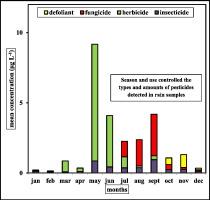
Pesticide volatilization and deposition with precipitation is widely documented and has been connected to adverse ecological impact. Here we describe a 3-yr study of current use and legacy pesticides in event-based rain samples within a 123-ha agricultural watershed. Crops in farm fields were documented quarterly with data used to estimate target compound use. The median number of pesticide detections in samples was 6. The fungicide, chlorothalonil which was used most intensively was detected in nearly all samples. It had the highest mean and peak concentrations with total deposition ≈ 0.1% of the estimated amount applied. The insecticide endosulfan also had relatively high use with behavior mirroring chlorothalonil. There was strong seasonal variation in concentration and depositional dynamics with the highest values measured during growing seasons. Similar behavior was observed with other compounds detected in rain samples with a general decrease in deposition and mean concentrations as use decreased. Comparison of measured concentrations to values associated with toxic impact on aquatic organisms indicated that chlorothalonil, endosulfan, chlorpyrifos, malathion and atrazine may contribute to adverse impact. The number of samples exceeding risk endpoints ranged from 1 to 77%. The highest value was for endosulfan; however its on-going phase-out is expected to reduce risks. Another finding was that the wet deposition of the herbicide, metolachlor exceeded measured runoff rates in the watershed by 5-fold. The study has demonstrated that localized pesticide wet deposition may present ecological risks and that volatilization and wet deposition is an important pesticide transport pathway at the local scale. Findings point to the need to include wet deposition in assessments of pesticide ecological risk and environmental fate.
期刊介绍:
The Science of the Total Environment is an international journal dedicated to scientific research on the environment and its interaction with humanity. It covers a wide range of disciplines and seeks to publish innovative, hypothesis-driven, and impactful research that explores the entire environment, including the atmosphere, lithosphere, hydrosphere, biosphere, and anthroposphere.
The journal's updated Aims & Scope emphasizes the importance of interdisciplinary environmental research with broad impact. Priority is given to studies that advance fundamental understanding and explore the interconnectedness of multiple environmental spheres. Field studies are preferred, while laboratory experiments must demonstrate significant methodological advancements or mechanistic insights with direct relevance to the environment.



 京公网安备 11010802042870号
京ICP备2023020795号-1
京公网安备 11010802042870号
京ICP备2023020795号-1

 分享
分享
 求助内容:
求助内容: 应助结果提醒方式:
 扫码关注我们
