Chuncui Huang , Jingyu Yan , Lingpeng Zhan , Min Zhao , Jinyu Zhou , Huanyu Gao , Wenchun Xie , Yan Li , Wengang Chai
{"title":"Linkage and sequence analysis of neutral oligosaccharides by negative-ion MALDI tandem mass spectrometry with laser-induced dissociation","authors":"Chuncui Huang , Jingyu Yan , Lingpeng Zhan , Min Zhao , Jinyu Zhou , Huanyu Gao , Wenchun Xie , Yan Li , Wengang Chai","doi":"10.1016/j.aca.2019.04.067","DOIUrl":null,"url":null,"abstract":"<div><p><span>Mass spectrometry (MS) has become the primary method for high-sensitivity structural determination of oligosaccharides. Fragmentation in the negative-ion MS can provide a wealth of structural information and these can be used for sequence determination. However, although negative-ion MS of neutral oligosaccharide using the deprotonated molecule [M−H]</span><sup>−</sup><span> as the precursor has been very successful for electrospray ionization (ESI), it has only limited success for matrix-assisted laser desorption/ionization (MALDI). In the present study, the features of negative-ion MALDI primary spectra were investigated in detail and the product-ion spectra using [M−H]</span><sup>–</sup> and [M+Cl]<sup>–</sup> as the precursors were carefully compared. The formation of [M−H]<sup>–</sup> was the main difficulty for MALDI while [M+Cl]<sup>–</sup> was proved to be useful as alternative precursor anion for MALDI-MS/MS to produce similar fragmentation for sequencing of neutral oligosaccharides. <em>N</em>-(1-naphthyl)ethylenediamine dihydrochloride was then used as both the matrix and the Cl<sup>−</sup> dopant to evaluate the extent of structural information that can be obtained by negative-ion fragmentation from [M+Cl]<sup>–</sup> using laser-induced dissociation (LID)-MS/MS for linkage assignment of gluco-oligosaccharides and for typing of blood-group ABO(H) and Lewis antigens on either type 1 or type 2 backbone-chains.</p></div>","PeriodicalId":240,"journal":{"name":"Analytica Chimica Acta","volume":"1071 ","pages":"Pages 25-35"},"PeriodicalIF":6.0000,"publicationDate":"2019-09-13","publicationTypes":"Journal Article","fieldsOfStudy":null,"isOpenAccess":false,"openAccessPdf":"https://sci-hub-pdf.com/10.1016/j.aca.2019.04.067","citationCount":"10","resultStr":null,"platform":"Semanticscholar","paperid":null,"PeriodicalName":"Analytica Chimica Acta","FirstCategoryId":"92","ListUrlMain":"https://www.sciencedirect.com/science/article/pii/S0003267019305240","RegionNum":2,"RegionCategory":"化学","ArticlePicture":[],"TitleCN":null,"AbstractTextCN":null,"PMCID":null,"EPubDate":"2019/4/29 0:00:00","PubModel":"Epub","JCR":"Q1","JCRName":"CHEMISTRY, ANALYTICAL","Score":null,"Total":0}
引用次数: 10
Abstract
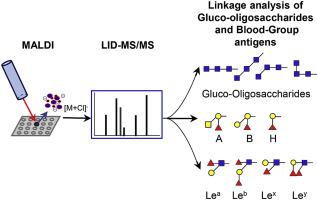
Mass spectrometry (MS) has become the primary method for high-sensitivity structural determination of oligosaccharides. Fragmentation in the negative-ion MS can provide a wealth of structural information and these can be used for sequence determination. However, although negative-ion MS of neutral oligosaccharide using the deprotonated molecule [M−H]− as the precursor has been very successful for electrospray ionization (ESI), it has only limited success for matrix-assisted laser desorption/ionization (MALDI). In the present study, the features of negative-ion MALDI primary spectra were investigated in detail and the product-ion spectra using [M−H]– and [M+Cl]– as the precursors were carefully compared. The formation of [M−H]– was the main difficulty for MALDI while [M+Cl]– was proved to be useful as alternative precursor anion for MALDI-MS/MS to produce similar fragmentation for sequencing of neutral oligosaccharides. N-(1-naphthyl)ethylenediamine dihydrochloride was then used as both the matrix and the Cl− dopant to evaluate the extent of structural information that can be obtained by negative-ion fragmentation from [M+Cl]– using laser-induced dissociation (LID)-MS/MS for linkage assignment of gluco-oligosaccharides and for typing of blood-group ABO(H) and Lewis antigens on either type 1 or type 2 backbone-chains.
期刊介绍:
Analytica Chimica Acta has an open access mirror journal Analytica Chimica Acta: X, sharing the same aims and scope, editorial team, submission system and rigorous peer review.
Analytica Chimica Acta provides a forum for the rapid publication of original research, and critical, comprehensive reviews dealing with all aspects of fundamental and applied modern analytical chemistry. The journal welcomes the submission of research papers which report studies concerning the development of new and significant analytical methodologies. In determining the suitability of submitted articles for publication, particular scrutiny will be placed on the degree of novelty and impact of the research and the extent to which it adds to the existing body of knowledge in analytical chemistry.




 京公网安备 11010802042870号
京ICP备2023020795号-1
京公网安备 11010802042870号
京ICP备2023020795号-1

 分享
分享
 求助内容:
求助内容: 应助结果提醒方式:
 扫码关注我们
