Andrew Martin Kilale, Esther Ngadaya, Gibson Benard Kagaruki, Yakobo Leonard Lema, Julius Muhumuza, Bernard James Ngowi, Sayoki Godfrey Mfinanga, Sven Gudmund Hinderaker
{"title":"Experienced and Perceived Risks of Mycobacterial Diseases: A Cross Sectional Study among Agropastoral Communities in Northern Tanzania.","authors":"Andrew Martin Kilale, Esther Ngadaya, Gibson Benard Kagaruki, Yakobo Leonard Lema, Julius Muhumuza, Bernard James Ngowi, Sayoki Godfrey Mfinanga, Sven Gudmund Hinderaker","doi":"10.1371/journal.pone.0130180","DOIUrl":null,"url":null,"abstract":"<p><strong>Objective: </strong>The current study was conducted to assess experienced risk factors and perceptions of mycobacterial diseases in communities in northern Tanzania.</p><p><strong>Methods: </strong>We conducted a cross-sectional study in Arusha and Manyara regions in Northern Tanzania. We enrolled tuberculosis (TB) patients attending Mount Meru Hospital, Enduleni Hospital and Haydom Lutheran Hospitals in Arusha municipality, Ngorongoro and Mbulu districts, respectively. Patient addresses were recorded during their first visit to the hospitals. Patients with confirmed diagnosis of TB by sputum smear microscopy and/or culture at central laboratory were followed up and interviewed using pre-tested questionnaires, and selected relatives and neighbors were also interviewed. The study was conducted between June 2011 and May 2013.</p><p><strong>Results: </strong>The study involved 164 respondents: 41(25%) were TB patients, 68(41.5%) were their relatives and 55(33.5%) their neighbors. Sixty four (39%) knew a risk factor for mycobacterial disease. Overall, 64(39%) perceived to be at risk of mycobacterial diseases. Exposure to potential risks of mycobacterial diseases were: keeping livestock, not boiling drinking water, large family, smoking and sharing dwelling with TB patients. Rural dwellers were more often livestock keepers (p<0.01), more often shared dwelling with livestock (p<0.01) than urban dwellers. More primary school leavers reported sharing dwelling with TB patients than participants with secondary and higher education (p = 0.01).</p><p><strong>Conclusion: </strong>Livestock keeping, sharing dwelling with livestock, sharing household with a TB patient were perceived risk factors for mycobacterial diseases and the participants were exposed to some of these risk factors. Improving knowledge about the risk factors may protect them from these serious diseases.</p>","PeriodicalId":20189,"journal":{"name":"PLoS ONE","volume":" ","pages":"e0130180"},"PeriodicalIF":2.6000,"publicationDate":"2015-06-24","publicationTypes":"Journal Article","fieldsOfStudy":null,"isOpenAccess":false,"openAccessPdf":"https://sci-hub-pdf.com/10.1371/journal.pone.0130180","citationCount":"4","resultStr":null,"platform":"Semanticscholar","paperid":null,"PeriodicalName":"PLoS ONE","FirstCategoryId":"103","ListUrlMain":"https://doi.org/10.1371/journal.pone.0130180","RegionNum":3,"RegionCategory":"综合性期刊","ArticlePicture":[],"TitleCN":null,"AbstractTextCN":null,"PMCID":null,"EPubDate":"2015/1/1 0:00:00","PubModel":"eCollection","JCR":"Q1","JCRName":"MULTIDISCIPLINARY SCIENCES","Score":null,"Total":0}
引用次数: 4
Abstract
Objective: The current study was conducted to assess experienced risk factors and perceptions of mycobacterial diseases in communities in northern Tanzania.
Methods: We conducted a cross-sectional study in Arusha and Manyara regions in Northern Tanzania. We enrolled tuberculosis (TB) patients attending Mount Meru Hospital, Enduleni Hospital and Haydom Lutheran Hospitals in Arusha municipality, Ngorongoro and Mbulu districts, respectively. Patient addresses were recorded during their first visit to the hospitals. Patients with confirmed diagnosis of TB by sputum smear microscopy and/or culture at central laboratory were followed up and interviewed using pre-tested questionnaires, and selected relatives and neighbors were also interviewed. The study was conducted between June 2011 and May 2013.
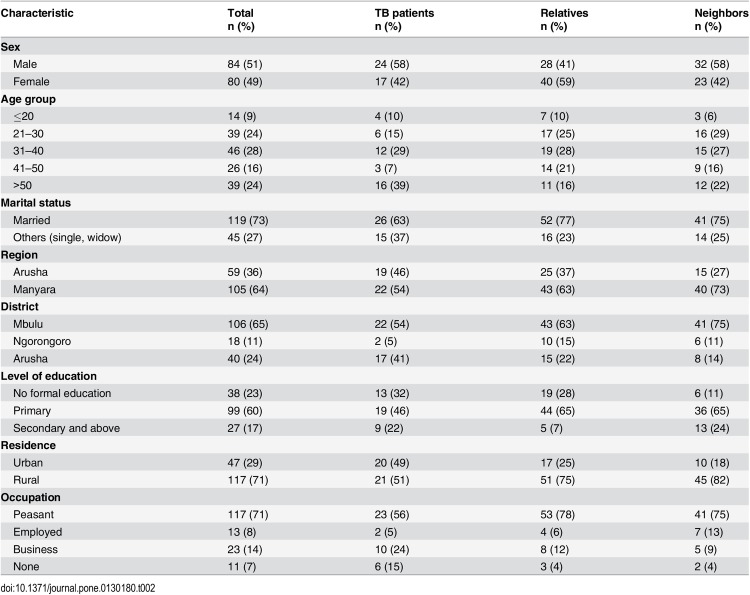
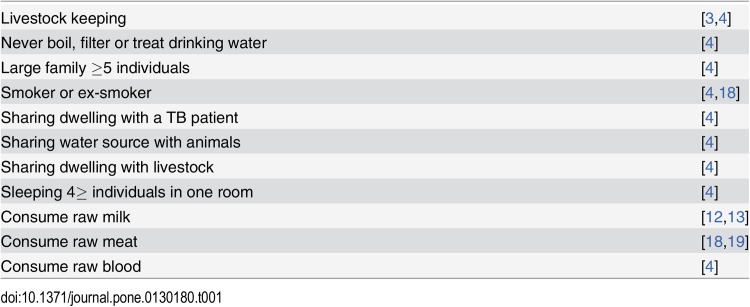
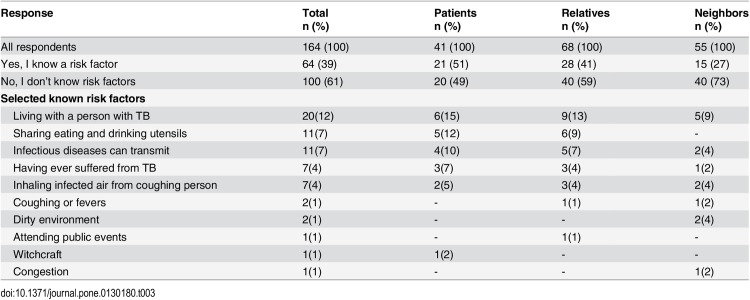
Results: The study involved 164 respondents: 41(25%) were TB patients, 68(41.5%) were their relatives and 55(33.5%) their neighbors. Sixty four (39%) knew a risk factor for mycobacterial disease. Overall, 64(39%) perceived to be at risk of mycobacterial diseases. Exposure to potential risks of mycobacterial diseases were: keeping livestock, not boiling drinking water, large family, smoking and sharing dwelling with TB patients. Rural dwellers were more often livestock keepers (p<0.01), more often shared dwelling with livestock (p<0.01) than urban dwellers. More primary school leavers reported sharing dwelling with TB patients than participants with secondary and higher education (p = 0.01).
Conclusion: Livestock keeping, sharing dwelling with livestock, sharing household with a TB patient were perceived risk factors for mycobacterial diseases and the participants were exposed to some of these risk factors. Improving knowledge about the risk factors may protect them from these serious diseases.
期刊介绍:
PLOS ONE is an international, peer-reviewed, open-access, online publication. PLOS ONE welcomes reports on primary research from any scientific discipline. It provides:
* Open-access—freely accessible online, authors retain copyright
* Fast publication times
* Peer review by expert, practicing researchers
* Post-publication tools to indicate quality and impact
* Community-based dialogue on articles
* Worldwide media coverage




 京公网安备 11010802042870号
京ICP备2023020795号-1
京公网安备 11010802042870号
京ICP备2023020795号-1

 分享
分享
 求助内容:
求助内容: 应助结果提醒方式:
 扫码关注我们
