Qunxiang Ong, Winson Wee, Joshua Dela Cruz, Jin Wah Ronnie Teo, Weiping Han
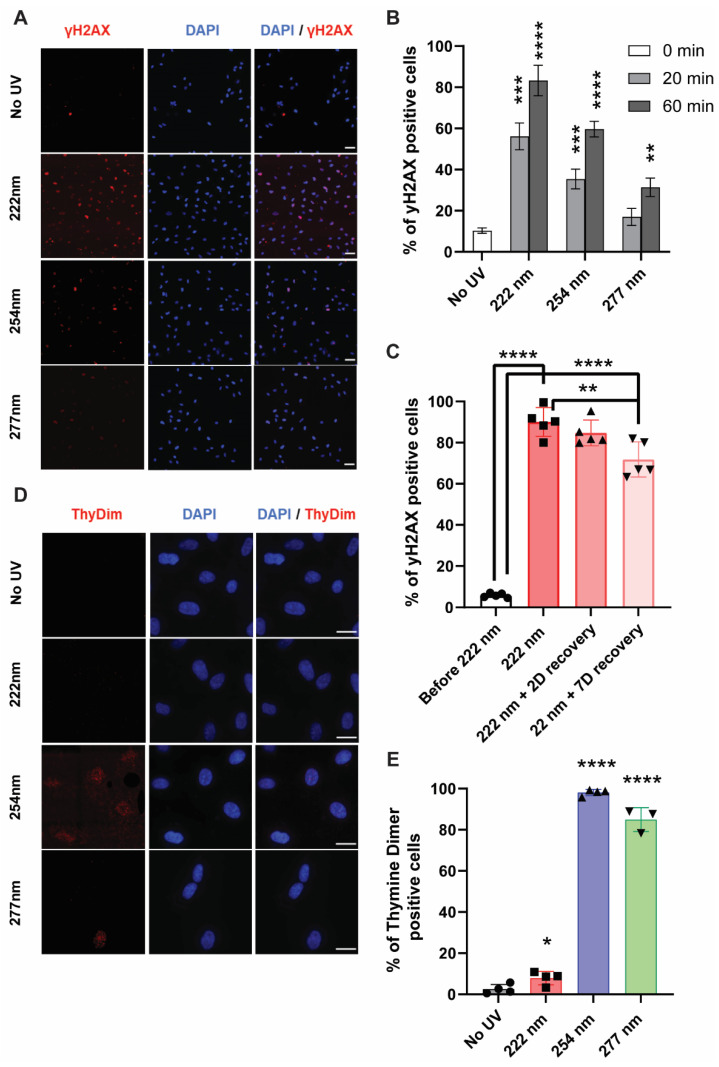
{"title":"222-Nanometer Far-UVC Exposure Results in DNA Damage and Transcriptional Changes to Mammalian Cells.","authors":"Qunxiang Ong, Winson Wee, Joshua Dela Cruz, Jin Wah Ronnie Teo, Weiping Han","doi":"10.3390/ijms23169112","DOIUrl":null,"url":null,"abstract":"<p><p>Ultraviolet (UV) germicidal tools have recently gained attention as a disinfection strategy against the COVID-19 pandemic, but the safety profile arising from their exposure has been controversial and impeded larger-scale implementation. We compare the emerging 222-nanometer far UVC and 277-nanometer UVC LED disinfection modules with the traditional UVC mercury lamp emitting at 254 nm to understand their effects on human retinal cell line ARPE-19 and HEK-A keratinocytes. Cells illuminated with 222-nanometer far UVC survived, while those treated with 254-nanometer and 277-nanometer wavelengths underwent apoptosis via the JNK/ATF2 pathway. However, cells exposed to 222-nanometer far UVC presented the highest degree of DNA damage as evidenced by yH2AX staining. Globally, these cells displayed transcriptional changes in cell-cycle and senescence pathways. Thus, the introduction of 222-nanometer far UVC lamps for disinfection purposes should be carefully considered and designed with the inherent dangers involved.</p>","PeriodicalId":5,"journal":{"name":"ACS Applied Materials & Interfaces","volume":" ","pages":""},"PeriodicalIF":8.2000,"publicationDate":"2022-08-14","publicationTypes":"Journal Article","fieldsOfStudy":null,"isOpenAccess":false,"openAccessPdf":"https://www.ncbi.nlm.nih.gov/pmc/articles/PMC9408858/pdf/","citationCount":"0","resultStr":null,"platform":"Semanticscholar","paperid":null,"PeriodicalName":"ACS Applied Materials & Interfaces","FirstCategoryId":"99","ListUrlMain":"https://doi.org/10.3390/ijms23169112","RegionNum":2,"RegionCategory":"材料科学","ArticlePicture":[],"TitleCN":null,"AbstractTextCN":null,"PMCID":null,"EPubDate":"","PubModel":"","JCR":"Q1","JCRName":"MATERIALS SCIENCE, MULTIDISCIPLINARY","Score":null,"Total":0}
引用次数: 0
Abstract
Ultraviolet (UV) germicidal tools have recently gained attention as a disinfection strategy against the COVID-19 pandemic, but the safety profile arising from their exposure has been controversial and impeded larger-scale implementation. We compare the emerging 222-nanometer far UVC and 277-nanometer UVC LED disinfection modules with the traditional UVC mercury lamp emitting at 254 nm to understand their effects on human retinal cell line ARPE-19 and HEK-A keratinocytes. Cells illuminated with 222-nanometer far UVC survived, while those treated with 254-nanometer and 277-nanometer wavelengths underwent apoptosis via the JNK/ATF2 pathway. However, cells exposed to 222-nanometer far UVC presented the highest degree of DNA damage as evidenced by yH2AX staining. Globally, these cells displayed transcriptional changes in cell-cycle and senescence pathways. Thus, the introduction of 222-nanometer far UVC lamps for disinfection purposes should be carefully considered and designed with the inherent dangers involved.
期刊介绍:
ACS Applied Materials & Interfaces is a leading interdisciplinary journal that brings together chemists, engineers, physicists, and biologists to explore the development and utilization of newly-discovered materials and interfacial processes for specific applications. Our journal has experienced remarkable growth since its establishment in 2009, both in terms of the number of articles published and the impact of the research showcased. We are proud to foster a truly global community, with the majority of published articles originating from outside the United States, reflecting the rapid growth of applied research worldwide.





 京公网安备 11010802042870号
京ICP备2023020795号-1
京公网安备 11010802042870号
京ICP备2023020795号-1

 分享
分享
 求助内容:
求助内容: 应助结果提醒方式:
 扫码关注我们
