{"title":"Determination of Mycotoxin Contamination Levels in Rice and Dietary Exposure Assessment.","authors":"Jose Troestch, Stephany Reyes, Aracelly Vega","doi":"10.1155/2022/3596768","DOIUrl":null,"url":null,"abstract":"<p><p>The contamination by aflatoxins, ochratoxin A, and zearalenone of samples of paddy and polished rice stored in silos located in Chiriquí, Panama, was evaluated. A total of 23 samples were extracted using immunoaffinity columns and analyzed by high-performance liquid chromatography (HPLC) with a fluorescence detector (FLD) and post-column photochemical derivatization. For the method used, the detection limits were lower than 0.25 <i>μ</i>g/Kg for aflatoxins (AFB<sub>1</sub>, AFB<sub>2</sub>, AFG<sub>1</sub>, AFG<sub>2</sub>) and ochratoxin A and 9.35 <i>μ</i>g/Kg for zearalenone; the limits of quantification were between 0.25 and 18.75 <i>μ</i>g/Kg, respectively. Of the samples analyzed, all of the paddy rice samples were positive for at least one of the mycotoxins studied, zearalenone being the one found with the highest incidence (90.91%); for the polished rice samples, the mycotoxin with the highest incidence was zearalenone (50%), although in concentrations lower than those established in European legislation (100 <i>μ</i>g/Kg). The estimate of the daily zearalenone intake according to the concentrations found was always less than 0.07 <i>μ</i>g/Kg/bw. This is the first report on the determination of 6 mycotoxins in rice grains from Panama by the HPLC-FLD methodology. Considering the high incidence of mycotoxins in the analyzed rice samples, regular control in the production process is recommended to improve quality and ascertain its safety.</p>","PeriodicalId":3,"journal":{"name":"ACS Applied Electronic Materials","volume":" ","pages":"3596768"},"PeriodicalIF":4.7000,"publicationDate":"2022-09-02","publicationTypes":"Journal Article","fieldsOfStudy":null,"isOpenAccess":false,"openAccessPdf":"https://www.ncbi.nlm.nih.gov/pmc/articles/PMC9463030/pdf/","citationCount":"0","resultStr":null,"platform":"Semanticscholar","paperid":null,"PeriodicalName":"ACS Applied Electronic Materials","FirstCategoryId":"3","ListUrlMain":"https://doi.org/10.1155/2022/3596768","RegionNum":3,"RegionCategory":"材料科学","ArticlePicture":[],"TitleCN":null,"AbstractTextCN":null,"PMCID":null,"EPubDate":"2022/1/1 0:00:00","PubModel":"eCollection","JCR":"Q1","JCRName":"ENGINEERING, ELECTRICAL & ELECTRONIC","Score":null,"Total":0}
引用次数: 0
Abstract
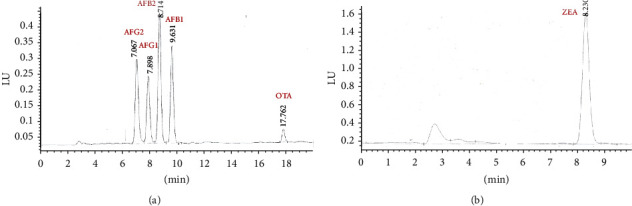
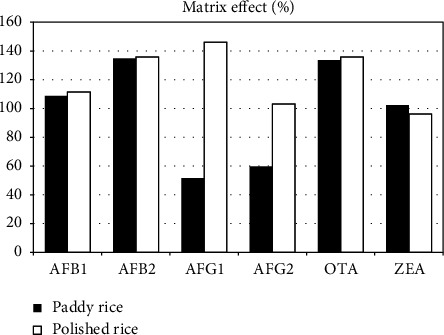
The contamination by aflatoxins, ochratoxin A, and zearalenone of samples of paddy and polished rice stored in silos located in Chiriquí, Panama, was evaluated. A total of 23 samples were extracted using immunoaffinity columns and analyzed by high-performance liquid chromatography (HPLC) with a fluorescence detector (FLD) and post-column photochemical derivatization. For the method used, the detection limits were lower than 0.25 μg/Kg for aflatoxins (AFB1, AFB2, AFG1, AFG2) and ochratoxin A and 9.35 μg/Kg for zearalenone; the limits of quantification were between 0.25 and 18.75 μg/Kg, respectively. Of the samples analyzed, all of the paddy rice samples were positive for at least one of the mycotoxins studied, zearalenone being the one found with the highest incidence (90.91%); for the polished rice samples, the mycotoxin with the highest incidence was zearalenone (50%), although in concentrations lower than those established in European legislation (100 μg/Kg). The estimate of the daily zearalenone intake according to the concentrations found was always less than 0.07 μg/Kg/bw. This is the first report on the determination of 6 mycotoxins in rice grains from Panama by the HPLC-FLD methodology. Considering the high incidence of mycotoxins in the analyzed rice samples, regular control in the production process is recommended to improve quality and ascertain its safety.
期刊介绍:
ACS Applied Electronic Materials is an interdisciplinary journal publishing original research covering all aspects of electronic materials. The journal is devoted to reports of new and original experimental and theoretical research of an applied nature that integrate knowledge in the areas of materials science, engineering, optics, physics, and chemistry into important applications of electronic materials. Sample research topics that span the journal's scope are inorganic, organic, ionic and polymeric materials with properties that include conducting, semiconducting, superconducting, insulating, dielectric, magnetic, optoelectronic, piezoelectric, ferroelectric and thermoelectric.
Indexed/Abstracted:
Web of Science SCIE
Scopus
CAS
INSPEC
Portico




 京公网安备 11010802042870号
京ICP备2023020795号-1
京公网安备 11010802042870号
京ICP备2023020795号-1

 分享
分享
 求助内容:
求助内容: 应助结果提醒方式:
 扫码关注我们
