Sodium doping and 3D honeycomb nanoarchitecture: Key features of covalent triazine-based frameworks (CTF) organocatalyst for enhanced solar-driven advanced oxidation processes
Tao Zeng , Shuqi Li , Yi Shen , Haiyan Zhang , Hongru Feng , Xiaole Zhang , Lingxiangyu Li , Zongwei Cai , Shuang Song
{"title":"Sodium doping and 3D honeycomb nanoarchitecture: Key features of covalent triazine-based frameworks (CTF) organocatalyst for enhanced solar-driven advanced oxidation processes","authors":"Tao Zeng , Shuqi Li , Yi Shen , Haiyan Zhang , Hongru Feng , Xiaole Zhang , Lingxiangyu Li , Zongwei Cai , Shuang Song","doi":"10.1016/j.apcatb.2019.117915","DOIUrl":null,"url":null,"abstract":"<div><p><span>Herein, we designed a novel sodium-doped covalent triazine-based framework with a 3D honeycomb nanoarchitecture (H-CTF-Na) as visible-light-responsive organocatalyst to efficiently drive advanced oxidation processes (AOPs). Experimental and theoretical findings reveal that Na doping narrows the band gap by elevating the band edges and the 3D hierarchical nanocellular morphology improves light harvesting and electron transfer. With these merits, H-CTF-Na showed a photoactivity enhancement of 4.9–6.0-fold for the degradation of carbamazepine (CBZ) compared to those of pristine CTFs and g-C</span><sub>3</sub>N<sub>4</sub> through peroxymonosulfate (PMS) activation under visible-light irradiation. The quenching and EPR results indicate that a synergistic effect between photooxidation (<em>h<sup>+</sup></em>) and PMS activation (<sup>•</sup>OH and SO<sub>4</sub><sup>•−</sup>) derived from the vigorous capture of photogenerated e<sup>−</sup><span> by PMS is responsible for the marked efficacy of H-CTF-Na/vis/PMS system. Moreover, this system exhibited excellent versatility in degrading other organics (such as various phenols and dyes) and good reusability in terms of five high-efficiency recycled uses.</span></p></div>","PeriodicalId":244,"journal":{"name":"Applied Catalysis B: Environmental","volume":"257 ","pages":"Article 117915"},"PeriodicalIF":21.1000,"publicationDate":"2019-11-15","publicationTypes":"Journal Article","fieldsOfStudy":null,"isOpenAccess":false,"openAccessPdf":"https://sci-hub-pdf.com/10.1016/j.apcatb.2019.117915","citationCount":"34","resultStr":null,"platform":"Semanticscholar","paperid":null,"PeriodicalName":"Applied Catalysis B: Environmental","FirstCategoryId":"1","ListUrlMain":"https://www.sciencedirect.com/science/article/pii/S0926337319306617","RegionNum":1,"RegionCategory":"化学","ArticlePicture":[],"TitleCN":null,"AbstractTextCN":null,"PMCID":null,"EPubDate":"","PubModel":"","JCR":"Q1","JCRName":"CHEMISTRY, PHYSICAL","Score":null,"Total":0}
引用次数: 34
Abstract
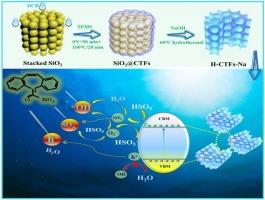
Herein, we designed a novel sodium-doped covalent triazine-based framework with a 3D honeycomb nanoarchitecture (H-CTF-Na) as visible-light-responsive organocatalyst to efficiently drive advanced oxidation processes (AOPs). Experimental and theoretical findings reveal that Na doping narrows the band gap by elevating the band edges and the 3D hierarchical nanocellular morphology improves light harvesting and electron transfer. With these merits, H-CTF-Na showed a photoactivity enhancement of 4.9–6.0-fold for the degradation of carbamazepine (CBZ) compared to those of pristine CTFs and g-C3N4 through peroxymonosulfate (PMS) activation under visible-light irradiation. The quenching and EPR results indicate that a synergistic effect between photooxidation (h+) and PMS activation (•OH and SO4•−) derived from the vigorous capture of photogenerated e− by PMS is responsible for the marked efficacy of H-CTF-Na/vis/PMS system. Moreover, this system exhibited excellent versatility in degrading other organics (such as various phenols and dyes) and good reusability in terms of five high-efficiency recycled uses.
期刊介绍:
Applied Catalysis B: Environment and Energy (formerly Applied Catalysis B: Environmental) is a journal that focuses on the transition towards cleaner and more sustainable energy sources. The journal's publications cover a wide range of topics, including:
1.Catalytic elimination of environmental pollutants such as nitrogen oxides, carbon monoxide, sulfur compounds, chlorinated and other organic compounds, and soot emitted from stationary or mobile sources.
2.Basic understanding of catalysts used in environmental pollution abatement, particularly in industrial processes.
3.All aspects of preparation, characterization, activation, deactivation, and regeneration of novel and commercially applicable environmental catalysts.
4.New catalytic routes and processes for the production of clean energy, such as hydrogen generation via catalytic fuel processing, and new catalysts and electrocatalysts for fuel cells.
5.Catalytic reactions that convert wastes into useful products.
6.Clean manufacturing techniques that replace toxic chemicals with environmentally friendly catalysts.
7.Scientific aspects of photocatalytic processes and a basic understanding of photocatalysts as applied to environmental problems.
8.New catalytic combustion technologies and catalysts.
9.New catalytic non-enzymatic transformations of biomass components.
The journal is abstracted and indexed in API Abstracts, Research Alert, Chemical Abstracts, Web of Science, Theoretical Chemical Engineering Abstracts, Engineering, Technology & Applied Sciences, and others.



 京公网安备 11010802042870号
京ICP备2023020795号-1
京公网安备 11010802042870号
京ICP备2023020795号-1

 分享
分享
 求助内容:
求助内容: 应助结果提醒方式:
 扫码关注我们
