{"title":"Capturing high and low levels of participant engagement in sensory and consumer evaluations via a known groups design and an implicit correlate","authors":"Mackenzie E. Hannum , Christopher T. Simons","doi":"10.1016/j.foodres.2022.111786","DOIUrl":null,"url":null,"abstract":"<div><p><span>Recently developed to characterize consumer engagement during sensory and consumer testing, the Engagement Questionnaire (EQ) can quantify differences in participant engagement; however, the limits of the scale to detect disengagement has not been established. We conducted a known-group experimental design to verify the EQ’s ability to differentiate between an engaged and disengaged participant. Participants were randomly assigned to a more engaging (positive condition) and a less engaging sensory task (negative condition). In the positive condition, participants (N = 31) completed 20 tetrad tests; however, stimuli varied in type and difficulty. For the negative condition, participants (N = 28) completed 20 tetrads of the same sucrose concentration to promote a state of helplessness and encourage disengagement with the task. Facial expressions were collected through video recordings, using automatic facial emotion recognition software (FaceReader, Noldus Technology). Accounting for sex differences across the conditions, the EQ successfully discriminated between the positive and negative conditions. When in the positive condition, participants were more </span><em>actively involved</em> in the task (F<sub>1,59</sub> = 23.99, p < 0.001), and experienced higher levels of <em>purposeful intent</em> (F<sub>1,59</sub> = 11.10, p = 0.002) and <em>affective value</em> (F<sub>1,59</sub> = 26.03, p < 0.001). Participants were more emotive in general, and experienced increased happiness (F<sub>1,42</sub> = 22.24, p < 0.001), anger (F<sub>1,42</sub> = 12.10, p = 0.001) and disgust (F<sub>1,42</sub> = 4.33, p = 0.04) as well as lower levels of a neutral expression (F<sub>1,42</sub> = 24.88, p < 0.001) in the positive condition. Now validated via known-groups analysis, the EQ can confidently differentiate a greater range of engagement. Such an instrument allows for a deeper understanding of participant engagement and its potential effect on data quality.</p></div>","PeriodicalId":323,"journal":{"name":"Food Research International","volume":"161 ","pages":"Article 111786"},"PeriodicalIF":8.0000,"publicationDate":"2022-11-01","publicationTypes":"Journal Article","fieldsOfStudy":null,"isOpenAccess":false,"openAccessPdf":"","citationCount":"1","resultStr":null,"platform":"Semanticscholar","paperid":null,"PeriodicalName":"Food Research International","FirstCategoryId":"97","ListUrlMain":"https://www.sciencedirect.com/science/article/pii/S0963996922008444","RegionNum":1,"RegionCategory":"农林科学","ArticlePicture":[],"TitleCN":null,"AbstractTextCN":null,"PMCID":null,"EPubDate":"","PubModel":"","JCR":"Q1","JCRName":"FOOD SCIENCE & TECHNOLOGY","Score":null,"Total":0}
引用次数: 1
Abstract
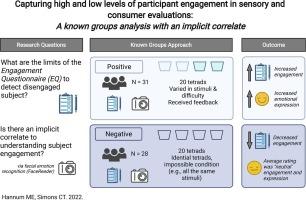
Recently developed to characterize consumer engagement during sensory and consumer testing, the Engagement Questionnaire (EQ) can quantify differences in participant engagement; however, the limits of the scale to detect disengagement has not been established. We conducted a known-group experimental design to verify the EQ’s ability to differentiate between an engaged and disengaged participant. Participants were randomly assigned to a more engaging (positive condition) and a less engaging sensory task (negative condition). In the positive condition, participants (N = 31) completed 20 tetrad tests; however, stimuli varied in type and difficulty. For the negative condition, participants (N = 28) completed 20 tetrads of the same sucrose concentration to promote a state of helplessness and encourage disengagement with the task. Facial expressions were collected through video recordings, using automatic facial emotion recognition software (FaceReader, Noldus Technology). Accounting for sex differences across the conditions, the EQ successfully discriminated between the positive and negative conditions. When in the positive condition, participants were more actively involved in the task (F1,59 = 23.99, p < 0.001), and experienced higher levels of purposeful intent (F1,59 = 11.10, p = 0.002) and affective value (F1,59 = 26.03, p < 0.001). Participants were more emotive in general, and experienced increased happiness (F1,42 = 22.24, p < 0.001), anger (F1,42 = 12.10, p = 0.001) and disgust (F1,42 = 4.33, p = 0.04) as well as lower levels of a neutral expression (F1,42 = 24.88, p < 0.001) in the positive condition. Now validated via known-groups analysis, the EQ can confidently differentiate a greater range of engagement. Such an instrument allows for a deeper understanding of participant engagement and its potential effect on data quality.
期刊介绍:
Food Research International serves as a rapid dissemination platform for significant and impactful research in food science, technology, engineering, and nutrition. The journal focuses on publishing novel, high-quality, and high-impact review papers, original research papers, and letters to the editors across various disciplines in the science and technology of food. Additionally, it follows a policy of publishing special issues on topical and emergent subjects in food research or related areas. Selected, peer-reviewed papers from scientific meetings, workshops, and conferences on the science, technology, and engineering of foods are also featured in special issues.



 京公网安备 11010802042870号
京ICP备2023020795号-1
京公网安备 11010802042870号
京ICP备2023020795号-1

 分享
分享
 求助内容:
求助内容: 应助结果提醒方式:
 扫码关注我们
