Yunli Zhao, Gordon Guyatt, Ya Gao, Qiukui Hao, Ream Abdullah, John Basmaji, Farid Foroutan
{"title":"Living alone and all-cause mortality in community-dwelling adults: A systematic review and meta-analysis.","authors":"Yunli Zhao, Gordon Guyatt, Ya Gao, Qiukui Hao, Ream Abdullah, John Basmaji, Farid Foroutan","doi":"10.1016/j.eclinm.2022.101677","DOIUrl":null,"url":null,"abstract":"<p><strong>Background: </strong>The non-causal and causal associations, possible age and sex differences between living alone and all-cause mortality among adults were unclear. We aimed to assess the association and causal relation between living alone and all-cause mortality among community-dwelling adults, addressing the certainty of evidence, possible age and sex differences.</p><p><strong>Methods: </strong>We searched Medline, Embase, and APA PsycINFO for cohort studies examining the association between living alone and all-cause mortality on November 19, 2021. We used the GRADE approach to assess certainty of evidence, and the Instrument for the Credibility of Effect Modification Analyses (ICEMAN) to evaluate credibility of subgroup inferences and conducted a meta-analysis of measures of association between living alone and mortality. The study was registered with PROSPERO, CRD42021290895.</p><p><strong>Findings: </strong>18 cohort studies with 62,174 adults proved eligible. Living alone was associated with mortality (relative risk (RR) = 1.15, 95% confidence interval (CI) 1.08-1.23). Both age and sex modified the association (high and moderate credibility, separately). Living alone increased the risk of dying only in younger but not older individuals (ratio of RRs = 1.59, interaction <i>P</i> = 0.003; younger RR 1.41, 95% CI 1.17-1.71, high certainty for prognosis, low for causation; older RR = 1.05, 95% CI 0.91-1.22, moderate certainty for prognosis, very low for causation). Living alone increased risk to a greater extent in males than females (ratio of RRs = 1.39, 95% CI 1.14-1.70; interaction <i>P</i> = 0.001, males RR = 1.41, 95% CI 1.17-1.71, high certainty for prognosis, low for causation; females RR = 1.15, 95% CI 0.99-1.33; moderate for prognosis factor, very low for causation).</p><p><strong>Interpretation: </strong>Living alone is associated with increased mortality in individuals under 65 years (high certainty) but not with those over 75 years; the association may be causal (low certainty). Associations, and possibly effects, may be stronger in men than women.</p><p><strong>Funding: </strong>None.</p>","PeriodicalId":9,"journal":{"name":"ACS Catalysis ","volume":" ","pages":"101677"},"PeriodicalIF":13.1000,"publicationDate":"2022-09-29","publicationTypes":"Journal Article","fieldsOfStudy":null,"isOpenAccess":false,"openAccessPdf":"https://ftp.ncbi.nlm.nih.gov/pub/pmc/oa_pdf/71/b5/main.PMC9530481.pdf","citationCount":"0","resultStr":null,"platform":"Semanticscholar","paperid":null,"PeriodicalName":"ACS Catalysis ","FirstCategoryId":"3","ListUrlMain":"https://doi.org/10.1016/j.eclinm.2022.101677","RegionNum":1,"RegionCategory":"化学","ArticlePicture":[],"TitleCN":null,"AbstractTextCN":null,"PMCID":null,"EPubDate":"2022/12/1 0:00:00","PubModel":"eCollection","JCR":"Q1","JCRName":"CHEMISTRY, PHYSICAL","Score":null,"Total":0}
引用次数: 0
Abstract
Background: The non-causal and causal associations, possible age and sex differences between living alone and all-cause mortality among adults were unclear. We aimed to assess the association and causal relation between living alone and all-cause mortality among community-dwelling adults, addressing the certainty of evidence, possible age and sex differences.
Methods: We searched Medline, Embase, and APA PsycINFO for cohort studies examining the association between living alone and all-cause mortality on November 19, 2021. We used the GRADE approach to assess certainty of evidence, and the Instrument for the Credibility of Effect Modification Analyses (ICEMAN) to evaluate credibility of subgroup inferences and conducted a meta-analysis of measures of association between living alone and mortality. The study was registered with PROSPERO, CRD42021290895.
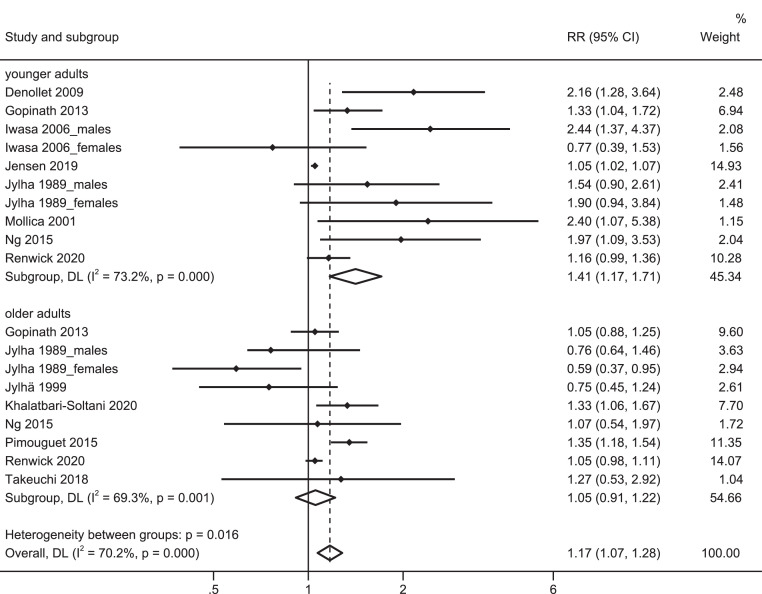
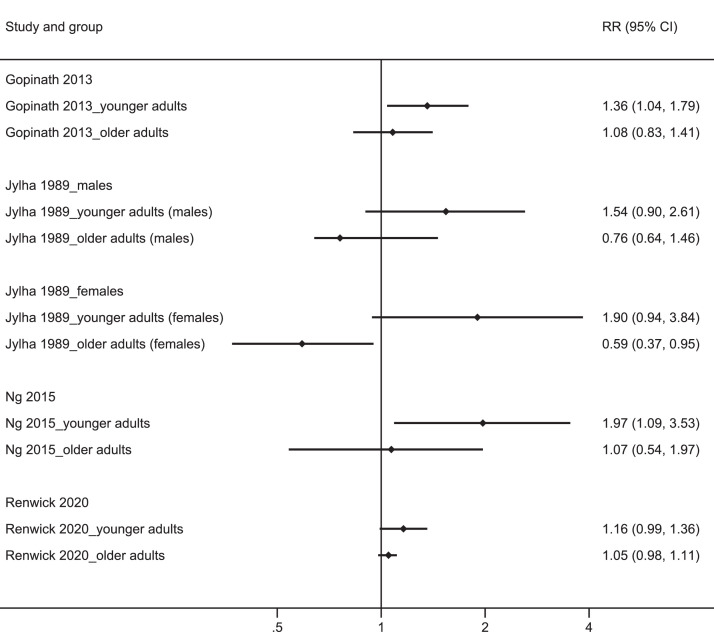
Findings: 18 cohort studies with 62,174 adults proved eligible. Living alone was associated with mortality (relative risk (RR) = 1.15, 95% confidence interval (CI) 1.08-1.23). Both age and sex modified the association (high and moderate credibility, separately). Living alone increased the risk of dying only in younger but not older individuals (ratio of RRs = 1.59, interaction P = 0.003; younger RR 1.41, 95% CI 1.17-1.71, high certainty for prognosis, low for causation; older RR = 1.05, 95% CI 0.91-1.22, moderate certainty for prognosis, very low for causation). Living alone increased risk to a greater extent in males than females (ratio of RRs = 1.39, 95% CI 1.14-1.70; interaction P = 0.001, males RR = 1.41, 95% CI 1.17-1.71, high certainty for prognosis, low for causation; females RR = 1.15, 95% CI 0.99-1.33; moderate for prognosis factor, very low for causation).
Interpretation: Living alone is associated with increased mortality in individuals under 65 years (high certainty) but not with those over 75 years; the association may be causal (low certainty). Associations, and possibly effects, may be stronger in men than women.
期刊介绍:
ACS Catalysis is an esteemed journal that publishes original research in the fields of heterogeneous catalysis, molecular catalysis, and biocatalysis. It offers broad coverage across diverse areas such as life sciences, organometallics and synthesis, photochemistry and electrochemistry, drug discovery and synthesis, materials science, environmental protection, polymer discovery and synthesis, and energy and fuels.
The scope of the journal is to showcase innovative work in various aspects of catalysis. This includes new reactions and novel synthetic approaches utilizing known catalysts, the discovery or modification of new catalysts, elucidation of catalytic mechanisms through cutting-edge investigations, practical enhancements of existing processes, as well as conceptual advances in the field. Contributions to ACS Catalysis can encompass both experimental and theoretical research focused on catalytic molecules, macromolecules, and materials that exhibit catalytic turnover.




 京公网安备 11010802042870号
京ICP备2023020795号-1
京公网安备 11010802042870号
京ICP备2023020795号-1

 分享
分享
 求助内容:
求助内容: 应助结果提醒方式:
 扫码关注我们
