{"title":"Tuning Functionalized Ionic Liquids for CO<sub>2</sub> Capture.","authors":"Ruina Zhang, Quanli Ke, Zekai Zhang, Bing Zhou, Guokai Cui, Hanfeng Lu","doi":"10.3390/ijms231911401","DOIUrl":null,"url":null,"abstract":"<p><p>The increasing concentration of CO<sub>2</sub> in the atmosphere is related to global climate change. Carbon capture, utilization, and storage (CCUS) is an important technology to reduce CO<sub>2</sub> emissions and to deal with global climate change. The development of new materials and technologies for efficient CO<sub>2</sub> capture has received increasing attention among global researchers. Ionic liquids (ILs), especially functionalized ILs, with such unique properties as almost no vapor pressure, thermal- and chemical-stability, non-flammability, and tunable properties, have been used in CCUS with great interest. This paper focuses on the development of functionalized ILs for CO<sub>2</sub> capture in the past decade (2012~2022). Functionalized ILs, or task-specific ILs, are ILs with active sites on cations or/and anions. The main contents include three parts: cation-functionalized ILs, anion-functionalized ILs, and cation-anion dual-functionalized ILs for CO<sub>2</sub> capture. In addition, classification, structures, and synthesis of functionalized ILs are also summarized. Finally, future directions, concerns, and prospects for functionalized ILs in CCUS are discussed. This review is beneficial for researchers to obtain an overall understanding of CO<sub>2</sub>-philic ILs. This work will open a door to develop novel IL-based solvents and materials for the capture and separation of other gases, such as SO<sub>2</sub>, H<sub>2</sub>S, NOx, NH<sub>3</sub>, and so on.</p>","PeriodicalId":49179,"journal":{"name":"International Journal of Molecular Sciences","volume":"23 19","pages":""},"PeriodicalIF":4.9000,"publicationDate":"2022-09-27","publicationTypes":"Journal Article","fieldsOfStudy":null,"isOpenAccess":false,"openAccessPdf":"https://www.ncbi.nlm.nih.gov/pmc/articles/PMC9570259/pdf/","citationCount":"13","resultStr":null,"platform":"Semanticscholar","paperid":null,"PeriodicalName":"International Journal of Molecular Sciences","FirstCategoryId":"99","ListUrlMain":"https://doi.org/10.3390/ijms231911401","RegionNum":2,"RegionCategory":"生物学","ArticlePicture":[],"TitleCN":null,"AbstractTextCN":null,"PMCID":null,"EPubDate":"","PubModel":"","JCR":"Q1","JCRName":"BIOCHEMISTRY & MOLECULAR BIOLOGY","Score":null,"Total":0}
引用次数: 13
Abstract
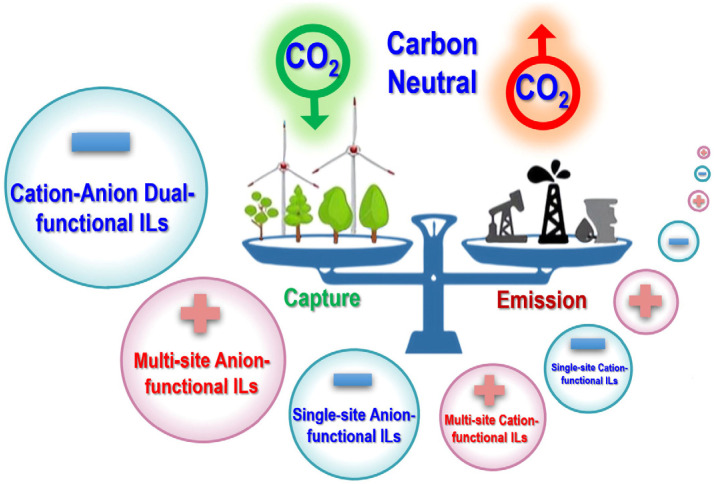
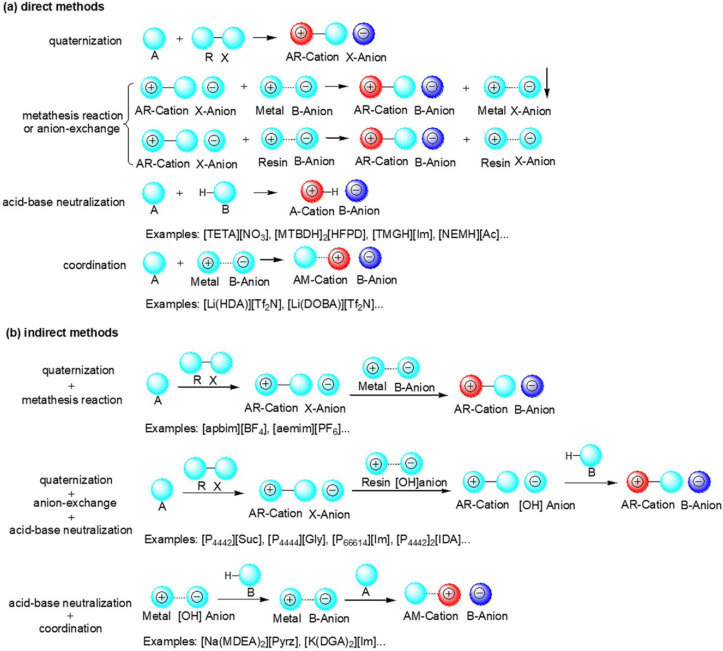
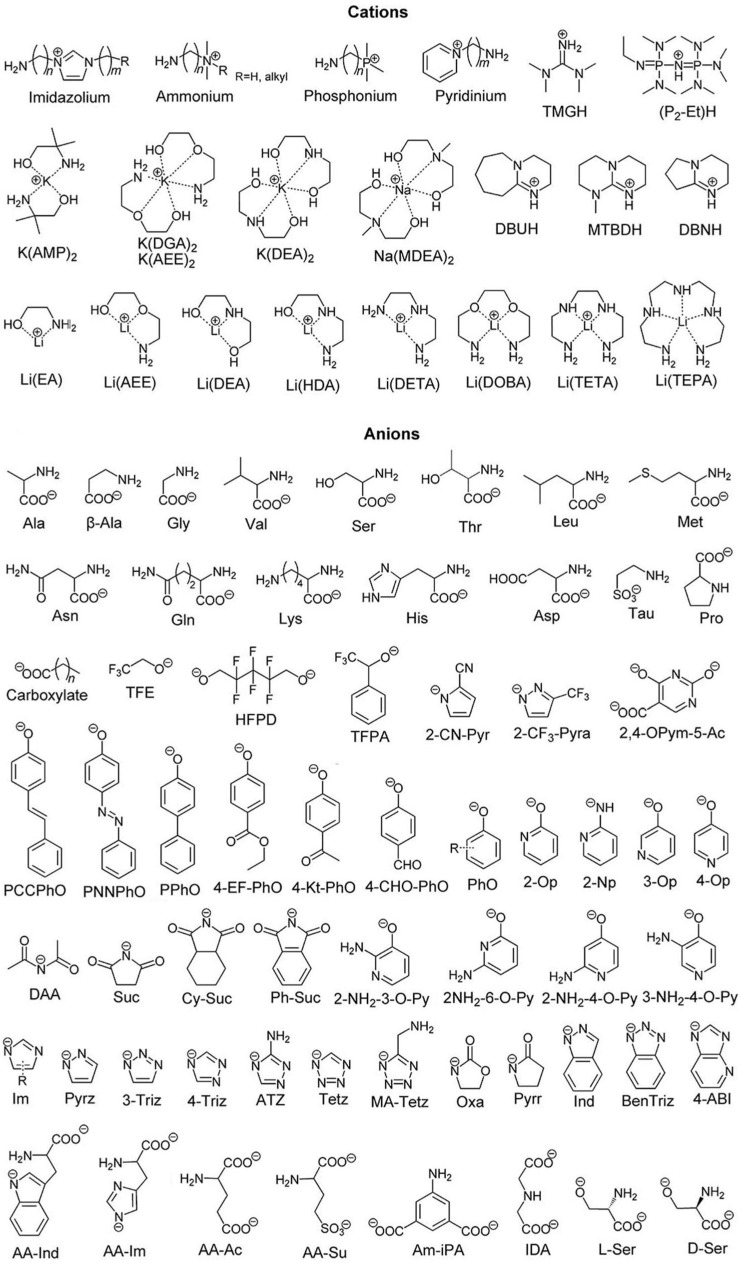
The increasing concentration of CO2 in the atmosphere is related to global climate change. Carbon capture, utilization, and storage (CCUS) is an important technology to reduce CO2 emissions and to deal with global climate change. The development of new materials and technologies for efficient CO2 capture has received increasing attention among global researchers. Ionic liquids (ILs), especially functionalized ILs, with such unique properties as almost no vapor pressure, thermal- and chemical-stability, non-flammability, and tunable properties, have been used in CCUS with great interest. This paper focuses on the development of functionalized ILs for CO2 capture in the past decade (2012~2022). Functionalized ILs, or task-specific ILs, are ILs with active sites on cations or/and anions. The main contents include three parts: cation-functionalized ILs, anion-functionalized ILs, and cation-anion dual-functionalized ILs for CO2 capture. In addition, classification, structures, and synthesis of functionalized ILs are also summarized. Finally, future directions, concerns, and prospects for functionalized ILs in CCUS are discussed. This review is beneficial for researchers to obtain an overall understanding of CO2-philic ILs. This work will open a door to develop novel IL-based solvents and materials for the capture and separation of other gases, such as SO2, H2S, NOx, NH3, and so on.
期刊介绍:
The International Journal of Molecular Sciences (ISSN 1422-0067) provides an advanced forum for chemistry, molecular physics (chemical physics and physical chemistry) and molecular biology. It publishes research articles, reviews, communications and short notes. Our aim is to encourage scientists to publish their theoretical and experimental results in as much detail as possible. Therefore, there is no restriction on the length of the papers or the number of electronics supplementary files. For articles with computational results, the full experimental details must be provided so that the results can be reproduced. Electronic files regarding the full details of the calculation and experimental procedure, if unable to be published in a normal way, can be deposited as supplementary material (including animated pictures, videos, interactive Excel sheets, software executables and others).



 京公网安备 11010802042870号
京ICP备2023020795号-1
京公网安备 11010802042870号
京ICP备2023020795号-1

 分享
分享
 求助内容:
求助内容: 应助结果提醒方式:
 扫码关注我们
