{"title":"Toxicity Analysis of Hybrid Nanodiamond/Fe<sub>3</sub>O<sub>4</sub> Nanoparticles on <i>Allium cepa</i> L.","authors":"Bhaludra Chandra Sekhar Singh","doi":"10.1155/2022/5903409","DOIUrl":null,"url":null,"abstract":"<p><strong>Materials and methods: </strong>The chemicals of hydrochloric acid, nitric acid, FeCl<sub>3</sub>.6H<sub>2</sub>O, FeCl<sub>2</sub>.4H<sub>2</sub>O, NaCl, and NaOH (Sigma-Aldrich chemicals, USA) were utilized in this study. A statistical analysis was performed on the results with a prevalence of <i>p</i> < 0.05.</p><p><strong>Results: </strong>A novel ND/Fe<sub>3</sub>O<sub>4</sub> nanocomposite material was successfully synthesized by the <i>in-situ</i> method and characterized by various characterization techniques. The analysis of X-ray diffraction indicated the formation of an ND/Fe<sub>3</sub>O<sub>4</sub> nanocomposite with both participating phases. The saturation magnification of the ND/Fe<sub>3</sub>O<sub>4</sub> nanocomposite is 13.2 emu/g, whereas for a pure Fe<sub>3</sub>O<sub>4</sub> nanomaterial, it is 47 emu/g. The weight rates of ND and Fe<sub>3</sub>O<sub>4</sub> existent in the nanocomposite are 28% and 72%, respectively. From the electrical conductivity analysis, ND/Fe<sub>3</sub>O<sub>4</sub> exhibits conductivity in the order of 27 times more compared to ND.</p><p><strong>Conclusion: </strong>The result implies that the product ND/Fe<sub>3</sub>O<sub>4</sub> has both magnetic and electrical properties. The biocompatibility of the synthesized ND/Fe<sub>3</sub>O<sub>4</sub> material was studied based on the <i>in-vitro</i> method.</p>","PeriodicalId":3,"journal":{"name":"ACS Applied Electronic Materials","volume":" ","pages":"5903409"},"PeriodicalIF":4.7000,"publicationDate":"2022-09-19","publicationTypes":"Journal Article","fieldsOfStudy":null,"isOpenAccess":false,"openAccessPdf":"https://www.ncbi.nlm.nih.gov/pmc/articles/PMC9553711/pdf/","citationCount":"0","resultStr":null,"platform":"Semanticscholar","paperid":null,"PeriodicalName":"ACS Applied Electronic Materials","FirstCategoryId":"3","ListUrlMain":"https://doi.org/10.1155/2022/5903409","RegionNum":3,"RegionCategory":"材料科学","ArticlePicture":[],"TitleCN":null,"AbstractTextCN":null,"PMCID":null,"EPubDate":"2022/1/1 0:00:00","PubModel":"eCollection","JCR":"Q1","JCRName":"ENGINEERING, ELECTRICAL & ELECTRONIC","Score":null,"Total":0}
引用次数: 0
Abstract
Materials and methods: The chemicals of hydrochloric acid, nitric acid, FeCl3.6H2O, FeCl2.4H2O, NaCl, and NaOH (Sigma-Aldrich chemicals, USA) were utilized in this study. A statistical analysis was performed on the results with a prevalence of p < 0.05.
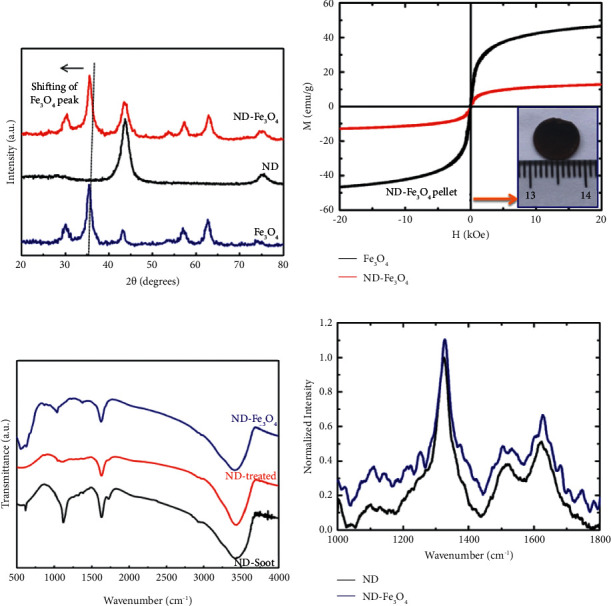
Results: A novel ND/Fe3O4 nanocomposite material was successfully synthesized by the in-situ method and characterized by various characterization techniques. The analysis of X-ray diffraction indicated the formation of an ND/Fe3O4 nanocomposite with both participating phases. The saturation magnification of the ND/Fe3O4 nanocomposite is 13.2 emu/g, whereas for a pure Fe3O4 nanomaterial, it is 47 emu/g. The weight rates of ND and Fe3O4 existent in the nanocomposite are 28% and 72%, respectively. From the electrical conductivity analysis, ND/Fe3O4 exhibits conductivity in the order of 27 times more compared to ND.
Conclusion: The result implies that the product ND/Fe3O4 has both magnetic and electrical properties. The biocompatibility of the synthesized ND/Fe3O4 material was studied based on the in-vitro method.
期刊介绍:
ACS Applied Electronic Materials is an interdisciplinary journal publishing original research covering all aspects of electronic materials. The journal is devoted to reports of new and original experimental and theoretical research of an applied nature that integrate knowledge in the areas of materials science, engineering, optics, physics, and chemistry into important applications of electronic materials. Sample research topics that span the journal's scope are inorganic, organic, ionic and polymeric materials with properties that include conducting, semiconducting, superconducting, insulating, dielectric, magnetic, optoelectronic, piezoelectric, ferroelectric and thermoelectric.
Indexed/Abstracted:
Web of Science SCIE
Scopus
CAS
INSPEC
Portico




 京公网安备 11010802042870号
京ICP备2023020795号-1
京公网安备 11010802042870号
京ICP备2023020795号-1

 分享
分享
 求助内容:
求助内容: 应助结果提醒方式:
 扫码关注我们
