Recovery and preparation of high-grade silica from iron ore tailings by S-HGMS coupling with acid leaching technology: Description of separation mechanism and leaching kinetics
{"title":"Recovery and preparation of high-grade silica from iron ore tailings by S-HGMS coupling with acid leaching technology: Description of separation mechanism and leaching kinetics","authors":"Yongkui Li, Suqin Li, Xiaodong Pan, Xin Zhao, Penghui Guo, Zekun Zhao","doi":"10.1016/j.powtec.2023.118523","DOIUrl":null,"url":null,"abstract":"<div><p><span>High‑silicon iron ore<span> tailings (IOTs) as mineral solid wastes derived from the processing and utilization of iron ore, which would threaten human health and the ecological environment if handled improperly. Coincidently, it consists of abundant quartz gangue. In this study, we proposed a superconducting high gradient magnetic separation (S-HGMS) coupling with acid leaching technology to prepare high-grade silica from high‑silicon IOTs. S-HGMS was applied to high‑silicon IOTs to pre-concentrate silica into quartz concentrate. Under the optimized conditions, the SiO</span></span><sub>2</sub> grade in quartz concentrate reached 92.06% with a SiO<sub>2</sub> recovery of 43.54%. The results indicate that the S-HGMS effectively achieved a selective separation of silica from high‑silicon IOTs, but entrainment occurred between silica and sub-micron impurities particles, reducing the SiO<sub>2</sub><span> grade and recovery. Quartz concentrate was then subjected to a mixed acid leaching to remove metallic impurities. Under the conditions of the ratio of mixed acid of 5 mol/L HCl<span> + 1 mol/L HF, leaching temperature of 353.15 K, and leaching time of 12 h, the SiO</span></span><sub>2</sub> purity of high-grade silica reached 99.51%, and the removal efficiency of Fe, Al, Mg, and Ca from quartz concentrate was 95.20%, 85.60%, 97.99%, and 97.19%, respectively. During the leaching process, HF played a vital role and its' nucleophilic attack can provide the effective removal of metallic impurities. The dissolution behaviors of Fe, Al, Mg, and Ca were described as shrinking core models, but their controlled steps were significantly different. Thermodynamic results indicate that Fe, Al, Mg, and Ca leaching processes were dominated by <em>ΔS</em><sup>0</sup> rather than <em>ΔH</em><sup>0</sup>, and their <em>ΔG</em><sup>0</sup> from lowest to highest were <span><math><mi>Δ</mi><msub><msup><mi>G</mi><mn>0</mn></msup><mi>Ca</mi></msub><mo><</mo><mi>Δ</mi><msub><msup><mi>G</mi><mn>0</mn></msup><mi>Mg</mi></msub><mo><</mo><mi>Δ</mi><msub><msup><mi>G</mi><mn>0</mn></msup><mi>Fe</mi></msub><mo><</mo><mi>Δ</mi><msub><msup><mi>G</mi><mn>0</mn></msup><mi>Al</mi></msub><mo><</mo><mn>0</mn></math></span><span>, indicating that Ca ion may be leached more easily. Ultimately, a prospect was proposed for the high-value application of high‑silicon IOTs resource. This study provides valuable insight to realize the recycling and utilization of tailings for its industrialization.</span></p></div>","PeriodicalId":407,"journal":{"name":"Powder Technology","volume":"424 ","pages":"Article 118523"},"PeriodicalIF":4.6000,"publicationDate":"2023-06-15","publicationTypes":"Journal Article","fieldsOfStudy":null,"isOpenAccess":false,"openAccessPdf":"","citationCount":"4","resultStr":null,"platform":"Semanticscholar","paperid":null,"PeriodicalName":"Powder Technology","FirstCategoryId":"5","ListUrlMain":"https://www.sciencedirect.com/science/article/pii/S0032591023003078","RegionNum":2,"RegionCategory":"工程技术","ArticlePicture":[],"TitleCN":null,"AbstractTextCN":null,"PMCID":null,"EPubDate":"","PubModel":"","JCR":"Q2","JCRName":"ENGINEERING, CHEMICAL","Score":null,"Total":0}
引用次数: 4
Abstract
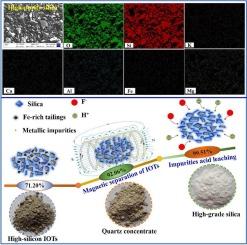
High‑silicon iron ore tailings (IOTs) as mineral solid wastes derived from the processing and utilization of iron ore, which would threaten human health and the ecological environment if handled improperly. Coincidently, it consists of abundant quartz gangue. In this study, we proposed a superconducting high gradient magnetic separation (S-HGMS) coupling with acid leaching technology to prepare high-grade silica from high‑silicon IOTs. S-HGMS was applied to high‑silicon IOTs to pre-concentrate silica into quartz concentrate. Under the optimized conditions, the SiO2 grade in quartz concentrate reached 92.06% with a SiO2 recovery of 43.54%. The results indicate that the S-HGMS effectively achieved a selective separation of silica from high‑silicon IOTs, but entrainment occurred between silica and sub-micron impurities particles, reducing the SiO2 grade and recovery. Quartz concentrate was then subjected to a mixed acid leaching to remove metallic impurities. Under the conditions of the ratio of mixed acid of 5 mol/L HCl + 1 mol/L HF, leaching temperature of 353.15 K, and leaching time of 12 h, the SiO2 purity of high-grade silica reached 99.51%, and the removal efficiency of Fe, Al, Mg, and Ca from quartz concentrate was 95.20%, 85.60%, 97.99%, and 97.19%, respectively. During the leaching process, HF played a vital role and its' nucleophilic attack can provide the effective removal of metallic impurities. The dissolution behaviors of Fe, Al, Mg, and Ca were described as shrinking core models, but their controlled steps were significantly different. Thermodynamic results indicate that Fe, Al, Mg, and Ca leaching processes were dominated by ΔS0 rather than ΔH0, and their ΔG0 from lowest to highest were , indicating that Ca ion may be leached more easily. Ultimately, a prospect was proposed for the high-value application of high‑silicon IOTs resource. This study provides valuable insight to realize the recycling and utilization of tailings for its industrialization.
期刊介绍:
Powder Technology is an International Journal on the Science and Technology of Wet and Dry Particulate Systems. Powder Technology publishes papers on all aspects of the formation of particles and their characterisation and on the study of systems containing particulate solids. No limitation is imposed on the size of the particles, which may range from nanometre scale, as in pigments or aerosols, to that of mined or quarried materials. The following list of topics is not intended to be comprehensive, but rather to indicate typical subjects which fall within the scope of the journal's interests:
Formation and synthesis of particles by precipitation and other methods.
Modification of particles by agglomeration, coating, comminution and attrition.
Characterisation of the size, shape, surface area, pore structure and strength of particles and agglomerates (including the origins and effects of inter particle forces).
Packing, failure, flow and permeability of assemblies of particles.
Particle-particle interactions and suspension rheology.
Handling and processing operations such as slurry flow, fluidization, pneumatic conveying.
Interactions between particles and their environment, including delivery of particulate products to the body.
Applications of particle technology in production of pharmaceuticals, chemicals, foods, pigments, structural, and functional materials and in environmental and energy related matters.
For materials-oriented contributions we are looking for articles revealing the effect of particle/powder characteristics (size, morphology and composition, in that order) on material performance or functionality and, ideally, comparison to any industrial standard.



 京公网安备 11010802042870号
京ICP备2023020795号-1
京公网安备 11010802042870号
京ICP备2023020795号-1

 分享
分享
 求助内容:
求助内容: 应助结果提醒方式:
 扫码关注我们
