Concetta Pelligra , Javad Samei , Jidong Kang , David S. Wilkinson
{"title":"The effect of vanadium on microstrain partitioning and localized damage during deformation of unnotched and notched DP1300 steels","authors":"Concetta Pelligra , Javad Samei , Jidong Kang , David S. Wilkinson","doi":"10.1016/j.ijplas.2022.103435","DOIUrl":null,"url":null,"abstract":"<div><p>The use of vanadium-microalloying in ultrahigh strength dual phase (DP) steels has been shown to yield a fine dispersion of nano-scale vanadium carbonitrides (V(C,N)) in ferrite along with a pronounced grain refinement, leading to enhanced micromechanical compatibility and increased local ductility. Here we present data on microstrain partitioning and the evolution of damage in vanadium-free (V-free) Fine-Grained (FG) and vanadium-added (V-added) Ultra Fine-Grained (UFG) DP steels, each with a UTS of about 1300 MPa (DP1300), using quasi <em>in-situ</em> tensile tests coupled with scanning electron microscopy, followed by microscopic Digital Image Correlation (µDIC). Quantitative analysis shows that the homogenization of microstrain between ferrite and martensite is locally enhanced and the strain gradients at the ferrite/martensite (F/M) interfaces reduced in the V-added steel. This trend was also evident in the V-added steel exhibiting different states of stress obtained with unique notched microtensile specimen designs. Three different µDIC-based computational techniques were used to quantify the extent of microstrain partitioning, in order to determine the mechanistic basis for the increase in true strain to fracture with vanadium-microalloying. This work was supplemented with damage evolution studies in both V-free and V-added materials using high resolution, field emission scanning electron microscope (FESEM) imaging, and X-ray computed microtomography (µXCT). These corroborate the microscopic analyses and confirm that both vanadium-microalloying and stress-state impacts the local strain gradient at ferrite/martensite (F/M) interfaces, and thereby changes the way damage is initiated and grows within the material.</p></div>","PeriodicalId":340,"journal":{"name":"International Journal of Plasticity","volume":"158 ","pages":"Article 103435"},"PeriodicalIF":12.8000,"publicationDate":"2022-11-01","publicationTypes":"Journal Article","fieldsOfStudy":null,"isOpenAccess":false,"openAccessPdf":"","citationCount":"7","resultStr":null,"platform":"Semanticscholar","paperid":null,"PeriodicalName":"International Journal of Plasticity","FirstCategoryId":"88","ListUrlMain":"https://www.sciencedirect.com/science/article/pii/S0749641922002133","RegionNum":1,"RegionCategory":"材料科学","ArticlePicture":[],"TitleCN":null,"AbstractTextCN":null,"PMCID":null,"EPubDate":"","PubModel":"","JCR":"Q1","JCRName":"ENGINEERING, MECHANICAL","Score":null,"Total":0}
引用次数: 7
Abstract
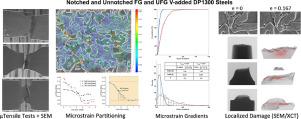
The use of vanadium-microalloying in ultrahigh strength dual phase (DP) steels has been shown to yield a fine dispersion of nano-scale vanadium carbonitrides (V(C,N)) in ferrite along with a pronounced grain refinement, leading to enhanced micromechanical compatibility and increased local ductility. Here we present data on microstrain partitioning and the evolution of damage in vanadium-free (V-free) Fine-Grained (FG) and vanadium-added (V-added) Ultra Fine-Grained (UFG) DP steels, each with a UTS of about 1300 MPa (DP1300), using quasi in-situ tensile tests coupled with scanning electron microscopy, followed by microscopic Digital Image Correlation (µDIC). Quantitative analysis shows that the homogenization of microstrain between ferrite and martensite is locally enhanced and the strain gradients at the ferrite/martensite (F/M) interfaces reduced in the V-added steel. This trend was also evident in the V-added steel exhibiting different states of stress obtained with unique notched microtensile specimen designs. Three different µDIC-based computational techniques were used to quantify the extent of microstrain partitioning, in order to determine the mechanistic basis for the increase in true strain to fracture with vanadium-microalloying. This work was supplemented with damage evolution studies in both V-free and V-added materials using high resolution, field emission scanning electron microscope (FESEM) imaging, and X-ray computed microtomography (µXCT). These corroborate the microscopic analyses and confirm that both vanadium-microalloying and stress-state impacts the local strain gradient at ferrite/martensite (F/M) interfaces, and thereby changes the way damage is initiated and grows within the material.
期刊介绍:
International Journal of Plasticity aims to present original research encompassing all facets of plastic deformation, damage, and fracture behavior in both isotropic and anisotropic solids. This includes exploring the thermodynamics of plasticity and fracture, continuum theory, and macroscopic as well as microscopic phenomena.
Topics of interest span the plastic behavior of single crystals and polycrystalline metals, ceramics, rocks, soils, composites, nanocrystalline and microelectronics materials, shape memory alloys, ferroelectric ceramics, thin films, and polymers. Additionally, the journal covers plasticity aspects of failure and fracture mechanics. Contributions involving significant experimental, numerical, or theoretical advancements that enhance the understanding of the plastic behavior of solids are particularly valued. Papers addressing the modeling of finite nonlinear elastic deformation, bearing similarities to the modeling of plastic deformation, are also welcomed.



 京公网安备 11010802042870号
京ICP备2023020795号-1
京公网安备 11010802042870号
京ICP备2023020795号-1

 分享
分享
 求助内容:
求助内容: 应助结果提醒方式:
 扫码关注我们
