{"title":"Pneumocystis jirovecii Pneumonia in Rheumatoid Arthritis Patients: Risks and Prophylaxis Recommendations.","authors":"Shunsuke Mori, Mineharu Sugimoto","doi":"10.4137/CCRPM.S23286","DOIUrl":null,"url":null,"abstract":"<p><p>Pneumocystis jirovecii infection causes fulminant interstitial pneumonia (Pneumocystis pneumonia, PCP) in patients with rheumatoid arthritis (RA) who are receiving biological and/or nonbiological antirheumatic drugs. Recently, we encountered a PCP outbreak among RA outpatients at our institution. Hospital-acquired, person-to-person transmission appears to be the most likely mode of this cluster of P. jirovecii infection. Carriage of P. jirovecii seems a time-limited phenomenon in immunocompetent hosts, but in RA patients receiving antirheumatic therapy, clearance of this organism from the lungs is delayed. Carriers among RA patients can serve as sources and reservoirs of P. jirovecii infection for other susceptible patients in outpatient facilities. Development of PCP is a matter of time in such carriers. Considering the poor survival rates of PCP cases, prophylactic antibiotics should be considered for RA patients who are scheduled to receive antirheumatic therapy. Once a new case of PCP occurs, we should take prompt action not only to treat the PCP patient but also to prevent other patients from becoming new carriers of P. jirovecii. Short-term prophylaxis with trimethoprim-sulfamethoxazole is effective in controlling P. jirovecii infection and preventing future outbreaks of PCP among RA patients. </p>","PeriodicalId":44269,"journal":{"name":"Clinical Medicine Insights-Circulatory Respiratory and Pulmonary Medicine","volume":"9 Suppl 1","pages":"29-40"},"PeriodicalIF":0.9000,"publicationDate":"2015-09-06","publicationTypes":"Journal Article","fieldsOfStudy":null,"isOpenAccess":false,"openAccessPdf":"https://sci-hub-pdf.com/10.4137/CCRPM.S23286","citationCount":"33","resultStr":null,"platform":"Semanticscholar","paperid":null,"PeriodicalName":"Clinical Medicine Insights-Circulatory Respiratory and Pulmonary Medicine","FirstCategoryId":"1085","ListUrlMain":"https://doi.org/10.4137/CCRPM.S23286","RegionNum":0,"RegionCategory":null,"ArticlePicture":[],"TitleCN":null,"AbstractTextCN":null,"PMCID":null,"EPubDate":"2015/1/1 0:00:00","PubModel":"eCollection","JCR":"Q4","JCRName":"RESPIRATORY SYSTEM","Score":null,"Total":0}
引用次数: 33
Abstract
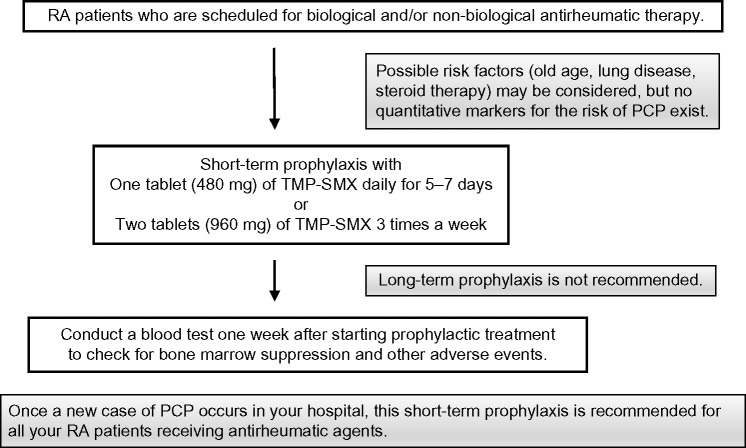
Pneumocystis jirovecii infection causes fulminant interstitial pneumonia (Pneumocystis pneumonia, PCP) in patients with rheumatoid arthritis (RA) who are receiving biological and/or nonbiological antirheumatic drugs. Recently, we encountered a PCP outbreak among RA outpatients at our institution. Hospital-acquired, person-to-person transmission appears to be the most likely mode of this cluster of P. jirovecii infection. Carriage of P. jirovecii seems a time-limited phenomenon in immunocompetent hosts, but in RA patients receiving antirheumatic therapy, clearance of this organism from the lungs is delayed. Carriers among RA patients can serve as sources and reservoirs of P. jirovecii infection for other susceptible patients in outpatient facilities. Development of PCP is a matter of time in such carriers. Considering the poor survival rates of PCP cases, prophylactic antibiotics should be considered for RA patients who are scheduled to receive antirheumatic therapy. Once a new case of PCP occurs, we should take prompt action not only to treat the PCP patient but also to prevent other patients from becoming new carriers of P. jirovecii. Short-term prophylaxis with trimethoprim-sulfamethoxazole is effective in controlling P. jirovecii infection and preventing future outbreaks of PCP among RA patients.




 京公网安备 11010802042870号
京ICP备2023020795号-1
京公网安备 11010802042870号
京ICP备2023020795号-1

 分享
分享
 求助内容:
求助内容: 应助结果提醒方式:
 扫码关注我们
