High-intensity ultrasound combined with glycation enhances the thermal stability and in vitro digestion behaviors of myofibrillar protein aqueous solution
Ge Han, Siqi Zhao, Qian Liu, Xiufang Xia, Qian Chen, Haotian Liu, Baohua Kong
{"title":"High-intensity ultrasound combined with glycation enhances the thermal stability and in vitro digestion behaviors of myofibrillar protein aqueous solution","authors":"Ge Han, Siqi Zhao, Qian Liu, Xiufang Xia, Qian Chen, Haotian Liu, Baohua Kong","doi":"10.1016/j.ijbiomac.2023.126301","DOIUrl":null,"url":null,"abstract":"<div><p>The low thermal stability of myofibrillar proteins (MPs) is a technological barrier to them being applied in beverage formulas. In this study, we investigated the effect of high-intensity ultrasound (HIU) pretreatment combined with glycation on the thermal stability, structural characteristics, and <em>in vitro</em> digestion behavior of MPs in water. The results indicated that HIU pretreatment combined with glycation significantly inhibited thermal aggregation and reduced the particle size of MPs compared to using either HIU or glycation treatments individually. The grafting of dextran (DX) shielded the sulfhydryl (–SH) and hydrophobic groups and inhibited disulfide bond cross-linking and hydrophobic association. Moreover, HIU pretreatment facilitated the shielding effect of glycation by destroying the filamentous myosin structure and exposing the internal –SH and hydrophobic groups as well as the grafting sites, maximally inhibiting thermal aggregation. In addition, the smaller protein particles and more flexible structure caused by HIU pretreatment combined with glycation increased their binding affinity toward protease. Overall, these findings can promote the technological development of modulating the MP structure–digestion for formulating novel meat protein-based products.</p></div>","PeriodicalId":333,"journal":{"name":"International Journal of Biological Macromolecules","volume":"251 ","pages":"Article 126301"},"PeriodicalIF":8.5000,"publicationDate":"2023-08-11","publicationTypes":"Journal Article","fieldsOfStudy":null,"isOpenAccess":false,"openAccessPdf":"","citationCount":"0","resultStr":null,"platform":"Semanticscholar","paperid":null,"PeriodicalName":"International Journal of Biological Macromolecules","FirstCategoryId":"92","ListUrlMain":"https://www.sciencedirect.com/science/article/pii/S0141813023031975","RegionNum":1,"RegionCategory":"化学","ArticlePicture":[],"TitleCN":null,"AbstractTextCN":null,"PMCID":null,"EPubDate":"","PubModel":"","JCR":"Q1","JCRName":"BIOCHEMISTRY & MOLECULAR BIOLOGY","Score":null,"Total":0}
引用次数: 0
Abstract
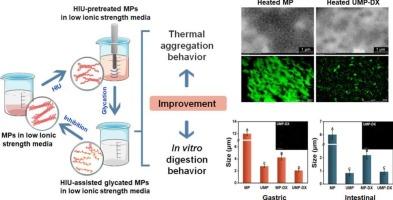
The low thermal stability of myofibrillar proteins (MPs) is a technological barrier to them being applied in beverage formulas. In this study, we investigated the effect of high-intensity ultrasound (HIU) pretreatment combined with glycation on the thermal stability, structural characteristics, and in vitro digestion behavior of MPs in water. The results indicated that HIU pretreatment combined with glycation significantly inhibited thermal aggregation and reduced the particle size of MPs compared to using either HIU or glycation treatments individually. The grafting of dextran (DX) shielded the sulfhydryl (–SH) and hydrophobic groups and inhibited disulfide bond cross-linking and hydrophobic association. Moreover, HIU pretreatment facilitated the shielding effect of glycation by destroying the filamentous myosin structure and exposing the internal –SH and hydrophobic groups as well as the grafting sites, maximally inhibiting thermal aggregation. In addition, the smaller protein particles and more flexible structure caused by HIU pretreatment combined with glycation increased their binding affinity toward protease. Overall, these findings can promote the technological development of modulating the MP structure–digestion for formulating novel meat protein-based products.
期刊介绍:
The International Journal of Biological Macromolecules is a well-established international journal dedicated to research on the chemical and biological aspects of natural macromolecules. Focusing on proteins, macromolecular carbohydrates, glycoproteins, proteoglycans, lignins, biological poly-acids, and nucleic acids, the journal presents the latest findings in molecular structure, properties, biological activities, interactions, modifications, and functional properties. Papers must offer new and novel insights, encompassing related model systems, structural conformational studies, theoretical developments, and analytical techniques. Each paper is required to primarily focus on at least one named biological macromolecule, reflected in the title, abstract, and text.