{"title":"Co-Positivity for Anti-dsDNA, -Nucleosome and -Histone Antibodies in Lupus Nephritis Is Indicative of High Serum Levels and Severe Nephropathy.","authors":"Jinfeng Yang, Zhaozhen Xu, Manshu Sui, Jihua Han, Lijie Sun, Xiuzhi Jia, Haiyu Zhang, Changsong Han, Xiaoming Jin, Fei Gao, Yanhong Liu, Yang Li, Jianbin Cao, Hong Ling, Fengmin Zhang, Huan Ren","doi":"10.1371/journal.pone.0140441","DOIUrl":null,"url":null,"abstract":"<p><strong>Objective: </strong>To characterize the significance of correlated autoantibodies in systemic lupus erythematosus (SLE) and its complication lupus nephritis (LN) in a large cohort of patients.</p><p><strong>Methods: </strong>Clinical data were statistically analyzed in 1699 SLE patients with or without nephritis who were diagnosed and treated during 2002-2013 in the northeast region of China. Reactivity to a list of 16 autoantibodies was detected by the serum test Euroline ANA profile (IgG). Serum titers of the anti-nucleosome autoantibodies were measured by ELISA assays. Kidney biopsies were examined by pathologists. Immune complex deposition was identified by immunohistochemistry stain.</p><p><strong>Results: </strong>Simultaneous positivity of anti-dsDNA, -nucleosome and -histone antibodies (3-pos) was prevalent in SLE patients with LN compared to Non-renal SLE patients (41% vs 11%, p< 0.001). Significant correlations were found between any two of the above three anti-nucleosome antibodies in LN patients. In comparison to non-3-pos cohorts, 3-pos patients with LN had significantly higher serum levels of the three antibodies and more active disease; was associated with type IV disease; suffered from more severe renal damages; received more intensive treatment and had worse disease outcome. The serum levels of these three autoantibodies in 3-pos LN patients were significantly decreased when they underwent clinical recovery.</p><p><strong>Conclusions: </strong>Simultaneous reactivity to anti-dsDNA, -nucleosome and -histone antibodies by Euroline ANA profile (IgG) may indicate severe nephropathy in patients with SLE.</p>","PeriodicalId":20189,"journal":{"name":"PLoS ONE","volume":" ","pages":"e0140441"},"PeriodicalIF":2.6000,"publicationDate":"2015-10-14","publicationTypes":"Journal Article","fieldsOfStudy":null,"isOpenAccess":false,"openAccessPdf":"https://sci-hub-pdf.com/10.1371/journal.pone.0140441","citationCount":"31","resultStr":null,"platform":"Semanticscholar","paperid":null,"PeriodicalName":"PLoS ONE","FirstCategoryId":"103","ListUrlMain":"https://doi.org/10.1371/journal.pone.0140441","RegionNum":3,"RegionCategory":"综合性期刊","ArticlePicture":[],"TitleCN":null,"AbstractTextCN":null,"PMCID":null,"EPubDate":"2015/1/1 0:00:00","PubModel":"eCollection","JCR":"Q1","JCRName":"MULTIDISCIPLINARY SCIENCES","Score":null,"Total":0}
引用次数: 31
Abstract
Objective: To characterize the significance of correlated autoantibodies in systemic lupus erythematosus (SLE) and its complication lupus nephritis (LN) in a large cohort of patients.
Methods: Clinical data were statistically analyzed in 1699 SLE patients with or without nephritis who were diagnosed and treated during 2002-2013 in the northeast region of China. Reactivity to a list of 16 autoantibodies was detected by the serum test Euroline ANA profile (IgG). Serum titers of the anti-nucleosome autoantibodies were measured by ELISA assays. Kidney biopsies were examined by pathologists. Immune complex deposition was identified by immunohistochemistry stain.
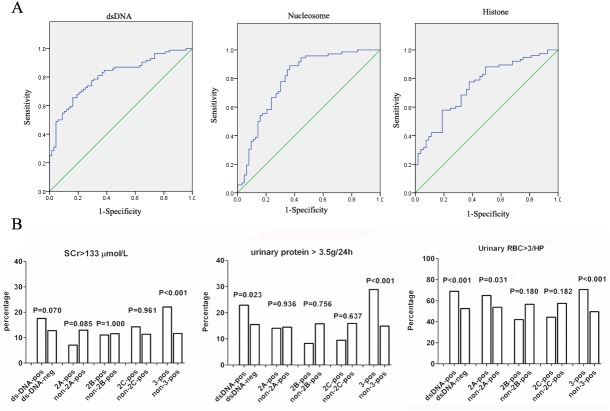
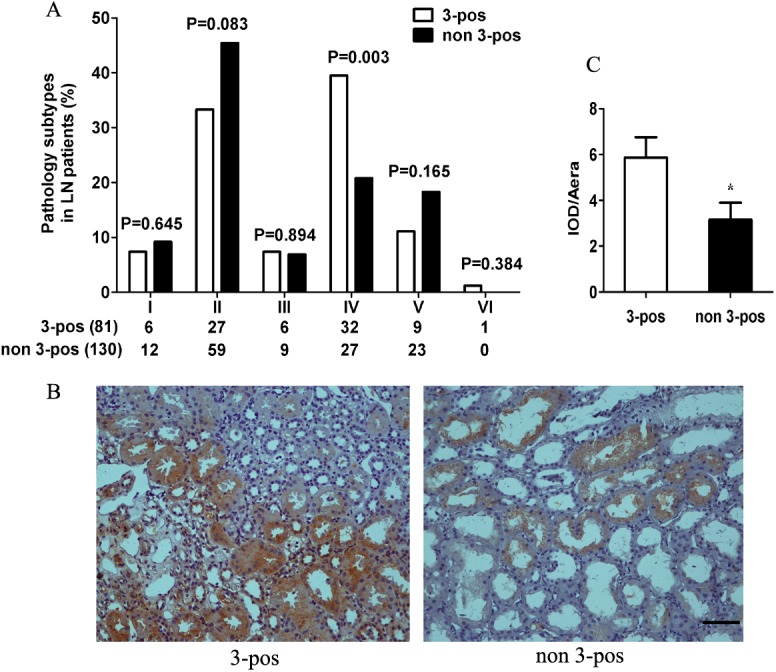
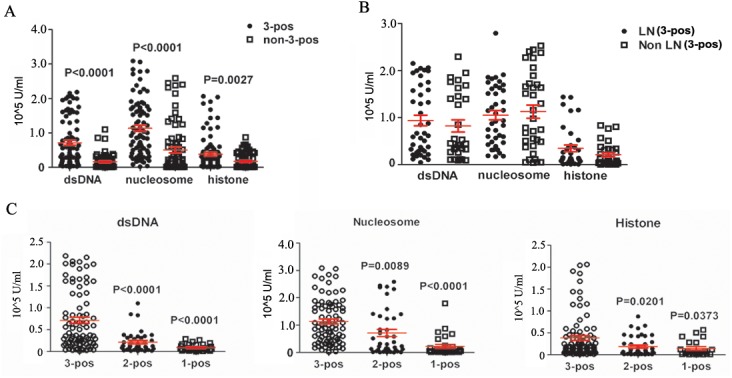
Results: Simultaneous positivity of anti-dsDNA, -nucleosome and -histone antibodies (3-pos) was prevalent in SLE patients with LN compared to Non-renal SLE patients (41% vs 11%, p< 0.001). Significant correlations were found between any two of the above three anti-nucleosome antibodies in LN patients. In comparison to non-3-pos cohorts, 3-pos patients with LN had significantly higher serum levels of the three antibodies and more active disease; was associated with type IV disease; suffered from more severe renal damages; received more intensive treatment and had worse disease outcome. The serum levels of these three autoantibodies in 3-pos LN patients were significantly decreased when they underwent clinical recovery.
Conclusions: Simultaneous reactivity to anti-dsDNA, -nucleosome and -histone antibodies by Euroline ANA profile (IgG) may indicate severe nephropathy in patients with SLE.
期刊介绍:
PLOS ONE is an international, peer-reviewed, open-access, online publication. PLOS ONE welcomes reports on primary research from any scientific discipline. It provides:
* Open-access—freely accessible online, authors retain copyright
* Fast publication times
* Peer review by expert, practicing researchers
* Post-publication tools to indicate quality and impact
* Community-based dialogue on articles
* Worldwide media coverage




 京公网安备 11010802042870号
京ICP备2023020795号-1
京公网安备 11010802042870号
京ICP备2023020795号-1

 分享
分享
 求助内容:
求助内容: 应助结果提醒方式:
 扫码关注我们
