Paulo Henrique Marchetti, Josinaldo Jarbas da Silva, Brad Jon Schoenfeld, Priscyla Silva Monteiro Nardi, Silvio Luis Pecoraro, Julia Maria D'Andréa Greve, Erin Hartigan
{"title":"Muscle Activation Differs between Three Different Knee Joint-Angle Positions during a Maximal Isometric Back Squat Exercise.","authors":"Paulo Henrique Marchetti, Josinaldo Jarbas da Silva, Brad Jon Schoenfeld, Priscyla Silva Monteiro Nardi, Silvio Luis Pecoraro, Julia Maria D'Andréa Greve, Erin Hartigan","doi":"10.1155/2016/3846123","DOIUrl":null,"url":null,"abstract":"<p><p>The purpose of this study was to compare muscle activation of the lower limb muscles when performing a maximal isometric back squat exercise over three different positions. Fifteen young, healthy, resistance-trained men performed an isometric back squat at three knee joint angles (20°, 90°, and 140°) in a randomized, counterbalanced fashion. Surface electromyography was used to measure muscle activation of the vastus lateralis (VL), vastus medialis (VM), rectus femoris (RF), biceps femoris (BF), semitendinosus (ST), and gluteus maximus (GM). In general, muscle activity was the highest at 90° for the three quadriceps muscles, yet differences in muscle activation between knee angles were muscle specific. Activity of the GM was significantly greater at 20° and 90° compared to 140°. The BF and ST displayed similar activation at all joint angles. In conclusion, knee position alters muscles activation of the quadriceps and gluteus maximus muscles. An isometric back squat at 90° generates the highest overall muscle activation, yet an isometric back squat at 140° generates the lowest overall muscle activation of the VL and GM only. </p>","PeriodicalId":30574,"journal":{"name":"Journal of Sports Medicine","volume":"2016 ","pages":"3846123"},"PeriodicalIF":0.0000,"publicationDate":"2016-01-01","publicationTypes":"Journal Article","fieldsOfStudy":null,"isOpenAccess":false,"openAccessPdf":"https://sci-hub-pdf.com/10.1155/2016/3846123","citationCount":"43","resultStr":null,"platform":"Semanticscholar","paperid":null,"PeriodicalName":"Journal of Sports Medicine","FirstCategoryId":"1085","ListUrlMain":"https://doi.org/10.1155/2016/3846123","RegionNum":0,"RegionCategory":null,"ArticlePicture":[],"TitleCN":null,"AbstractTextCN":null,"PMCID":null,"EPubDate":"2016/7/18 0:00:00","PubModel":"Epub","JCR":"","JCRName":"","Score":null,"Total":0}
引用次数: 43
Abstract
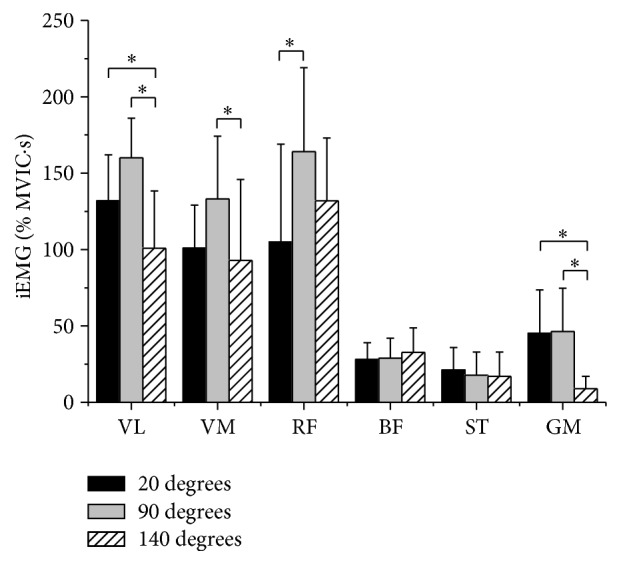
The purpose of this study was to compare muscle activation of the lower limb muscles when performing a maximal isometric back squat exercise over three different positions. Fifteen young, healthy, resistance-trained men performed an isometric back squat at three knee joint angles (20°, 90°, and 140°) in a randomized, counterbalanced fashion. Surface electromyography was used to measure muscle activation of the vastus lateralis (VL), vastus medialis (VM), rectus femoris (RF), biceps femoris (BF), semitendinosus (ST), and gluteus maximus (GM). In general, muscle activity was the highest at 90° for the three quadriceps muscles, yet differences in muscle activation between knee angles were muscle specific. Activity of the GM was significantly greater at 20° and 90° compared to 140°. The BF and ST displayed similar activation at all joint angles. In conclusion, knee position alters muscles activation of the quadriceps and gluteus maximus muscles. An isometric back squat at 90° generates the highest overall muscle activation, yet an isometric back squat at 140° generates the lowest overall muscle activation of the VL and GM only.



 京公网安备 11010802042870号
京ICP备2023020795号-1
京公网安备 11010802042870号
京ICP备2023020795号-1

 分享
分享

 求助内容:
求助内容: 应助结果提醒方式:
 扫码关注我们
