{"title":"A novel endothelial-derived anti-inflammatory activity significantly inhibits spontaneous choroidal neovascularisation in a mouse model.","authors":"Laura Paneghetti, Yin-Shan Eric Ng","doi":"10.1186/s13221-016-0036-4","DOIUrl":null,"url":null,"abstract":"<p><strong>Background: </strong>Endothelial cells (EC) grown on collagen particles inhibit intimal hyperplasia in animal models when applied perivascularly, and this effect appears to be, at least in part, the result of EC-derived soluble factors that suppress local vascular inflammation. To elucidate the molecular basis of the therapeutic effects of EC grown on collagen particles, the anti-inflammatory activity of conditioned medium from these cells was characterized.</p><p><strong>Methods: </strong>Human aortic EC (HAEC) and, for chromatin immunoprecipitation assays, human umbilical vein EC (HUVEC) were treated with tumor necrosis factor alpha (TNFα) in the presence of conditioned medium generated by HAEC grown on collagen particles (ECPCM), and the anti-inflammatory effects were evaluated by analysing the expression of the inflammation-related adhesion molecules E-selectin and vascular cell adhesion molecule-1 (VCAM-1). The therapeutic activity of ECPCM was studied using the mouse strain JR5558, which develops spontaneous choroidal neovascularisation (CNV) lesions driven by local inflammation.</p><p><strong>Results: </strong>ECPCM significantly suppressed TNFα-induced expression of E-selectin and VCAM-1. ECPCM did not affect the mRNA stability of the two genes, but suppressed TNFα-induced binding of the p65 subunit of NF-kB transcription factor to E-selectin and VCAM-1 promoters. In vivo, systemic ECPCM treatment significantly reduced the CNV area and the recruitment of activated macrophages to the lesions. Characterization of the molecule responsible for the anti-inflammatory activity in ECPCM indicates that it is unlikely to be a protein and that it is not any of the better characterized EC-derived anti-inflammatory molecules.</p><p><strong>Conclusions: </strong>Medium conditioned by HAEC grown on collagen particles exhibits significant anti-inflammatory activity via inhibition of genes that mediate inflammatory responses in EC.</p>","PeriodicalId":23948,"journal":{"name":"Vascular Cell","volume":"8 ","pages":"2"},"PeriodicalIF":0.0000,"publicationDate":"2016-05-11","publicationTypes":"Journal Article","fieldsOfStudy":null,"isOpenAccess":false,"openAccessPdf":"https://sci-hub-pdf.com/10.1186/s13221-016-0036-4","citationCount":"11","resultStr":null,"platform":"Semanticscholar","paperid":null,"PeriodicalName":"Vascular Cell","FirstCategoryId":"1085","ListUrlMain":"https://doi.org/10.1186/s13221-016-0036-4","RegionNum":0,"RegionCategory":null,"ArticlePicture":[],"TitleCN":null,"AbstractTextCN":null,"PMCID":null,"EPubDate":"2016/1/1 0:00:00","PubModel":"eCollection","JCR":"Q4","JCRName":"Neuroscience","Score":null,"Total":0}
引用次数: 11
Abstract
Background: Endothelial cells (EC) grown on collagen particles inhibit intimal hyperplasia in animal models when applied perivascularly, and this effect appears to be, at least in part, the result of EC-derived soluble factors that suppress local vascular inflammation. To elucidate the molecular basis of the therapeutic effects of EC grown on collagen particles, the anti-inflammatory activity of conditioned medium from these cells was characterized.
Methods: Human aortic EC (HAEC) and, for chromatin immunoprecipitation assays, human umbilical vein EC (HUVEC) were treated with tumor necrosis factor alpha (TNFα) in the presence of conditioned medium generated by HAEC grown on collagen particles (ECPCM), and the anti-inflammatory effects were evaluated by analysing the expression of the inflammation-related adhesion molecules E-selectin and vascular cell adhesion molecule-1 (VCAM-1). The therapeutic activity of ECPCM was studied using the mouse strain JR5558, which develops spontaneous choroidal neovascularisation (CNV) lesions driven by local inflammation.
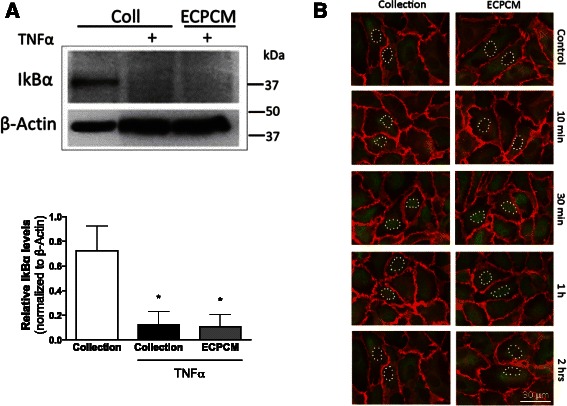
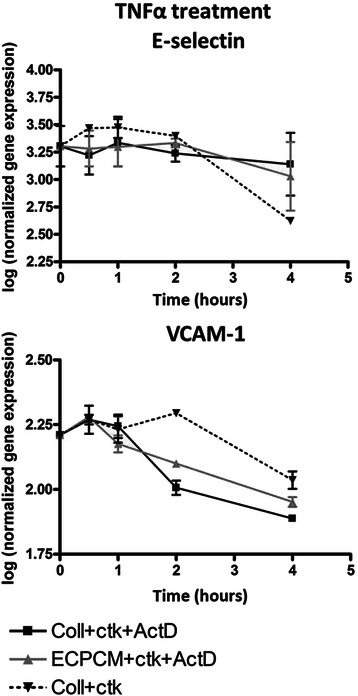
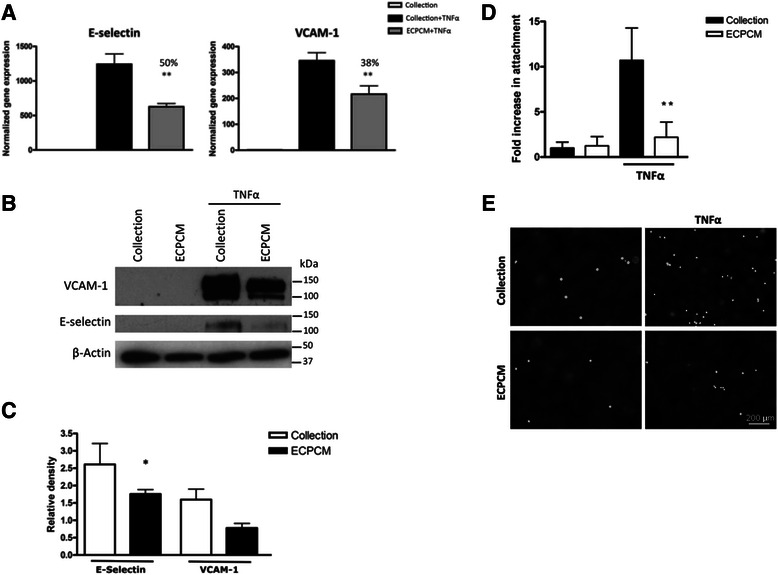
Results: ECPCM significantly suppressed TNFα-induced expression of E-selectin and VCAM-1. ECPCM did not affect the mRNA stability of the two genes, but suppressed TNFα-induced binding of the p65 subunit of NF-kB transcription factor to E-selectin and VCAM-1 promoters. In vivo, systemic ECPCM treatment significantly reduced the CNV area and the recruitment of activated macrophages to the lesions. Characterization of the molecule responsible for the anti-inflammatory activity in ECPCM indicates that it is unlikely to be a protein and that it is not any of the better characterized EC-derived anti-inflammatory molecules.
Conclusions: Medium conditioned by HAEC grown on collagen particles exhibits significant anti-inflammatory activity via inhibition of genes that mediate inflammatory responses in EC.




 京公网安备 11010802042870号
京ICP备2023020795号-1
京公网安备 11010802042870号
京ICP备2023020795号-1

 分享
分享
 求助内容:
求助内容: 应助结果提醒方式:
 扫码关注我们
