Rodrigo Custodio Urban , Liane Yuri Kondo Nakada , Ricardo de Lima Isaac
{"title":"A system dynamics approach for large-scale water treatment plant sludge management: A case study in Brazil","authors":"Rodrigo Custodio Urban , Liane Yuri Kondo Nakada , Ricardo de Lima Isaac","doi":"10.1016/j.jclepro.2023.138105","DOIUrl":null,"url":null,"abstract":"<div><p><span><span>A simulation model for water treatment plant </span>sludge<span><span> management was proposed, based on the system dynamics approach. This model can be extended to the </span>sludge management of a sanitation system (WTP + WWTP). The model is useful for the selection of the best destination for the sludge generated in treatment plants based on the various changes that a decision can have throughout the operation of the sanitation system. The applicability of the proposed model was tested in a case study of WTPs 3 and 4 and the Anhumas Wastewater Treatment Plant located in Campinas, the main city of the Piracicaba, Capivari and Jundiaí river basin, an important area of </span></span>water resource management<span><span> in Brazil<span>. The developed model can be used by treatment plants to: select the best final destination option according to treatment technologies<span>; select the best location for final disposal, considering transport, disposal and storage costs; verify the influence on treatment costs to adapt to a pre-defined final destination for joint management; or compare beneficial disposal costs with </span></span></span>landfill disposal<span><span> costs. The model was developed to allow for gradual increase in acceptance of the residue over time. By establishing this variable, slightly lower final costs were observed in the scenario of sending the sludge with aluminum coagulant to ceramic industries, compared to sending it to landfill, in the case study used for model development. Despite the interesting results, these values should be considered only indicative. Therefore, it can be stated that the major challenge to using the SD model is the accurate and appropriate data collection for correct simulation, as well as its historical series, for accurate evaluation of the viability of the model. The proposed simulation methods showed greater sensitivity to treatment costs, highlighting the importance of beneficial use of the proposed sludge to the technologies employed for water and </span>sludge treatment.</span></span></p></div>","PeriodicalId":349,"journal":{"name":"Journal of Cleaner Production","volume":"419 ","pages":"Article 138105"},"PeriodicalIF":10.0000,"publicationDate":"2023-07-14","publicationTypes":"Journal Article","fieldsOfStudy":null,"isOpenAccess":false,"openAccessPdf":"","citationCount":"0","resultStr":null,"platform":"Semanticscholar","paperid":null,"PeriodicalName":"Journal of Cleaner Production","FirstCategoryId":"93","ListUrlMain":"https://www.sciencedirect.com/science/article/pii/S0959652623022631","RegionNum":1,"RegionCategory":"环境科学与生态学","ArticlePicture":[],"TitleCN":null,"AbstractTextCN":null,"PMCID":null,"EPubDate":"","PubModel":"","JCR":"Q1","JCRName":"ENGINEERING, ENVIRONMENTAL","Score":null,"Total":0}
引用次数: 0
Abstract
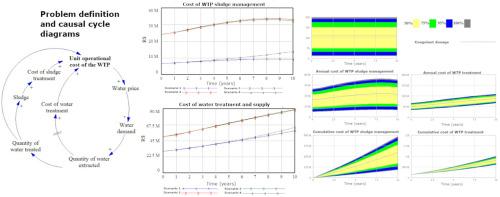
A simulation model for water treatment plant sludge management was proposed, based on the system dynamics approach. This model can be extended to the sludge management of a sanitation system (WTP + WWTP). The model is useful for the selection of the best destination for the sludge generated in treatment plants based on the various changes that a decision can have throughout the operation of the sanitation system. The applicability of the proposed model was tested in a case study of WTPs 3 and 4 and the Anhumas Wastewater Treatment Plant located in Campinas, the main city of the Piracicaba, Capivari and Jundiaí river basin, an important area of water resource management in Brazil. The developed model can be used by treatment plants to: select the best final destination option according to treatment technologies; select the best location for final disposal, considering transport, disposal and storage costs; verify the influence on treatment costs to adapt to a pre-defined final destination for joint management; or compare beneficial disposal costs with landfill disposal costs. The model was developed to allow for gradual increase in acceptance of the residue over time. By establishing this variable, slightly lower final costs were observed in the scenario of sending the sludge with aluminum coagulant to ceramic industries, compared to sending it to landfill, in the case study used for model development. Despite the interesting results, these values should be considered only indicative. Therefore, it can be stated that the major challenge to using the SD model is the accurate and appropriate data collection for correct simulation, as well as its historical series, for accurate evaluation of the viability of the model. The proposed simulation methods showed greater sensitivity to treatment costs, highlighting the importance of beneficial use of the proposed sludge to the technologies employed for water and sludge treatment.
期刊介绍:
The Journal of Cleaner Production is an international, transdisciplinary journal that addresses and discusses theoretical and practical Cleaner Production, Environmental, and Sustainability issues. It aims to help societies become more sustainable by focusing on the concept of 'Cleaner Production', which aims at preventing waste production and increasing efficiencies in energy, water, resources, and human capital use. The journal serves as a platform for corporations, governments, education institutions, regions, and societies to engage in discussions and research related to Cleaner Production, environmental, and sustainability practices.



 京公网安备 11010802042870号
京ICP备2023020795号-1
京公网安备 11010802042870号
京ICP备2023020795号-1

 分享
分享
 求助内容:
求助内容: 应助结果提醒方式:
 扫码关注我们
