Gabriela Rosenblau, Dorit Kliemann, Isabel Dziobek, Hauke R Heekeren
{"title":"Emotional prosody processing in autism spectrum disorder.","authors":"Gabriela Rosenblau, Dorit Kliemann, Isabel Dziobek, Hauke R Heekeren","doi":"10.1093/scan/nsw118","DOIUrl":null,"url":null,"abstract":"<p><p>Individuals with Autism Spectrum Disorder (ASD) are characterized by severe deficits in social communication, whereby the nature of their impairments in emotional prosody processing have yet to be specified. Here, we investigated emotional prosody processing in individuals with ASD and controls with novel, lifelike behavioral and neuroimaging paradigms. Compared to controls, individuals with ASD showed reduced emotional prosody recognition accuracy on a behavioral task. On the neural level, individuals with ASD displayed reduced activity of the STS, insula and amygdala for complex vs basic emotions compared to controls. Moreover, the coupling between the STS and amygdala for complex vs basic emotions was reduced in the ASD group. Finally, groups differed with respect to the relationship between brain activity and behavioral performance. Brain activity during emotional prosody processing was more strongly related to prosody recognition accuracy in ASD participants. In contrast, the coupling between STS and anterior cingulate cortex (ACC) activity predicted behavioral task performance more strongly in the control group. These results provide evidence for aberrant emotional prosody processing of individuals with ASD. They suggest that the differences in the relationship between the neural and behavioral level of individuals with ASD may account for their observed deficits in social communication.</p>","PeriodicalId":21789,"journal":{"name":"Social cognitive and affective neuroscience","volume":" ","pages":"224-239"},"PeriodicalIF":3.1000,"publicationDate":"2017-02-01","publicationTypes":"Journal Article","fieldsOfStudy":null,"isOpenAccess":false,"openAccessPdf":"https://sci-hub-pdf.com/10.1093/scan/nsw118","citationCount":"39","resultStr":null,"platform":"Semanticscholar","paperid":null,"PeriodicalName":"Social cognitive and affective neuroscience","FirstCategoryId":"3","ListUrlMain":"https://doi.org/10.1093/scan/nsw118","RegionNum":2,"RegionCategory":"医学","ArticlePicture":[],"TitleCN":null,"AbstractTextCN":null,"PMCID":null,"EPubDate":"","PubModel":"","JCR":"Q2","JCRName":"NEUROSCIENCES","Score":null,"Total":0}
引用次数: 39
Abstract
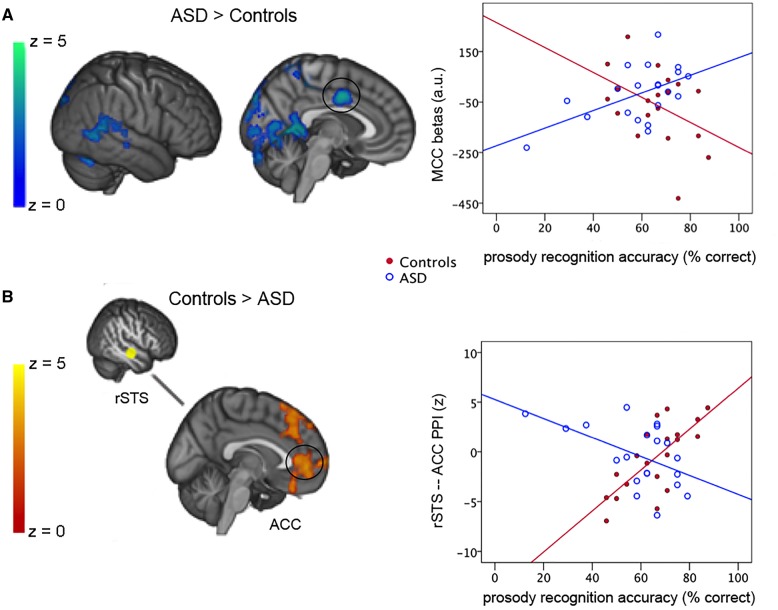
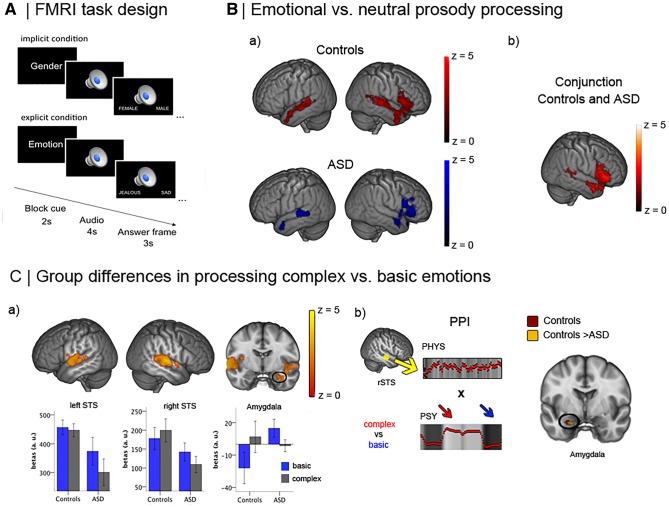
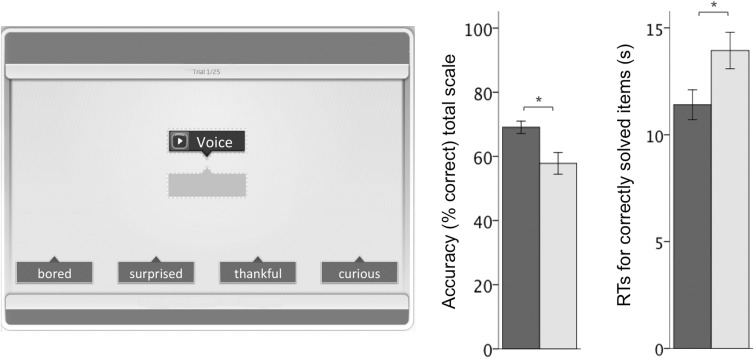
Individuals with Autism Spectrum Disorder (ASD) are characterized by severe deficits in social communication, whereby the nature of their impairments in emotional prosody processing have yet to be specified. Here, we investigated emotional prosody processing in individuals with ASD and controls with novel, lifelike behavioral and neuroimaging paradigms. Compared to controls, individuals with ASD showed reduced emotional prosody recognition accuracy on a behavioral task. On the neural level, individuals with ASD displayed reduced activity of the STS, insula and amygdala for complex vs basic emotions compared to controls. Moreover, the coupling between the STS and amygdala for complex vs basic emotions was reduced in the ASD group. Finally, groups differed with respect to the relationship between brain activity and behavioral performance. Brain activity during emotional prosody processing was more strongly related to prosody recognition accuracy in ASD participants. In contrast, the coupling between STS and anterior cingulate cortex (ACC) activity predicted behavioral task performance more strongly in the control group. These results provide evidence for aberrant emotional prosody processing of individuals with ASD. They suggest that the differences in the relationship between the neural and behavioral level of individuals with ASD may account for their observed deficits in social communication.
期刊介绍:
SCAN will consider research that uses neuroimaging (fMRI, MRI, PET, EEG, MEG), neuropsychological patient studies, animal lesion studies, single-cell recording, pharmacological perturbation, and transcranial magnetic stimulation. SCAN will also consider submissions that examine the mediational role of neural processes in linking social phenomena to physiological, neuroendocrine, immunological, developmental, and genetic processes. Additionally, SCAN will publish papers that address issues of mental and physical health as they relate to social and affective processes (e.g., autism, anxiety disorders, depression, stress, effects of child rearing) as long as cognitive neuroscience methods are used.



 京公网安备 11010802042870号
京ICP备2023020795号-1
京公网安备 11010802042870号
京ICP备2023020795号-1

 分享
分享
 求助内容:
求助内容: 应助结果提醒方式:
 扫码关注我们
