Lina Wang, Pengyan Wang, Yan Ren, Jingyun Du, Jianjun Jiang, Xuesong Jia, Chuangfu Chen, Yuanzhi Wang
{"title":"Prevalence of High-Risk Human Papillomavirus (HR-HPV) Genotypes and Multiple Infections in Cervical Abnormalities from Northern Xinjiang, China.","authors":"Lina Wang, Pengyan Wang, Yan Ren, Jingyun Du, Jianjun Jiang, Xuesong Jia, Chuangfu Chen, Yuanzhi Wang","doi":"10.1371/journal.pone.0160698","DOIUrl":null,"url":null,"abstract":"<p><p>Multiple human papillomavirus (HPV) genotypes often coexist within the cervical epithelia and are frequently detected together in various grades of the cervical neoplasia. To date, only a few reports exist on multiple HPV infections of HPV in Xinjiang Uygur Autonomous Region (XUAR). In the present study, we investigated the prevalence of High-Risk HPV (HR-HPV) genotypes and multiple infections. Cervical cytology samples were collected from 428 women who presented cervical abnormalities. Genotyping of HPV was performed by polymerase chain reaction-sequencing based typing (PCR-SBT) using consensus primers and specific primers. Of them, 166 samples were positive for HPV according to PCR results using the consensus primers. These samples contained cervical abnormalities enriched with inflammation (n = 107), cervical intraepithelial neoplasia (CIN) I (n = 19), CINII-III (n = 9) and cervical cancer (n = 31). Of the 166 HPV positive samples as determined by PCR analysis, 151 were further typed by PCR-SBT using 19 pairs of genotype-specific primers. Using this method, 17 different HR-HPV genotypes were identified. The most frequently observed HPV genotypes were HPV16 (44.0%, 73/166), 53 (28.9%, 48/166), 52 (25.3%, 42/166), 58 (22.3%, 37/166) and 35 (17.5%, 29/166). The proportions of single and multiple infections in the HPV-positive specimens were 34.9% and 65.1%, respectively. Multiple HPV types were most prevalent in the inflammatory state (63.0%), followed by cervical cancer (24.1%), CINI (11.1%), and CINII-III (1.9%). The results of our data analyses suggested that i) multiple HPV infection is not necessarily correlated with the severity of cervical abnormalities; and ii) among the multiple HPV infections, double infections combined with HPV16 is the most common. In addition, L1 full-length sequences of the top five high-risk HPV genotypes were amplified and sequenced. According to the L1 sequence of the epidemic genotypes that were amplified, we found that these genotypes contained the sequence point mutation, and that some of these genotypes further showed amino acid modifications. These results provide a basis for the construction of a polyvalent vaccine that is suitable for use in the XUAR, even in economically challenged communities located in China. </p>","PeriodicalId":20189,"journal":{"name":"PLoS ONE","volume":" ","pages":"e0160698"},"PeriodicalIF":2.6000,"publicationDate":"2016-08-05","publicationTypes":"Journal Article","fieldsOfStudy":null,"isOpenAccess":false,"openAccessPdf":"https://sci-hub-pdf.com/10.1371/journal.pone.0160698","citationCount":"25","resultStr":null,"platform":"Semanticscholar","paperid":null,"PeriodicalName":"PLoS ONE","FirstCategoryId":"103","ListUrlMain":"https://doi.org/10.1371/journal.pone.0160698","RegionNum":3,"RegionCategory":"综合性期刊","ArticlePicture":[],"TitleCN":null,"AbstractTextCN":null,"PMCID":null,"EPubDate":"2016/1/1 0:00:00","PubModel":"eCollection","JCR":"Q1","JCRName":"MULTIDISCIPLINARY SCIENCES","Score":null,"Total":0}
引用次数: 25
Abstract
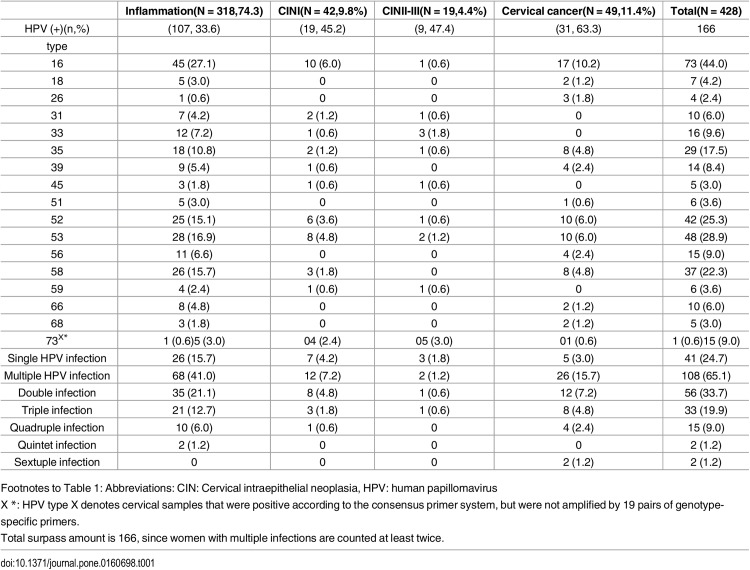
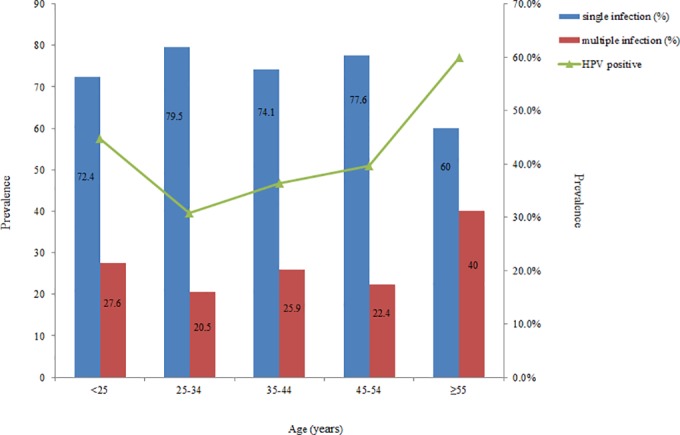
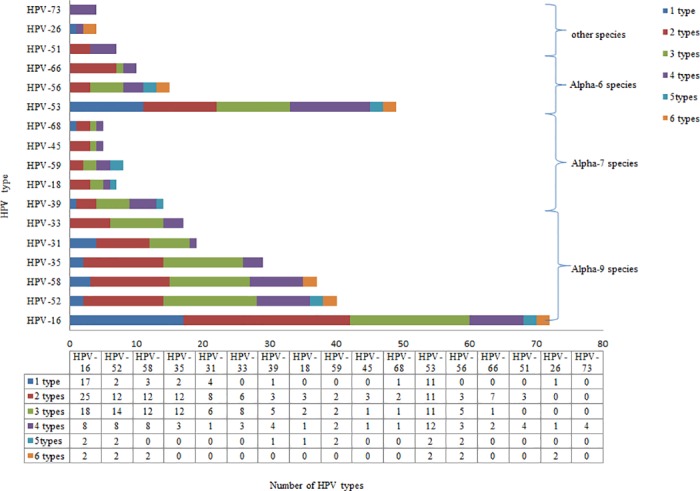
Multiple human papillomavirus (HPV) genotypes often coexist within the cervical epithelia and are frequently detected together in various grades of the cervical neoplasia. To date, only a few reports exist on multiple HPV infections of HPV in Xinjiang Uygur Autonomous Region (XUAR). In the present study, we investigated the prevalence of High-Risk HPV (HR-HPV) genotypes and multiple infections. Cervical cytology samples were collected from 428 women who presented cervical abnormalities. Genotyping of HPV was performed by polymerase chain reaction-sequencing based typing (PCR-SBT) using consensus primers and specific primers. Of them, 166 samples were positive for HPV according to PCR results using the consensus primers. These samples contained cervical abnormalities enriched with inflammation (n = 107), cervical intraepithelial neoplasia (CIN) I (n = 19), CINII-III (n = 9) and cervical cancer (n = 31). Of the 166 HPV positive samples as determined by PCR analysis, 151 were further typed by PCR-SBT using 19 pairs of genotype-specific primers. Using this method, 17 different HR-HPV genotypes were identified. The most frequently observed HPV genotypes were HPV16 (44.0%, 73/166), 53 (28.9%, 48/166), 52 (25.3%, 42/166), 58 (22.3%, 37/166) and 35 (17.5%, 29/166). The proportions of single and multiple infections in the HPV-positive specimens were 34.9% and 65.1%, respectively. Multiple HPV types were most prevalent in the inflammatory state (63.0%), followed by cervical cancer (24.1%), CINI (11.1%), and CINII-III (1.9%). The results of our data analyses suggested that i) multiple HPV infection is not necessarily correlated with the severity of cervical abnormalities; and ii) among the multiple HPV infections, double infections combined with HPV16 is the most common. In addition, L1 full-length sequences of the top five high-risk HPV genotypes were amplified and sequenced. According to the L1 sequence of the epidemic genotypes that were amplified, we found that these genotypes contained the sequence point mutation, and that some of these genotypes further showed amino acid modifications. These results provide a basis for the construction of a polyvalent vaccine that is suitable for use in the XUAR, even in economically challenged communities located in China.
期刊介绍:
PLOS ONE is an international, peer-reviewed, open-access, online publication. PLOS ONE welcomes reports on primary research from any scientific discipline. It provides:
* Open-access—freely accessible online, authors retain copyright
* Fast publication times
* Peer review by expert, practicing researchers
* Post-publication tools to indicate quality and impact
* Community-based dialogue on articles
* Worldwide media coverage




 京公网安备 11010802042870号
京ICP备2023020795号-1
京公网安备 11010802042870号
京ICP备2023020795号-1

 分享
分享
 求助内容:
求助内容: 应助结果提醒方式:
 扫码关注我们
