{"title":"Inducible clindamycin and methicillin resistant Staphylococcus aureus in a tertiary care hospital, Kathmandu, Nepal.","authors":"R P Adhikari, S Shrestha, A Barakoti, R Amatya","doi":"10.1186/s12879-017-2584-5","DOIUrl":null,"url":null,"abstract":"<p><strong>Background: </strong>Staphylococcus aureus, an important nosocomial pathogen, is frequently associated with infections in human. The management of the infections by it especially methicillin resistant ones is often difficult because methicillin resistant S. aureus is usually resistant to multiple antibiotics. Macrolide-lincosamide streptogramin B family of antibiotics is commonly used to treat such infections as an alternative to vancomycin.</p><p><strong>Methods: </strong>This study was conducted over the period of one and half year from November 2013-April 2015 in Microbiology laboratory of Nepal Medical College and Teaching Hospital, Kathmandu, Nepal to find the incidence of different phenotypes of MLS<sub>B</sub> resistance among S. aureus from clinical samples and their association with methicillin resistance. Two hundred seventy isolates of S. aureus were included in the study. Methicillin resistance was detected by cefoxitin disc diffusion method and inducible clindamycin resistance by erythromycin and clindamycin disc approximation test (D-test).</p><p><strong>Results: </strong>Of the 270 clinical isolates of S. aureus, 25.1% (68/270) were MRSA. Erythromycin and clindamycin resistance was seen in 54.4% (147/270) and 41.8% (113/270) isolates respectively. Resistance to erythromycin and clindamycin were higher in MRSA as compared to MSSA (erythromycin-resistance: 88.2% Vs 39.1% and clindamycin-resistance: 79.4% Vs 41.8%). The overall prevalence of <sub>i</sub>MLS<sub>B</sub> and <sub>c</sub>MLS<sub>B</sub> phenotype was 11.48% (31/270) and 29.25% (79/270) respectively. Both <sub>i</sub>MLS<sub>B</sub> and <sub>c</sub>MLS<sub>B</sub> phenotypes predominated in MRSA strains.</p><p><strong>Conclusions: </strong>Detection rate of MRSA in our study shows the necessity to improve in healthcare practices and to formulate new policy for the control of MRSA infections. Clindamycin resistance in the form of <sub>i</sub>MLS<sub>B</sub> and <sub>c</sub>MLS<sub>B</sub> especially among MRSA emphasizes the need of D-test to be performed routinely in our set up while using clindamycin as an alternative choice to anti-staphylococcal antibiotics like vancomycin and linezolid in the treatment of staphylococcal infections.</p>","PeriodicalId":8981,"journal":{"name":"BMC Infectious Diseases","volume":" ","pages":"483"},"PeriodicalIF":3.0000,"publicationDate":"2017-07-11","publicationTypes":"Journal Article","fieldsOfStudy":null,"isOpenAccess":false,"openAccessPdf":"https://sci-hub-pdf.com/10.1186/s12879-017-2584-5","citationCount":"70","resultStr":null,"platform":"Semanticscholar","paperid":null,"PeriodicalName":"BMC Infectious Diseases","FirstCategoryId":"3","ListUrlMain":"https://doi.org/10.1186/s12879-017-2584-5","RegionNum":3,"RegionCategory":"医学","ArticlePicture":[],"TitleCN":null,"AbstractTextCN":null,"PMCID":null,"EPubDate":"","PubModel":"","JCR":"Q2","JCRName":"INFECTIOUS DISEASES","Score":null,"Total":0}
引用次数: 70
Abstract
Background: Staphylococcus aureus, an important nosocomial pathogen, is frequently associated with infections in human. The management of the infections by it especially methicillin resistant ones is often difficult because methicillin resistant S. aureus is usually resistant to multiple antibiotics. Macrolide-lincosamide streptogramin B family of antibiotics is commonly used to treat such infections as an alternative to vancomycin.
Methods: This study was conducted over the period of one and half year from November 2013-April 2015 in Microbiology laboratory of Nepal Medical College and Teaching Hospital, Kathmandu, Nepal to find the incidence of different phenotypes of MLSB resistance among S. aureus from clinical samples and their association with methicillin resistance. Two hundred seventy isolates of S. aureus were included in the study. Methicillin resistance was detected by cefoxitin disc diffusion method and inducible clindamycin resistance by erythromycin and clindamycin disc approximation test (D-test).
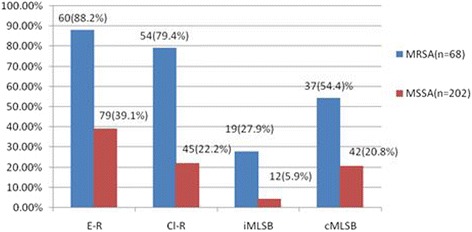
Results: Of the 270 clinical isolates of S. aureus, 25.1% (68/270) were MRSA. Erythromycin and clindamycin resistance was seen in 54.4% (147/270) and 41.8% (113/270) isolates respectively. Resistance to erythromycin and clindamycin were higher in MRSA as compared to MSSA (erythromycin-resistance: 88.2% Vs 39.1% and clindamycin-resistance: 79.4% Vs 41.8%). The overall prevalence of iMLSB and cMLSB phenotype was 11.48% (31/270) and 29.25% (79/270) respectively. Both iMLSB and cMLSB phenotypes predominated in MRSA strains.
Conclusions: Detection rate of MRSA in our study shows the necessity to improve in healthcare practices and to formulate new policy for the control of MRSA infections. Clindamycin resistance in the form of iMLSB and cMLSB especially among MRSA emphasizes the need of D-test to be performed routinely in our set up while using clindamycin as an alternative choice to anti-staphylococcal antibiotics like vancomycin and linezolid in the treatment of staphylococcal infections.
背景:金黄色葡萄球菌是一种重要的医院病原菌,常与人类感染有关。由于耐甲氧西林金黄色葡萄球菌通常对多种抗生素具有耐药性,因此对其感染特别是耐甲氧西林感染的管理往往是困难的。大环内酯-利可沙胺链霉素B家族抗生素通常用于治疗这类感染,作为万古霉素的替代品。方法:本研究于2013年11月- 2015年4月在尼泊尔加德满都尼泊尔医学院和教学医院微生物实验室进行为期一年半的研究,调查临床样品中金黄色葡萄球菌不同表型的MLSB耐药发生率及其与甲氧西林耐药的关系。研究中包括了270株金黄色葡萄球菌。采用头孢西林圆盘扩散法检测甲氧西林耐药性,采用红霉素和克林霉素圆盘近似试验(d检验)检测诱导型克林霉素耐药性。结果:270株临床分离的金黄色葡萄球菌中,有25.1%(68/270)为MRSA。对红霉素和克林霉素的耐药性分别为54.4%(147/270)和41.8%(113/270)。MRSA对红霉素和克林霉素的耐药性高于MSSA(红霉素耐药:88.2% Vs 39.1%,克林霉素耐药:79.4% Vs 41.8%)。iMLSB和cMLSB表型的总体患病率分别为11.48%(31/270)和29.25%(79/270)。MRSA菌株中以iMLSB和cMLSB表型为主。结论:本研究的MRSA检出率表明,有必要改进医疗实践,制定新的控制MRSA感染的政策。以iMLSB和cMLSB形式出现的克林霉素耐药,特别是在MRSA中,强调了在我们的研究中常规进行d试验的必要性,同时使用克林霉素作为万古霉素和利奈唑胺等抗葡萄球菌抗生素治疗葡萄球菌感染的替代选择。
期刊介绍:
BMC Infectious Diseases is an open access, peer-reviewed journal that considers articles on all aspects of the prevention, diagnosis and management of infectious and sexually transmitted diseases in humans, as well as related molecular genetics, pathophysiology, and epidemiology.



 京公网安备 11010802042870号
京ICP备2023020795号-1
京公网安备 11010802042870号
京ICP备2023020795号-1

 分享
分享
 求助内容:
求助内容: 应助结果提醒方式:
 扫码关注我们
