Uzma Saleem, Sana Khalid, Shingraf Zaib, Fareeha Anwar, Muhammad Furqan Akhtar, Liaqat Hussain, Ammara Saleem, Bashir Ahmad
{"title":"Wound Healing Potential and In Silico Appraisal of <i>Convolvulus arvensis</i> L. Methanolic Extract.","authors":"Uzma Saleem, Sana Khalid, Shingraf Zaib, Fareeha Anwar, Muhammad Furqan Akhtar, Liaqat Hussain, Ammara Saleem, Bashir Ahmad","doi":"10.1155/2022/1373160","DOIUrl":null,"url":null,"abstract":"<p><p><i>Convolvulus arvensis</i> L. is rich in phenolic compounds and traditionally used to treat wounds, skin ulcer, and inflammation. The current study is aimed at scientifically potentiating its traditional wound healing use. The methanolic extract of <i>C. arvensis</i> stem (<i>Ca</i>ME) was analyzed for HPLC and GC-MS analyses. The binding modes of active compounds were investigated against protein targets glycogen synthase kinase-3<i>β</i> (GSK-3<i>β</i>), transforming growth factor-beta (TGF-<i>β</i>), c-myc, and <i>β</i>-catenin by molecular docking followed by molecular dynamic simulations which revealed some conserved mode of binding as reported in crystal structures. The antioxidant potential of C<i>a</i>ME was evaluated by in vitro methods such as 2,2-diphenyl-1-picrylhydrazyl (DPPH) radical scavenging, hydrogen peroxide scavenging, and ferric reducing power assays. Ointment formulations of 10 and 20% <i>Ca</i>ME were applied topically and evaluated for wound healing potency against the excisional wound on the skin of Wistar rats. Gentamycin (0.1%) served as standard therapy. The healing process was observed for 20 days in the form of wound size and epithelialization followed by histopathological evaluation of the wound area. Chemical characterization showed the presence of 7-hexadecenoic acid, 2-hexadecylicosan-1-ol, quercetin, gallic acid, ferulic acid, and other compounds. The plant extract exhibited significant in vitro antioxidant activity. The animals treated with 10% ointment showed moderate healing, whereas the treatment with 20% <i>Ca</i>ME revealed healing potential comparable to the standard 0.1% gentamycin as coevidenced from histopathological evaluation of skin. The study corroborates promising potential of <i>C. arvensis</i> on the healing of wounds, which possibly will be attributed to its antioxidant activity, fatty acids, quercetin, and gallic and caffeic acids, and binding potential of its phytoconstituents (phenolic acids) with wound healing targets.</p>","PeriodicalId":9007,"journal":{"name":"BioMed Research International","volume":" ","pages":"1373160"},"PeriodicalIF":2.3000,"publicationDate":"2022-11-24","publicationTypes":"Journal Article","fieldsOfStudy":null,"isOpenAccess":false,"openAccessPdf":"https://www.ncbi.nlm.nih.gov/pmc/articles/PMC9715325/pdf/","citationCount":"0","resultStr":null,"platform":"Semanticscholar","paperid":null,"PeriodicalName":"BioMed Research International","FirstCategoryId":"99","ListUrlMain":"https://doi.org/10.1155/2022/1373160","RegionNum":3,"RegionCategory":"生物学","ArticlePicture":[],"TitleCN":null,"AbstractTextCN":null,"PMCID":null,"EPubDate":"2022/1/1 0:00:00","PubModel":"eCollection","JCR":"Q3","JCRName":"BIOTECHNOLOGY & APPLIED MICROBIOLOGY","Score":null,"Total":0}
引用次数: 0
Abstract
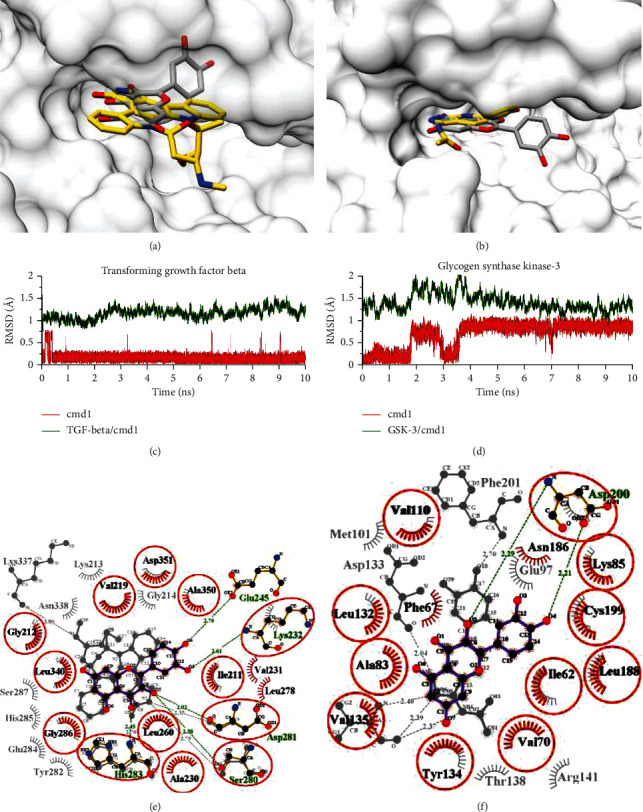
Convolvulus arvensis L. is rich in phenolic compounds and traditionally used to treat wounds, skin ulcer, and inflammation. The current study is aimed at scientifically potentiating its traditional wound healing use. The methanolic extract of C. arvensis stem (CaME) was analyzed for HPLC and GC-MS analyses. The binding modes of active compounds were investigated against protein targets glycogen synthase kinase-3β (GSK-3β), transforming growth factor-beta (TGF-β), c-myc, and β-catenin by molecular docking followed by molecular dynamic simulations which revealed some conserved mode of binding as reported in crystal structures. The antioxidant potential of CaME was evaluated by in vitro methods such as 2,2-diphenyl-1-picrylhydrazyl (DPPH) radical scavenging, hydrogen peroxide scavenging, and ferric reducing power assays. Ointment formulations of 10 and 20% CaME were applied topically and evaluated for wound healing potency against the excisional wound on the skin of Wistar rats. Gentamycin (0.1%) served as standard therapy. The healing process was observed for 20 days in the form of wound size and epithelialization followed by histopathological evaluation of the wound area. Chemical characterization showed the presence of 7-hexadecenoic acid, 2-hexadecylicosan-1-ol, quercetin, gallic acid, ferulic acid, and other compounds. The plant extract exhibited significant in vitro antioxidant activity. The animals treated with 10% ointment showed moderate healing, whereas the treatment with 20% CaME revealed healing potential comparable to the standard 0.1% gentamycin as coevidenced from histopathological evaluation of skin. The study corroborates promising potential of C. arvensis on the healing of wounds, which possibly will be attributed to its antioxidant activity, fatty acids, quercetin, and gallic and caffeic acids, and binding potential of its phytoconstituents (phenolic acids) with wound healing targets.
期刊介绍:
BioMed Research International is a peer-reviewed, Open Access journal that publishes original research articles, review articles, and clinical studies covering a wide range of subjects in life sciences and medicine. The journal is divided into 55 subject areas.





 京公网安备 11010802042870号
京ICP备2023020795号-1
京公网安备 11010802042870号
京ICP备2023020795号-1

 分享
分享
 求助内容:
求助内容: 应助结果提醒方式:
 扫码关注我们
