Khadijah M Al-Zaydi, Hosam H Khalil, Ayman El-Faham, Sherine N Khattab
{"title":"Synthesis, characterization and evaluation of 1,3,5-triazine aminobenzoic acid derivatives for their antimicrobial activity.","authors":"Khadijah M Al-Zaydi, Hosam H Khalil, Ayman El-Faham, Sherine N Khattab","doi":"10.1186/s13065-017-0267-3","DOIUrl":null,"url":null,"abstract":"<p><strong>Background: </strong>Replacement of chloride ions in cyanuric chloride give several variants of 1,3,5-triazine derivatives which were investigated as biologically active small molecules. These compounds exhibit antimalarial, antimicrobial, anti-cancer and anti-viral activities, among other beneficial properties. On the other hand, treatment of bacterial infections remains a challenging therapeutic problem because of the emerging infectious diseases and the increasing number of multidrug-resistant microbial pathogens. As multidrug-resistant bacterial strains proliferate, the necessity for effective therapy has stimulated research into the design and synthesis of novel antimicrobial molecules.</p><p><strong>Results: </strong>1,3,5-Triazine 4-aminobenzoic acid derivatives were prepared by conventional method or by using microwave irradiation. Using microwave irradiation gave the desired products in less time, good yield and higher purity. Esterification of the 4-aminobenzoic acid moiety afforded methyl ester analogues. The s-triazine derivatives and their methyl ester analogues were fully characterized by FT-IR, NMR (<sup>1</sup>H-NMR and <sup>13</sup>C-NMR), mass spectra and elemental analysis. All the synthesized compounds were evaluated for their antimicrobial activity. Some tested compounds showed promising activity against Staphylococcus aureus and Escherichia coli.</p><p><strong>Conclusions: </strong>Three series of mono-, di- and trisubstituted s-triazine derivatives and their methyl ester analogues were synthesized and fully characterized. All the synthesized compounds were evaluated for their antimicrobial activity. Compounds (10), (16), (25) and (30) have antimicrobial activity against S. aureus comparable to that of ampicillin, while the activity of compound (13) is about 50% of that of ampicillin. Compounds (13) and (14) have antimicrobial activity against E. coli comparable to that of ampicillin, while the activity of compounds (9-12) and (15) is about 50% of that of ampicillin. Furthermore, minimum inhibitory concentrations values for clinical isolates of compounds (10), (13), (14), (16), (25) and (30) were measured. Compounds (10) and (13) were more active against MRSA and E. coli than ampicillin. Invitro cytotoxicity results revealed that compounds (10) and (13) were nontoxic up to 250 µg/mL (with SI = 10) and 125 µg/mL (with SI = 5), respectively. Graphical abstract Three series of mono-, di- and trisubstituted s-triazine derivatives and their methyl ester analogues were synthesized and evaluated for their antimicrobial activity. Several compounds have antimicrobial activity against S. aureus and E. coli comparable to that of ampicillin.</p>","PeriodicalId":9842,"journal":{"name":"Chemistry Central Journal","volume":"11 1","pages":"39"},"PeriodicalIF":0.0000,"publicationDate":"2017-05-10","publicationTypes":"Journal Article","fieldsOfStudy":null,"isOpenAccess":false,"openAccessPdf":"https://sci-hub-pdf.com/10.1186/s13065-017-0267-3","citationCount":"26","resultStr":null,"platform":"Semanticscholar","paperid":null,"PeriodicalName":"Chemistry Central Journal","FirstCategoryId":"1085","ListUrlMain":"https://doi.org/10.1186/s13065-017-0267-3","RegionNum":0,"RegionCategory":null,"ArticlePicture":[],"TitleCN":null,"AbstractTextCN":null,"PMCID":null,"EPubDate":"","PubModel":"","JCR":"Q1","JCRName":"Chemistry","Score":null,"Total":0}
引用次数: 26
Abstract
Background: Replacement of chloride ions in cyanuric chloride give several variants of 1,3,5-triazine derivatives which were investigated as biologically active small molecules. These compounds exhibit antimalarial, antimicrobial, anti-cancer and anti-viral activities, among other beneficial properties. On the other hand, treatment of bacterial infections remains a challenging therapeutic problem because of the emerging infectious diseases and the increasing number of multidrug-resistant microbial pathogens. As multidrug-resistant bacterial strains proliferate, the necessity for effective therapy has stimulated research into the design and synthesis of novel antimicrobial molecules.
Results: 1,3,5-Triazine 4-aminobenzoic acid derivatives were prepared by conventional method or by using microwave irradiation. Using microwave irradiation gave the desired products in less time, good yield and higher purity. Esterification of the 4-aminobenzoic acid moiety afforded methyl ester analogues. The s-triazine derivatives and their methyl ester analogues were fully characterized by FT-IR, NMR (1H-NMR and 13C-NMR), mass spectra and elemental analysis. All the synthesized compounds were evaluated for their antimicrobial activity. Some tested compounds showed promising activity against Staphylococcus aureus and Escherichia coli.
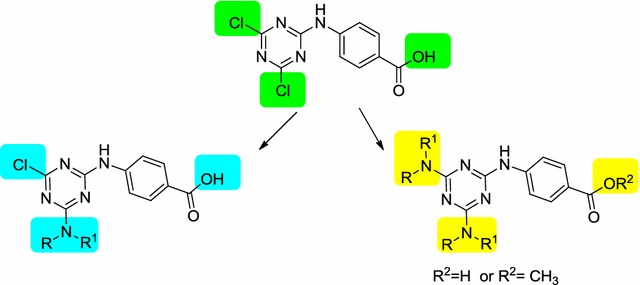
Conclusions: Three series of mono-, di- and trisubstituted s-triazine derivatives and their methyl ester analogues were synthesized and fully characterized. All the synthesized compounds were evaluated for their antimicrobial activity. Compounds (10), (16), (25) and (30) have antimicrobial activity against S. aureus comparable to that of ampicillin, while the activity of compound (13) is about 50% of that of ampicillin. Compounds (13) and (14) have antimicrobial activity against E. coli comparable to that of ampicillin, while the activity of compounds (9-12) and (15) is about 50% of that of ampicillin. Furthermore, minimum inhibitory concentrations values for clinical isolates of compounds (10), (13), (14), (16), (25) and (30) were measured. Compounds (10) and (13) were more active against MRSA and E. coli than ampicillin. Invitro cytotoxicity results revealed that compounds (10) and (13) were nontoxic up to 250 µg/mL (with SI = 10) and 125 µg/mL (with SI = 5), respectively. Graphical abstract Three series of mono-, di- and trisubstituted s-triazine derivatives and their methyl ester analogues were synthesized and evaluated for their antimicrobial activity. Several compounds have antimicrobial activity against S. aureus and E. coli comparable to that of ampicillin.
期刊介绍:
BMC Chemistry is an open access, peer reviewed journal that considers all articles in the broad field of chemistry, including research on fundamental concepts, new developments and the application of chemical sciences to broad range of research fields, industry, and other disciplines. It provides an inclusive platform for the dissemination and discussion of chemistry to aid the advancement of all areas of research.
Sections:
-Analytical Chemistry
-Organic Chemistry
-Environmental and Energy Chemistry
-Agricultural and Food Chemistry
-Inorganic Chemistry
-Medicinal Chemistry
-Physical Chemistry
-Materials and Macromolecular Chemistry
-Green and Sustainable Chemistry




 京公网安备 11010802042870号
京ICP备2023020795号-1
京公网安备 11010802042870号
京ICP备2023020795号-1

 分享
分享
 求助内容:
求助内容: 应助结果提醒方式:
 扫码关注我们
