Tian-Shin Yeh, Yu-Chun Ho, Cherng-Lan Hsu, Shin-Liang Pan
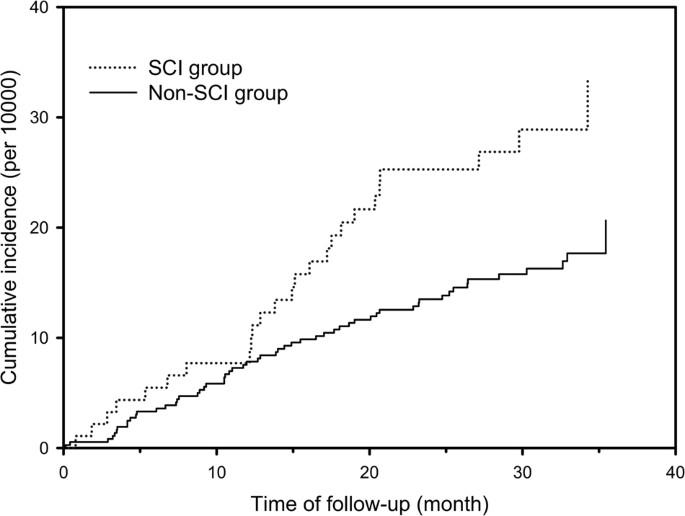
{"title":"Spinal cord injury and Alzheimer’s disease risk: a population-based, retrospective cohort study","authors":"Tian-Shin Yeh, Yu-Chun Ho, Cherng-Lan Hsu, Shin-Liang Pan","doi":"10.1038/s41393-017-0009-3","DOIUrl":null,"url":null,"abstract":"Propensity score-matched, retrospective cohort study. To determine the risk of developing Alzheimer’s disease (AD) in patients with spinal cord injury (SCI). The present study used Taiwan’s National Health Insurance Research Database. A total of 9257 patients who had ⩾2 ambulatory visits with a diagnosis of SCI in 2001 were included in the SCI group. The non-SCI group consisted of 37,028 propensity score-matched patients without a diagnosis of SCI. The cumulative incidence of AD was estimated for each of the two patient groups using the Kaplan–Meier method. Stratified Cox proportional hazard regression was then employed to assess the influence of SCI on the risk of AD. During the follow-up period, 25 subjects in the SCI group and 57 in the non-SCI group developed AD. The cumulative incidence of AD in the SCI group was higher than in the non-SCI group (P = 0.0168); and the hazard ratio of AD for the SCI group, as compared to the non-SCI group, was 1.71 (95% CI 1.06–2.76, P = 0.0273). This study suggests that patients with SCI have an increased risk of developing AD.","PeriodicalId":21976,"journal":{"name":"Spinal cord","volume":"56 2","pages":"151-157"},"PeriodicalIF":2.2000,"publicationDate":"2017-10-23","publicationTypes":"Journal Article","fieldsOfStudy":null,"isOpenAccess":false,"openAccessPdf":"https://sci-hub-pdf.com/10.1038/s41393-017-0009-3","citationCount":"17","resultStr":null,"platform":"Semanticscholar","paperid":null,"PeriodicalName":"Spinal cord","FirstCategoryId":"3","ListUrlMain":"https://www.nature.com/articles/s41393-017-0009-3","RegionNum":4,"RegionCategory":"医学","ArticlePicture":[],"TitleCN":null,"AbstractTextCN":null,"PMCID":null,"EPubDate":"","PubModel":"","JCR":"Q3","JCRName":"CLINICAL NEUROLOGY","Score":null,"Total":0}
引用次数: 17
Abstract
Propensity score-matched, retrospective cohort study. To determine the risk of developing Alzheimer’s disease (AD) in patients with spinal cord injury (SCI). The present study used Taiwan’s National Health Insurance Research Database. A total of 9257 patients who had ⩾2 ambulatory visits with a diagnosis of SCI in 2001 were included in the SCI group. The non-SCI group consisted of 37,028 propensity score-matched patients without a diagnosis of SCI. The cumulative incidence of AD was estimated for each of the two patient groups using the Kaplan–Meier method. Stratified Cox proportional hazard regression was then employed to assess the influence of SCI on the risk of AD. During the follow-up period, 25 subjects in the SCI group and 57 in the non-SCI group developed AD. The cumulative incidence of AD in the SCI group was higher than in the non-SCI group (P = 0.0168); and the hazard ratio of AD for the SCI group, as compared to the non-SCI group, was 1.71 (95% CI 1.06–2.76, P = 0.0273). This study suggests that patients with SCI have an increased risk of developing AD.
期刊介绍:
Spinal Cord is a specialised, international journal that has been publishing spinal cord related manuscripts since 1963. It appears monthly, online and in print, and accepts contributions on spinal cord anatomy, physiology, management of injury and disease, and the quality of life and life circumstances of people with a spinal cord injury. Spinal Cord is multi-disciplinary and publishes contributions across the entire spectrum of research ranging from basic science to applied clinical research. It focuses on high quality original research, systematic reviews and narrative reviews.
Spinal Cord''s sister journal Spinal Cord Series and Cases: Clinical Management in Spinal Cord Disorders publishes high quality case reports, small case series, pilot and retrospective studies perspectives, Pulse survey articles, Point-couterpoint articles, correspondences and book reviews. It specialises in material that addresses all aspects of life for persons with spinal cord injuries or disorders. For more information, please see the aims and scope of Spinal Cord Series and Cases.



 京公网安备 11010802042870号
京ICP备2023020795号-1
京公网安备 11010802042870号
京ICP备2023020795号-1

 分享
分享
 求助内容:
求助内容: 应助结果提醒方式:
 扫码关注我们
