{"title":"Quantum ensembles of quantum classifiers.","authors":"Maria Schuld, Francesco Petruccione","doi":"10.1038/s41598-018-20403-3","DOIUrl":null,"url":null,"abstract":"<p><p>Quantum machine learning witnesses an increasing amount of quantum algorithms for data-driven decision making, a problem with potential applications ranging from automated image recognition to medical diagnosis. Many of those algorithms are implementations of quantum classifiers, or models for the classification of data inputs with a quantum computer. Following the success of collective decision making with ensembles in classical machine learning, this paper introduces the concept of quantum ensembles of quantum classifiers. Creating the ensemble corresponds to a state preparation routine, after which the quantum classifiers are evaluated in parallel and their combined decision is accessed by a single-qubit measurement. This framework naturally allows for exponentially large ensembles in which - similar to Bayesian learning - the individual classifiers do not have to be trained. As an example, we analyse an exponentially large quantum ensemble in which each classifier is weighed according to its performance in classifying the training data, leading to new results for quantum as well as classical machine learning.</p>","PeriodicalId":3,"journal":{"name":"ACS Applied Electronic Materials","volume":" ","pages":"2772"},"PeriodicalIF":4.7000,"publicationDate":"2018-02-09","publicationTypes":"Journal Article","fieldsOfStudy":null,"isOpenAccess":false,"openAccessPdf":"https://www.ncbi.nlm.nih.gov/pmc/articles/PMC5807322/pdf/","citationCount":"0","resultStr":null,"platform":"Semanticscholar","paperid":null,"PeriodicalName":"ACS Applied Electronic Materials","FirstCategoryId":"103","ListUrlMain":"https://doi.org/10.1038/s41598-018-20403-3","RegionNum":3,"RegionCategory":"材料科学","ArticlePicture":[],"TitleCN":null,"AbstractTextCN":null,"PMCID":null,"EPubDate":"","PubModel":"","JCR":"Q1","JCRName":"ENGINEERING, ELECTRICAL & ELECTRONIC","Score":null,"Total":0}
引用次数: 0
Abstract
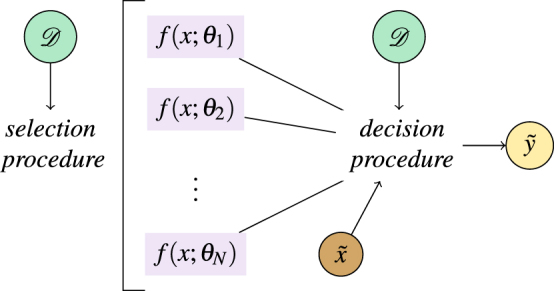
Quantum machine learning witnesses an increasing amount of quantum algorithms for data-driven decision making, a problem with potential applications ranging from automated image recognition to medical diagnosis. Many of those algorithms are implementations of quantum classifiers, or models for the classification of data inputs with a quantum computer. Following the success of collective decision making with ensembles in classical machine learning, this paper introduces the concept of quantum ensembles of quantum classifiers. Creating the ensemble corresponds to a state preparation routine, after which the quantum classifiers are evaluated in parallel and their combined decision is accessed by a single-qubit measurement. This framework naturally allows for exponentially large ensembles in which - similar to Bayesian learning - the individual classifiers do not have to be trained. As an example, we analyse an exponentially large quantum ensemble in which each classifier is weighed according to its performance in classifying the training data, leading to new results for quantum as well as classical machine learning.
期刊介绍:
ACS Applied Electronic Materials is an interdisciplinary journal publishing original research covering all aspects of electronic materials. The journal is devoted to reports of new and original experimental and theoretical research of an applied nature that integrate knowledge in the areas of materials science, engineering, optics, physics, and chemistry into important applications of electronic materials. Sample research topics that span the journal's scope are inorganic, organic, ionic and polymeric materials with properties that include conducting, semiconducting, superconducting, insulating, dielectric, magnetic, optoelectronic, piezoelectric, ferroelectric and thermoelectric.
Indexed/Abstracted:
Web of Science SCIE
Scopus
CAS
INSPEC
Portico





 京公网安备 11010802042870号
京ICP备2023020795号-1
京公网安备 11010802042870号
京ICP备2023020795号-1

 分享
分享
 求助内容:
求助内容: 应助结果提醒方式:
 扫码关注我们
