Xiaowen Liu, Thuy Vien, Jingjing Duan, Shu-Hsien Sheu, Paul G DeCaen, David E Clapham
{"title":"Polycystin-2 is an essential ion channel subunit in the primary cilium of the renal collecting duct epithelium.","authors":"Xiaowen Liu, Thuy Vien, Jingjing Duan, Shu-Hsien Sheu, Paul G DeCaen, David E Clapham","doi":"10.7554/eLife.33183","DOIUrl":null,"url":null,"abstract":"<p><p>Mutations in the polycystin genes, <i>PKD1</i> or <i>PKD2,</i> results in Autosomal Dominant Polycystic Kidney Disease (ADPKD). Although a genetic basis of ADPKD is established, we lack a clear understanding of polycystin proteins' functions as ion channels. This question remains unsolved largely because polycystins localize to the primary cilium - a tiny, antenna-like organelle. Using a new ADPKD mouse model, we observe primary cilia that are abnormally long in cells associated with cysts after conditional ablation of <i>Pkd1</i> or <i>Pkd2</i>. Using primary cultures of collecting duct cells, we show that polycystin-2, but not polycystin-1, is a required subunit for the ion channel in the primary cilium. The polycystin-2 channel preferentially conducts K<sup>+</sup> and Na<sup>+</sup>; intraciliary Ca<sup>2+</sup>, enhances its open probability. We introduce a novel method for measuring heterologous polycystin-2 channels in cilia, which will have utility in characterizing <i>PKD2</i> variants that cause ADPKD.</p>","PeriodicalId":11640,"journal":{"name":"eLife","volume":" ","pages":""},"PeriodicalIF":6.4000,"publicationDate":"2018-02-14","publicationTypes":"Journal Article","fieldsOfStudy":null,"isOpenAccess":false,"openAccessPdf":"https://sci-hub-pdf.com/10.7554/eLife.33183","citationCount":"100","resultStr":null,"platform":"Semanticscholar","paperid":null,"PeriodicalName":"eLife","FirstCategoryId":"99","ListUrlMain":"https://doi.org/10.7554/eLife.33183","RegionNum":1,"RegionCategory":"生物学","ArticlePicture":[],"TitleCN":null,"AbstractTextCN":null,"PMCID":null,"EPubDate":"","PubModel":"","JCR":"Q1","JCRName":"BIOLOGY","Score":null,"Total":0}
引用次数: 100
Abstract
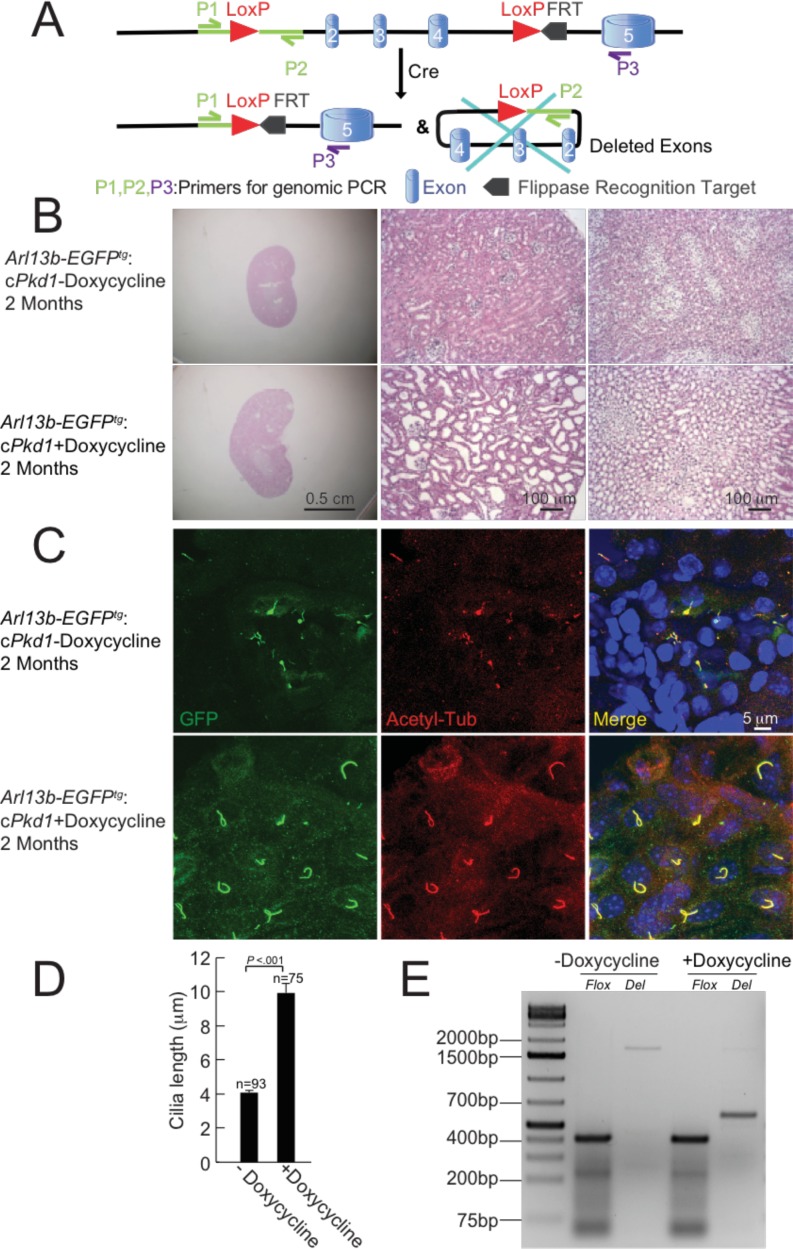
Mutations in the polycystin genes, PKD1 or PKD2, results in Autosomal Dominant Polycystic Kidney Disease (ADPKD). Although a genetic basis of ADPKD is established, we lack a clear understanding of polycystin proteins' functions as ion channels. This question remains unsolved largely because polycystins localize to the primary cilium - a tiny, antenna-like organelle. Using a new ADPKD mouse model, we observe primary cilia that are abnormally long in cells associated with cysts after conditional ablation of Pkd1 or Pkd2. Using primary cultures of collecting duct cells, we show that polycystin-2, but not polycystin-1, is a required subunit for the ion channel in the primary cilium. The polycystin-2 channel preferentially conducts K+ and Na+; intraciliary Ca2+, enhances its open probability. We introduce a novel method for measuring heterologous polycystin-2 channels in cilia, which will have utility in characterizing PKD2 variants that cause ADPKD.
期刊介绍:
eLife is a distinguished, not-for-profit, peer-reviewed open access scientific journal that specializes in the fields of biomedical and life sciences. eLife is known for its selective publication process, which includes a variety of article types such as:
Research Articles: Detailed reports of original research findings.
Short Reports: Concise presentations of significant findings that do not warrant a full-length research article.
Tools and Resources: Descriptions of new tools, technologies, or resources that facilitate scientific research.
Research Advances: Brief reports on significant scientific advancements that have immediate implications for the field.
Scientific Correspondence: Short communications that comment on or provide additional information related to published articles.
Review Articles: Comprehensive overviews of a specific topic or field within the life sciences.





 京公网安备 11010802042870号
京ICP备2023020795号-1
京公网安备 11010802042870号
京ICP备2023020795号-1

 分享
分享
 求助内容:
求助内容: 应助结果提醒方式:
 扫码关注我们
