{"title":"Cu(II) Complexes of 4-[(1<i>E</i>)-<i>N</i>-{2-[(<i>Z</i>)-Benzylidene-amino]ethyl}ethanimidoyl]benzene-1,3-diol Schiff Base: Synthesis, Spectroscopic, In-Vitro Antioxidant, Antifungal and Antibacterial Studies.","authors":"Ikechukwu P Ejidike","doi":"10.3390/molecules23071581","DOIUrl":null,"url":null,"abstract":"<p><p>The current study reports the synthesis of copper complexes of a tridentate Schiff base ligand. The compounds of the type [Cu(L)X]∙n(H₂O) (where L = tridentate ONN Schiff base ligand, X = Cl<sup>−</sup>, Br<sup>−</sup>, SCN<sup>−</sup>, NO₃<sup>−</sup>, CH₃COO<sup>−</sup>), were characterized on the basis of elemental analyses, FT-IR, UV-vis, molar conductance, ¹H-NMR, XRD and thermal analyses. The spectra revealed that the Schiff base ligand acts as a tridentate ligand through two azomethine nitrogen atoms and a phenolic oxygen atom. The molar conductance measurements of the complexes in DMF correspond to non-electrolytic nature. TGA and DTA studies results gave insight into the dehydration, thermal stability, and thermal decomposition. Square-planar geometry has been assigned to the prepared complexes as indicated by the electronic spectral measurements. Cu(II) compounds showed antiradical potential against DPPH and ABTS radicals. The antimicrobial potential of the Schiff base ligand and its Cu(II) complexes were evaluated by the rapid <i>p</i>-iodonitrotetrazolium chloride (INT) colorimetric assay against some selected bacteria strains: <i>Staphylococcus aureus</i> and <i>Enterococcus faecalis</i> (Gram +ve); <i>Klebsiella pneumoniae</i> and <i>Pseudomonas aeruginosa</i> (Gram −ve), and fungi (<i>Candida albicans</i> and <i>Cryptococcus neoformans</i>). The compounds showed a broad spectrum of antibacterial and antifungal activities, with MIC values ranging from 48.83 to 3125 μg/mL.</p>","PeriodicalId":19041,"journal":{"name":"Molecules","volume":"23 7","pages":""},"PeriodicalIF":4.6000,"publicationDate":"2018-06-29","publicationTypes":"Journal Article","fieldsOfStudy":null,"isOpenAccess":false,"openAccessPdf":"https://sci-hub-pdf.com/10.3390/molecules23071581","citationCount":"32","resultStr":null,"platform":"Semanticscholar","paperid":null,"PeriodicalName":"Molecules","FirstCategoryId":"92","ListUrlMain":"https://doi.org/10.3390/molecules23071581","RegionNum":2,"RegionCategory":"化学","ArticlePicture":[],"TitleCN":null,"AbstractTextCN":null,"PMCID":null,"EPubDate":"","PubModel":"","JCR":"Q2","JCRName":"BIOCHEMISTRY & MOLECULAR BIOLOGY","Score":null,"Total":0}
引用次数: 32
Abstract
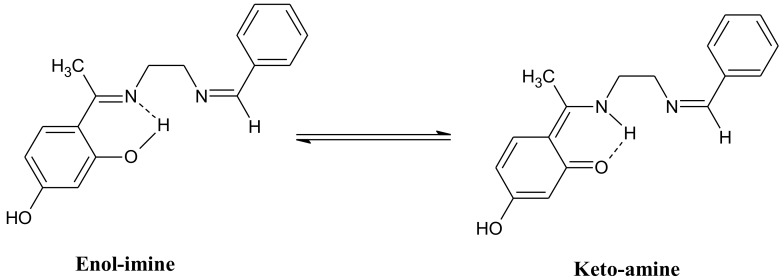
The current study reports the synthesis of copper complexes of a tridentate Schiff base ligand. The compounds of the type [Cu(L)X]∙n(H₂O) (where L = tridentate ONN Schiff base ligand, X = Cl−, Br−, SCN−, NO₃−, CH₃COO−), were characterized on the basis of elemental analyses, FT-IR, UV-vis, molar conductance, ¹H-NMR, XRD and thermal analyses. The spectra revealed that the Schiff base ligand acts as a tridentate ligand through two azomethine nitrogen atoms and a phenolic oxygen atom. The molar conductance measurements of the complexes in DMF correspond to non-electrolytic nature. TGA and DTA studies results gave insight into the dehydration, thermal stability, and thermal decomposition. Square-planar geometry has been assigned to the prepared complexes as indicated by the electronic spectral measurements. Cu(II) compounds showed antiradical potential against DPPH and ABTS radicals. The antimicrobial potential of the Schiff base ligand and its Cu(II) complexes were evaluated by the rapid p-iodonitrotetrazolium chloride (INT) colorimetric assay against some selected bacteria strains: Staphylococcus aureus and Enterococcus faecalis (Gram +ve); Klebsiella pneumoniae and Pseudomonas aeruginosa (Gram −ve), and fungi (Candida albicans and Cryptococcus neoformans). The compounds showed a broad spectrum of antibacterial and antifungal activities, with MIC values ranging from 48.83 to 3125 μg/mL.
期刊介绍:
Molecules (ISSN 1420-3049, CODEN: MOLEFW) is an open access journal of synthetic organic chemistry and natural product chemistry. All articles are peer-reviewed and published continously upon acceptance. Molecules is published by MDPI, Basel, Switzerland. Our aim is to encourage chemists to publish as much as possible their experimental detail, particularly synthetic procedures and characterization information. There is no restriction on the length of the experimental section. In addition, availability of compound samples is published and considered as important information. Authors are encouraged to register or deposit their chemical samples through the non-profit international organization Molecular Diversity Preservation International (MDPI). Molecules has been launched in 1996 to preserve and exploit molecular diversity of both, chemical information and chemical substances.





 京公网安备 11010802042870号
京ICP备2023020795号-1
京公网安备 11010802042870号
京ICP备2023020795号-1

 分享
分享
 求助内容:
求助内容: 应助结果提醒方式:
 扫码关注我们
