Young-Jo Kim, Hye-Jin Moon, Soo-Kyoung Lee, Bo-Ra Song, Jong-Soo Lim, Eun-Jeong Heo, Hyun-Jung Park, Sung-Hwan Wee, Jin-San Moon
{"title":"Development and Validation of Predictive Model for <i>Salmonella</i> Growth in Unpasteurized Liquid Eggs.","authors":"Young-Jo Kim, Hye-Jin Moon, Soo-Kyoung Lee, Bo-Ra Song, Jong-Soo Lim, Eun-Jeong Heo, Hyun-Jung Park, Sung-Hwan Wee, Jin-San Moon","doi":"10.5851/kosfa.2018.38.3.442","DOIUrl":null,"url":null,"abstract":"<p><p>Liquid egg products can be contaminated with <i>Salmonella</i> spp. during processing. A predictive model for the growth of <i>Salmonella</i> spp. in unpasteurized liquid eggs was developed and validated. Liquid whole egg, liquid yolk, and liquid egg white samples were prepared and inoculated with <i>Salmonella</i> mixture (approximately 3 Log CFU/mL) containing five serovars (<i>S.</i> Bareilly, <i>S.</i> Richmond, <i>S.</i> Typhimurium monophasic, <i>S</i>. Enteritidis, and <i>S</i>. Gallinarum). <i>Salmonella</i> growth data at isothermal temperatures (5, 10, 15, 20, 25, 30, 35, and 40°C) was collected by 960 h. The population of <i>Salmonella</i> in liquid whole egg and egg yolk increased at above 10°C, while <i>Salmonella</i> in egg white did not proliferate at all temperature. These results demonstrate that there is a difference in the growth of <i>Salmonella</i> depending on the types of liquid eggs (egg yolk, egg white, liquid whole egg) and storage temperature. To fit the growth data of <i>Salmonella</i> in liquid whole egg and egg yolk, Baranyi model was used as the primary model and the maximum growth rate and lag phase duration for each temperature were determined. A secondary model was developed with maximum growth rate as a function of temperature. The model performance measures, bias factor (B <sub><i>f</i></sub> , 0.96-0.99) and r<sup>2</sup> (0.96-0.99) indicated good fit for both primary and secondary models. In conclusion, it is thought that the growth model can be used usefully to predict <i>Salmonella</i> spp. growth in various types of unpasteurized liquid eggs when those are exposed to various temperature and time conditions during the processing.</p>","PeriodicalId":17915,"journal":{"name":"Korean Journal for Food Science of Animal Resources","volume":"38 3","pages":"442-450"},"PeriodicalIF":0.0000,"publicationDate":"2018-07-01","publicationTypes":"Journal Article","fieldsOfStudy":null,"isOpenAccess":false,"openAccessPdf":"https://ftp.ncbi.nlm.nih.gov/pub/pmc/oa_pdf/2a/65/kosfa-38-3-442.PMC6048364.pdf","citationCount":"1","resultStr":null,"platform":"Semanticscholar","paperid":null,"PeriodicalName":"Korean Journal for Food Science of Animal Resources","FirstCategoryId":"1085","ListUrlMain":"https://doi.org/10.5851/kosfa.2018.38.3.442","RegionNum":0,"RegionCategory":null,"ArticlePicture":[],"TitleCN":null,"AbstractTextCN":null,"PMCID":null,"EPubDate":"2018/7/31 0:00:00","PubModel":"Epub","JCR":"Q2","JCRName":"Agricultural and Biological Sciences","Score":null,"Total":0}
引用次数: 1
Abstract
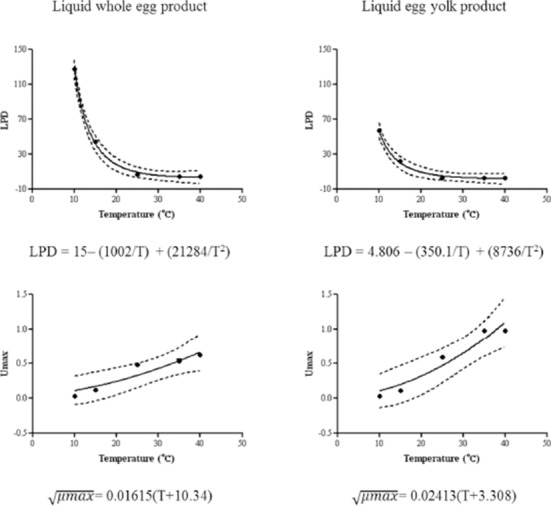
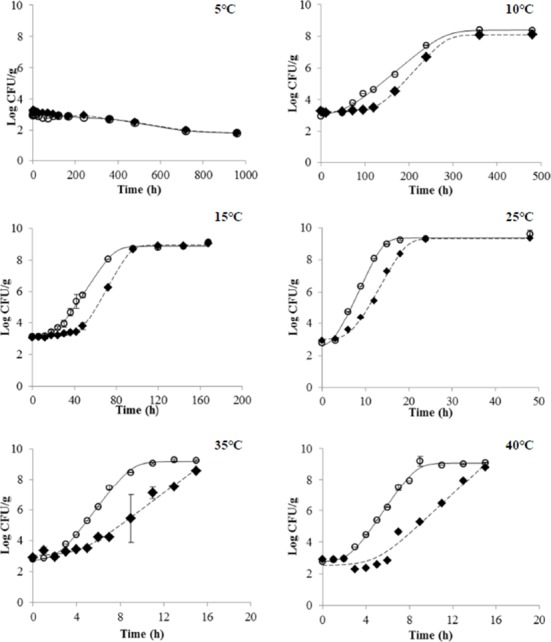
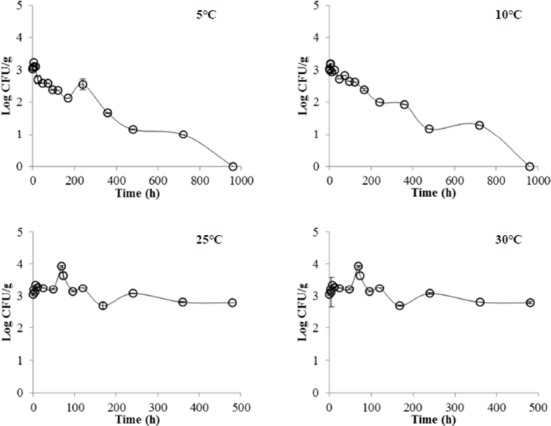
Liquid egg products can be contaminated with Salmonella spp. during processing. A predictive model for the growth of Salmonella spp. in unpasteurized liquid eggs was developed and validated. Liquid whole egg, liquid yolk, and liquid egg white samples were prepared and inoculated with Salmonella mixture (approximately 3 Log CFU/mL) containing five serovars (S. Bareilly, S. Richmond, S. Typhimurium monophasic, S. Enteritidis, and S. Gallinarum). Salmonella growth data at isothermal temperatures (5, 10, 15, 20, 25, 30, 35, and 40°C) was collected by 960 h. The population of Salmonella in liquid whole egg and egg yolk increased at above 10°C, while Salmonella in egg white did not proliferate at all temperature. These results demonstrate that there is a difference in the growth of Salmonella depending on the types of liquid eggs (egg yolk, egg white, liquid whole egg) and storage temperature. To fit the growth data of Salmonella in liquid whole egg and egg yolk, Baranyi model was used as the primary model and the maximum growth rate and lag phase duration for each temperature were determined. A secondary model was developed with maximum growth rate as a function of temperature. The model performance measures, bias factor (B f , 0.96-0.99) and r2 (0.96-0.99) indicated good fit for both primary and secondary models. In conclusion, it is thought that the growth model can be used usefully to predict Salmonella spp. growth in various types of unpasteurized liquid eggs when those are exposed to various temperature and time conditions during the processing.



 京公网安备 11010802042870号
京ICP备2023020795号-1
京公网安备 11010802042870号
京ICP备2023020795号-1

 分享
分享
 求助内容:
求助内容: 应助结果提醒方式:
 扫码关注我们
