{"title":"The effects of <i>Brassica juncea</i> L. leaf extract on obesity and lipid profiles of rats fed a high-fat/high-cholesterol diet.","authors":"Jae-Joon Lee, Hyun A Kim, Joomin Lee","doi":"10.4162/nrp.2018.12.4.298","DOIUrl":null,"url":null,"abstract":"<p><strong>Background/objectives: </strong>Obesity is a global health problem of significant importance which increases mortality. In place of anti-obesity drugs, natural products are being developed as alternative therapeutic materials. In this study, we investigated the effect of <i>Brassica juncea</i> L. leaf extract (BLE) on fat deposition and lipid profiles in high-fat, high-cholesterol diet (HFC)-induced obese rats.</p><p><strong>Materials/methods: </strong>Male Sprague-Dawley rats were divided into four groups (n = 8 per group) according to diet: normal diet group (ND), high-fat/high-cholesterol diet group (HFC), HFC with 3% BLE diet group (HFC-A1), and HFC with 5% BLE diet group (HFC-A2). Each group was fed for 6 weeks. Rat body and adipose tissue weights, serum biochemical parameters, and tissue lipid contents were determined. The expression levels of mRNA and proteins involved in lipid and cholesterol metabolism were determined by reverse transcription polymerase chain reaction and western blot analysis, respectively.</p><p><strong>Results: </strong>The HFC-A2 group showed significantly lower body weight gain and food efficiency ratio than the HFC group. BLE supplementation caused mesenteric, epididymal, and total adipose tissue weights to decrease. The serum levels of triglyceride, total cholesterol, and low-density lipoprotein cholesterol were significantly reduced, and high-density lipoprotein cholesterol was significantly increased in rats fed BLE. These results were related to lower glucose-6-phosphate dehydrogenase, acetyl-coA carboxylase, and fatty acid synthase mRNA expression, and to higher expression of the cholesterol 7α-hydroxylase and low density lipoprotein-receptor, as well as increased protein levels of peroxisome proliferator-activated receptor α. Histological analysis of the liver revealed decreased lipid droplets in HFC rats treated with BLE.</p><p><strong>Conclusions: </strong>Supplementation of HFC with 3% or 5% BLE inhibited body fat accumulation, improved lipid profiles, and modulated lipogenesis- and cholesterol metabolism-related gene and protein expression.</p>","PeriodicalId":19232,"journal":{"name":"Nutrition Research and Practice","volume":"12 4","pages":"298-306"},"PeriodicalIF":1.5000,"publicationDate":"2018-08-01","publicationTypes":"Journal Article","fieldsOfStudy":null,"isOpenAccess":false,"openAccessPdf":"https://sci-hub-pdf.com/10.4162/nrp.2018.12.4.298","citationCount":"12","resultStr":null,"platform":"Semanticscholar","paperid":null,"PeriodicalName":"Nutrition Research and Practice","FirstCategoryId":"3","ListUrlMain":"https://doi.org/10.4162/nrp.2018.12.4.298","RegionNum":4,"RegionCategory":"医学","ArticlePicture":[],"TitleCN":null,"AbstractTextCN":null,"PMCID":null,"EPubDate":"2018/7/18 0:00:00","PubModel":"Epub","JCR":"Q3","JCRName":"NUTRITION & DIETETICS","Score":null,"Total":0}
引用次数: 12
Abstract
Background/objectives: Obesity is a global health problem of significant importance which increases mortality. In place of anti-obesity drugs, natural products are being developed as alternative therapeutic materials. In this study, we investigated the effect of Brassica juncea L. leaf extract (BLE) on fat deposition and lipid profiles in high-fat, high-cholesterol diet (HFC)-induced obese rats.
Materials/methods: Male Sprague-Dawley rats were divided into four groups (n = 8 per group) according to diet: normal diet group (ND), high-fat/high-cholesterol diet group (HFC), HFC with 3% BLE diet group (HFC-A1), and HFC with 5% BLE diet group (HFC-A2). Each group was fed for 6 weeks. Rat body and adipose tissue weights, serum biochemical parameters, and tissue lipid contents were determined. The expression levels of mRNA and proteins involved in lipid and cholesterol metabolism were determined by reverse transcription polymerase chain reaction and western blot analysis, respectively.
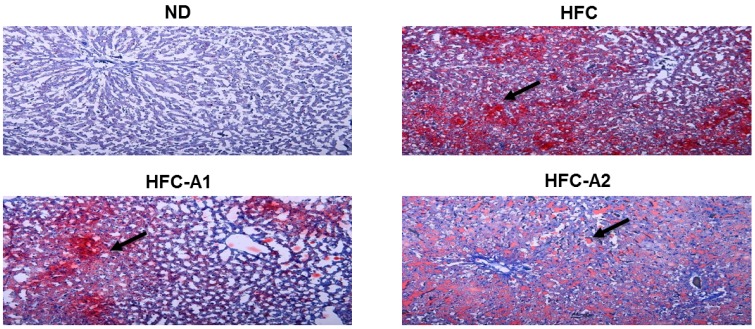
Results: The HFC-A2 group showed significantly lower body weight gain and food efficiency ratio than the HFC group. BLE supplementation caused mesenteric, epididymal, and total adipose tissue weights to decrease. The serum levels of triglyceride, total cholesterol, and low-density lipoprotein cholesterol were significantly reduced, and high-density lipoprotein cholesterol was significantly increased in rats fed BLE. These results were related to lower glucose-6-phosphate dehydrogenase, acetyl-coA carboxylase, and fatty acid synthase mRNA expression, and to higher expression of the cholesterol 7α-hydroxylase and low density lipoprotein-receptor, as well as increased protein levels of peroxisome proliferator-activated receptor α. Histological analysis of the liver revealed decreased lipid droplets in HFC rats treated with BLE.
Conclusions: Supplementation of HFC with 3% or 5% BLE inhibited body fat accumulation, improved lipid profiles, and modulated lipogenesis- and cholesterol metabolism-related gene and protein expression.
期刊介绍:
Nutrition Research and Practice (NRP) is an official journal, jointly published by the Korean Nutrition Society and the Korean Society of Community Nutrition since 2007. The journal had been published quarterly at the initial stage and has been published bimonthly since 2010.
NRP aims to stimulate research and practice across diverse areas of human nutrition. The Journal publishes peer-reviewed original manuscripts on nutrition biochemistry and metabolism, community nutrition, nutrition and disease management, nutritional epidemiology, nutrition education, foodservice management in the following categories: Original Research Articles, Notes, Communications, and Reviews. Reviews will be received by the invitation of the editors only. Statements made and opinions expressed in the manuscripts published in this Journal represent the views of authors and do not necessarily reflect the opinion of the Societies.





 京公网安备 11010802042870号
京ICP备2023020795号-1
京公网安备 11010802042870号
京ICP备2023020795号-1

 分享
分享
 求助内容:
求助内容: 应助结果提醒方式:
 扫码关注我们
