Charlotte D Vavourakis, Adrian-Stefan Andrei, Maliheh Mehrshad, Rohit Ghai, Dimitry Y Sorokin, Gerard Muyzer
{"title":"A metagenomics roadmap to the uncultured genome diversity in hypersaline soda lake sediments.","authors":"Charlotte D Vavourakis, Adrian-Stefan Andrei, Maliheh Mehrshad, Rohit Ghai, Dimitry Y Sorokin, Gerard Muyzer","doi":"10.1186/s40168-018-0548-7","DOIUrl":null,"url":null,"abstract":"<p><strong>Background: </strong>Hypersaline soda lakes are characterized by extreme high soluble carbonate alkalinity. Despite the high pH and salt content, highly diverse microbial communities are known to be present in soda lake brines but the microbiome of soda lake sediments received much less attention of microbiologists. Here, we performed metagenomic sequencing on soda lake sediments to give the first extensive overview of the taxonomic diversity found in these complex, extreme environments and to gain novel physiological insights into the most abundant, uncultured prokaryote lineages.</p><p><strong>Results: </strong>We sequenced five metagenomes obtained from four surface sediments of Siberian soda lakes with a pH 10 and a salt content between 70 and 400 g L<sup>-1</sup>. The recovered 16S rRNA gene sequences were mostly from Bacteria, even in the salt-saturated lakes. Most OTUs were assigned to uncultured families. We reconstructed 871 metagenome-assembled genomes (MAGs) spanning more than 45 phyla and discovered the first extremophilic members of the Candidate Phyla Radiation (CPR). Five new species of CPR were among the most dominant community members. Novel dominant lineages were found within previously well-characterized functional groups involved in carbon, sulfur, and nitrogen cycling. Moreover, key enzymes of the Wood-Ljungdahl pathway were encoded within at least four bacterial phyla never previously associated with this ancient anaerobic pathway for carbon fixation and dissimilation, including the Actinobacteria.</p><p><strong>Conclusions: </strong>Our first sequencing effort of hypersaline soda lake sediment metagenomes led to two important advances. First, we showed the existence and obtained the first genomes of haloalkaliphilic members of the CPR and several hundred other novel prokaryote lineages. The soda lake CPR is a functionally diverse group, but the most abundant organisms in this study are likely fermenters with a possible role in primary carbon degradation. Second, we found evidence for the presence of the Wood-Ljungdahl pathway in many more taxonomic groups than those encompassing known homo-acetogens, sulfate-reducers, and methanogens. Since only few environmental metagenomics studies have targeted sediment microbial communities and never to this extent, we expect that our findings are relevant not only for the understanding of haloalkaline environments but can also be used to set targets for future studies on marine and freshwater sediments.</p>","PeriodicalId":18447,"journal":{"name":"Microbiome","volume":" ","pages":"168"},"PeriodicalIF":12.7000,"publicationDate":"2018-09-19","publicationTypes":"Journal Article","fieldsOfStudy":null,"isOpenAccess":false,"openAccessPdf":"https://www.ncbi.nlm.nih.gov/pmc/articles/PMC6146748/pdf/","citationCount":"0","resultStr":null,"platform":"Semanticscholar","paperid":null,"PeriodicalName":"Microbiome","FirstCategoryId":"99","ListUrlMain":"https://doi.org/10.1186/s40168-018-0548-7","RegionNum":1,"RegionCategory":"生物学","ArticlePicture":[],"TitleCN":null,"AbstractTextCN":null,"PMCID":null,"EPubDate":"","PubModel":"","JCR":"Q1","JCRName":"MICROBIOLOGY","Score":null,"Total":0}
引用次数: 0
Abstract
Background: Hypersaline soda lakes are characterized by extreme high soluble carbonate alkalinity. Despite the high pH and salt content, highly diverse microbial communities are known to be present in soda lake brines but the microbiome of soda lake sediments received much less attention of microbiologists. Here, we performed metagenomic sequencing on soda lake sediments to give the first extensive overview of the taxonomic diversity found in these complex, extreme environments and to gain novel physiological insights into the most abundant, uncultured prokaryote lineages.
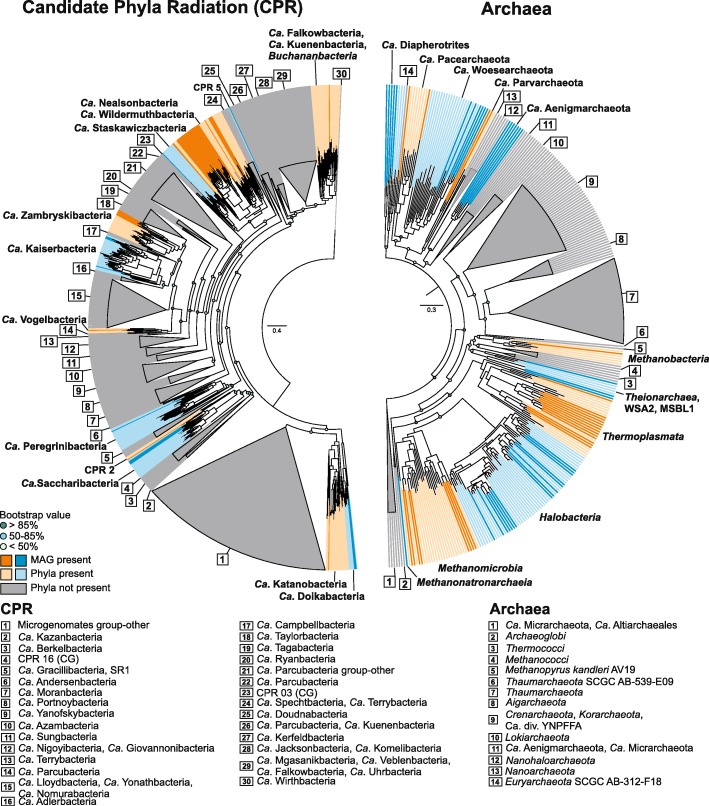
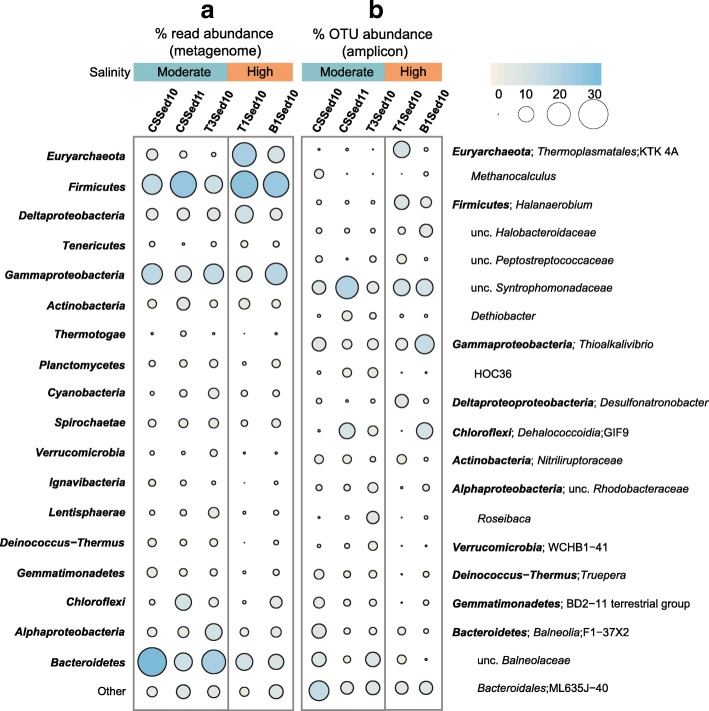
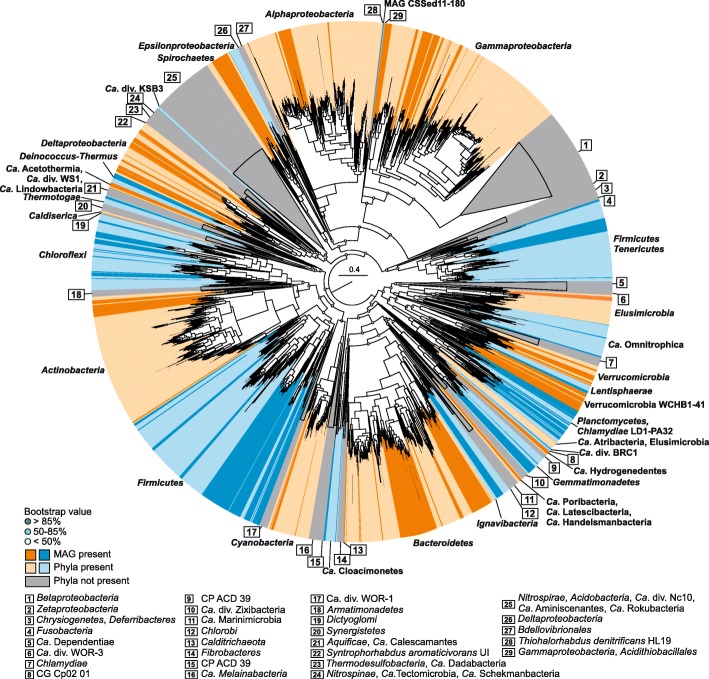
Results: We sequenced five metagenomes obtained from four surface sediments of Siberian soda lakes with a pH 10 and a salt content between 70 and 400 g L-1. The recovered 16S rRNA gene sequences were mostly from Bacteria, even in the salt-saturated lakes. Most OTUs were assigned to uncultured families. We reconstructed 871 metagenome-assembled genomes (MAGs) spanning more than 45 phyla and discovered the first extremophilic members of the Candidate Phyla Radiation (CPR). Five new species of CPR were among the most dominant community members. Novel dominant lineages were found within previously well-characterized functional groups involved in carbon, sulfur, and nitrogen cycling. Moreover, key enzymes of the Wood-Ljungdahl pathway were encoded within at least four bacterial phyla never previously associated with this ancient anaerobic pathway for carbon fixation and dissimilation, including the Actinobacteria.
Conclusions: Our first sequencing effort of hypersaline soda lake sediment metagenomes led to two important advances. First, we showed the existence and obtained the first genomes of haloalkaliphilic members of the CPR and several hundred other novel prokaryote lineages. The soda lake CPR is a functionally diverse group, but the most abundant organisms in this study are likely fermenters with a possible role in primary carbon degradation. Second, we found evidence for the presence of the Wood-Ljungdahl pathway in many more taxonomic groups than those encompassing known homo-acetogens, sulfate-reducers, and methanogens. Since only few environmental metagenomics studies have targeted sediment microbial communities and never to this extent, we expect that our findings are relevant not only for the understanding of haloalkaline environments but can also be used to set targets for future studies on marine and freshwater sediments.
期刊介绍:
Microbiome is a journal that focuses on studies of microbiomes in humans, animals, plants, and the environment. It covers both natural and manipulated microbiomes, such as those in agriculture. The journal is interested in research that uses meta-omics approaches or novel bioinformatics tools and emphasizes the community/host interaction and structure-function relationship within the microbiome. Studies that go beyond descriptive omics surveys and include experimental or theoretical approaches will be considered for publication. The journal also encourages research that establishes cause and effect relationships and supports proposed microbiome functions. However, studies of individual microbial isolates/species without exploring their impact on the host or the complex microbiome structures and functions will not be considered for publication. Microbiome is indexed in BIOSIS, Current Contents, DOAJ, Embase, MEDLINE, PubMed, PubMed Central, and Science Citations Index Expanded.



 京公网安备 11010802042870号
京ICP备2023020795号-1
京公网安备 11010802042870号
京ICP备2023020795号-1

 分享
分享
 求助内容:
求助内容: 应助结果提醒方式:
 扫码关注我们
