Yin He, Dehong Tan, Yan Mi, Qian Zhou and Shujuan Ji
{"title":"Epigallocatechin-3-gallate attenuates cerebral cortex damage and promotes brain regeneration in acrylamide-treated rats","authors":"Yin He, Dehong Tan, Yan Mi, Qian Zhou and Shujuan Ji","doi":"10.1039/C6FO01823H","DOIUrl":null,"url":null,"abstract":"<p >Acrylamide (ACR) is a neurotoxic industrial chemical intermediate, which is also present in food and water. We investigated the neuroprotective effects of epigallocatechin-3-gallate (EGCG), the most abundant polyphenol in green tea, on ACR-treated rat brain. Rats were pre-treated with EGCG for 4 d and then administered ACR and EGCG for 14 d. EGCG increased acetylcholinesterase (AChE) activity and the rate of Nissl-positive cells in ACR-treated rats. Senescence-associated β-galactosidase (SA-β-gal) staining indicated that EGCG attenuated ACR-induced senescence. Tumour necrosis factor alpha (TNF-α), inducible nitric oxide synthase (iNOS), and cyclooxygenase 2 (COX-2) protein expression indicated that EGCG inhibited ACR-induced inflammation. In addition, immunohistochemical analysis of nestin and brain-derived neurotrophic factor (BDNF) revealed that EGCG promoted brain regeneration in ACR-treated rats. Altogether, our results suggest that EGCG can attenuate ACR-induced brain damage and promote regeneration in the cerebral cortex of rats. Therefore, we hypothesized that EGCG may alleviate ACR-related nerve injury.</p>","PeriodicalId":77,"journal":{"name":"Food & Function","volume":" 6","pages":" 2275-2282"},"PeriodicalIF":5.4000,"publicationDate":"2017-05-31","publicationTypes":"Journal Article","fieldsOfStudy":null,"isOpenAccess":false,"openAccessPdf":"https://sci-hub-pdf.com/10.1039/C6FO01823H","citationCount":"20","resultStr":null,"platform":"Semanticscholar","paperid":null,"PeriodicalName":"Food & Function","FirstCategoryId":"97","ListUrlMain":"https://pubs.rsc.org/en/content/articlelanding/2017/fo/c6fo01823h","RegionNum":1,"RegionCategory":"农林科学","ArticlePicture":[],"TitleCN":null,"AbstractTextCN":null,"PMCID":null,"EPubDate":"","PubModel":"","JCR":"Q1","JCRName":"BIOCHEMISTRY & MOLECULAR BIOLOGY","Score":null,"Total":0}
引用次数: 20
Abstract
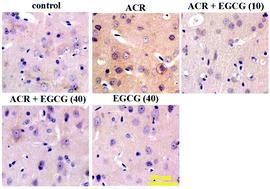
Acrylamide (ACR) is a neurotoxic industrial chemical intermediate, which is also present in food and water. We investigated the neuroprotective effects of epigallocatechin-3-gallate (EGCG), the most abundant polyphenol in green tea, on ACR-treated rat brain. Rats were pre-treated with EGCG for 4 d and then administered ACR and EGCG for 14 d. EGCG increased acetylcholinesterase (AChE) activity and the rate of Nissl-positive cells in ACR-treated rats. Senescence-associated β-galactosidase (SA-β-gal) staining indicated that EGCG attenuated ACR-induced senescence. Tumour necrosis factor alpha (TNF-α), inducible nitric oxide synthase (iNOS), and cyclooxygenase 2 (COX-2) protein expression indicated that EGCG inhibited ACR-induced inflammation. In addition, immunohistochemical analysis of nestin and brain-derived neurotrophic factor (BDNF) revealed that EGCG promoted brain regeneration in ACR-treated rats. Altogether, our results suggest that EGCG can attenuate ACR-induced brain damage and promote regeneration in the cerebral cortex of rats. Therefore, we hypothesized that EGCG may alleviate ACR-related nerve injury.
期刊介绍:
Food & Function provides a unique venue for physicists, chemists, biochemists, nutritionists and other food scientists to publish work at the interface of the chemistry, physics and biology of food. The journal focuses on food and the functions of food in relation to health.



 京公网安备 11010802042870号
京ICP备2023020795号-1
京公网安备 11010802042870号
京ICP备2023020795号-1

 分享
分享
 求助内容:
求助内容: 应助结果提醒方式:
 扫码关注我们
