{"title":"A simple protocol for isolating mouse lung endothelial cells.","authors":"Jinping Wang, Niu Niu, Suowen Xu, Zheng Gen Jin","doi":"10.1038/s41598-018-37130-4","DOIUrl":null,"url":null,"abstract":"<p><p>Endothelial dysfunction is the common molecular basis of multiple human diseases, such as atherosclerosis, diabetes, hypertension, and acute lung injury. Therefore, primary isolation of high-purity endothelial cells (ECs) is crucial to study the mechanisms of endothelial function and disease pathogenesis. Mouse lung ECs (MLECs) are widely used in vascular biology and lung cell biology studies such as pulmonary inflammation, angiogenesis, vessel permeability, leukocyte/EC interaction, nitric oxide production, and mechanotransduction. Thus, in this paper, we describe a simple, and reproducible protocol for the isolation and culture of MLECs from adult mice using collagenase I-based enzymatic digestion, followed by sequential sorting with PECAM1 (also known as CD31)- and ICAM2 (also known as CD102)-coated microbeads. The morphology of isolated MLECs were observed with phase contrast microscope. MLECs were authenticated by CD31 immunoblotting, and immunofluorescent staining of established EC markers VE-cadherin and von Willebrand factor (vWF). Cultured MLECs also showed functional characteristics of ECs, evidenced by DiI-oxLDL uptake assay and THP-1 monocyte adhesion assay. Finally, we used MLECs from endothelium-specific enhancer of zeste homolog 2 (EZH2) knockout mice to show the general applicability of our protocol. To conclude, we describe here a simple and reproducible protocol to isolate highly pure and functional ECs from adult mouse lungs. Isolation of ECs from genetically engineered mice is important for downstream phenotypic, genetic, or proteomic studies.</p>","PeriodicalId":3,"journal":{"name":"ACS Applied Electronic Materials","volume":" ","pages":"1458"},"PeriodicalIF":4.7000,"publicationDate":"2019-02-06","publicationTypes":"Journal Article","fieldsOfStudy":null,"isOpenAccess":false,"openAccessPdf":"https://www.ncbi.nlm.nih.gov/pmc/articles/PMC6365507/pdf/","citationCount":"0","resultStr":null,"platform":"Semanticscholar","paperid":null,"PeriodicalName":"ACS Applied Electronic Materials","FirstCategoryId":"103","ListUrlMain":"https://doi.org/10.1038/s41598-018-37130-4","RegionNum":3,"RegionCategory":"材料科学","ArticlePicture":[],"TitleCN":null,"AbstractTextCN":null,"PMCID":null,"EPubDate":"","PubModel":"","JCR":"Q1","JCRName":"ENGINEERING, ELECTRICAL & ELECTRONIC","Score":null,"Total":0}
引用次数: 0
Abstract
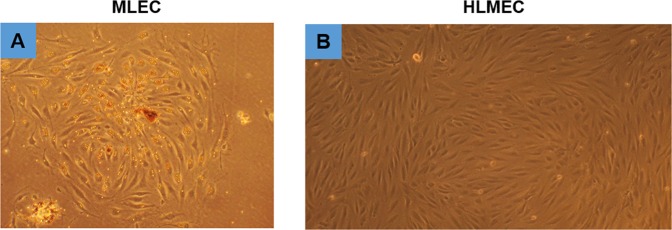
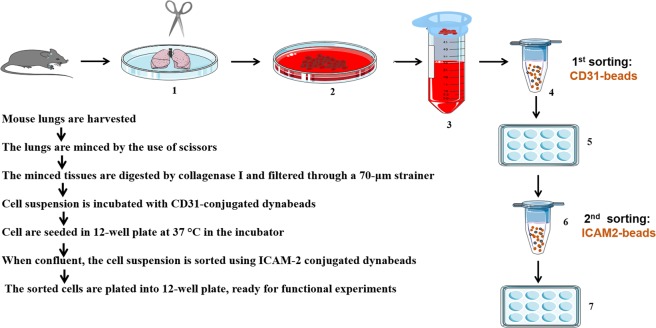
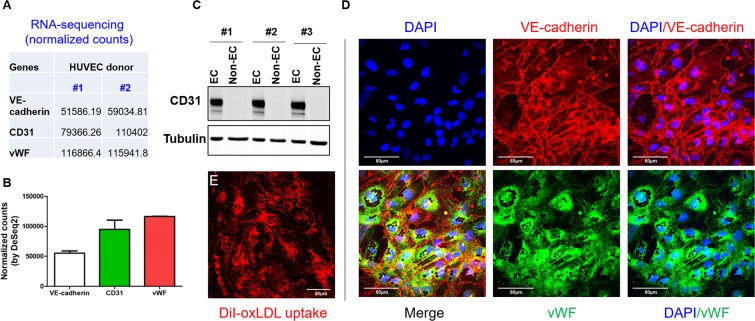
Endothelial dysfunction is the common molecular basis of multiple human diseases, such as atherosclerosis, diabetes, hypertension, and acute lung injury. Therefore, primary isolation of high-purity endothelial cells (ECs) is crucial to study the mechanisms of endothelial function and disease pathogenesis. Mouse lung ECs (MLECs) are widely used in vascular biology and lung cell biology studies such as pulmonary inflammation, angiogenesis, vessel permeability, leukocyte/EC interaction, nitric oxide production, and mechanotransduction. Thus, in this paper, we describe a simple, and reproducible protocol for the isolation and culture of MLECs from adult mice using collagenase I-based enzymatic digestion, followed by sequential sorting with PECAM1 (also known as CD31)- and ICAM2 (also known as CD102)-coated microbeads. The morphology of isolated MLECs were observed with phase contrast microscope. MLECs were authenticated by CD31 immunoblotting, and immunofluorescent staining of established EC markers VE-cadherin and von Willebrand factor (vWF). Cultured MLECs also showed functional characteristics of ECs, evidenced by DiI-oxLDL uptake assay and THP-1 monocyte adhesion assay. Finally, we used MLECs from endothelium-specific enhancer of zeste homolog 2 (EZH2) knockout mice to show the general applicability of our protocol. To conclude, we describe here a simple and reproducible protocol to isolate highly pure and functional ECs from adult mouse lungs. Isolation of ECs from genetically engineered mice is important for downstream phenotypic, genetic, or proteomic studies.
期刊介绍:
ACS Applied Electronic Materials is an interdisciplinary journal publishing original research covering all aspects of electronic materials. The journal is devoted to reports of new and original experimental and theoretical research of an applied nature that integrate knowledge in the areas of materials science, engineering, optics, physics, and chemistry into important applications of electronic materials. Sample research topics that span the journal's scope are inorganic, organic, ionic and polymeric materials with properties that include conducting, semiconducting, superconducting, insulating, dielectric, magnetic, optoelectronic, piezoelectric, ferroelectric and thermoelectric.
Indexed/Abstracted:
Web of Science SCIE
Scopus
CAS
INSPEC
Portico




 京公网安备 11010802042870号
京ICP备2023020795号-1
京公网安备 11010802042870号
京ICP备2023020795号-1

 分享
分享
 求助内容:
求助内容: 应助结果提醒方式:
 扫码关注我们
