Cássia Righy, Regis Goulart Rosa, Rodrigo Teixeira Amancio da Silva, Renata Kochhann, Celina Borges Migliavaca, Caroline Cabral Robinson, Stefania Pigatto Teche, Cassiano Teixeira, Fernando Augusto Bozza, Maicon Falavigna
{"title":"Prevalence of post-traumatic stress disorder symptoms in adult critical care survivors: a systematic review and meta-analysis.","authors":"Cássia Righy, Regis Goulart Rosa, Rodrigo Teixeira Amancio da Silva, Renata Kochhann, Celina Borges Migliavaca, Caroline Cabral Robinson, Stefania Pigatto Teche, Cassiano Teixeira, Fernando Augusto Bozza, Maicon Falavigna","doi":"10.1186/s13054-019-2489-3","DOIUrl":null,"url":null,"abstract":"<p><strong>Background: </strong>As more patients are surviving intensive care, mental health concerns in survivors have become a research priority. Among these, post-traumatic stress disorder (PTSD) can have an important impact on the quality of life of critical care survivors. However, data on its burden are conflicting. Therefore, this systematic review and meta-analysis aimed to evaluate the prevalence of PTSD symptoms in adult critical care patients after intensive care unit (ICU) discharge.</p><p><strong>Methods: </strong>We searched MEDLINE, EMBASE, LILACS, Web of Science, PsycNET, and Scopus databases from inception to September 2018. We included observational studies assessing the prevalence of PTSD symptoms in adult critical care survivors. Two reviewers independently screened studies and extracted data. Studies were meta-analyzed using a random-effects model to estimate PTSD symptom prevalence at different time points, also estimating confidence and prediction intervals. Subgroup and meta-regression analyses were performed to explore heterogeneity. Risk of bias was assessed using the Joanna Briggs Institute tool and the GRADE approach.</p><p><strong>Results: </strong>Of 13,267 studies retrieved, 48 were included in this review. Overall prevalence of PTSD symptoms was 19.83% (95% confidence interval [CI], 16.72-23.13; I<sup>2</sup> = 90%, low quality of evidence). Prevalence varied widely across studies, with a wide range of expected prevalence (from 3.70 to 43.73% in 95% of settings). Point prevalence estimates were 15.93% (95% CI, 11.15-21.35; I<sup>2</sup> = 90%; 17 studies), 16.80% (95% CI, 13.74-20.09; I<sup>2</sup> = 66%; 13 studies), 18.96% (95% CI, 14.28-24.12; I<sup>2</sup> = 92%; 13 studies), and 20.21% (95% CI, 13.79-27.44; I<sup>2</sup> = 58%; 7 studies) at 3, 6, 12, and > 12 months after discharge, respectively.</p><p><strong>Conclusion: </strong>PTSD symptoms may affect 1 in every 5 adult critical care survivors, with a high expected prevalence 12 months after discharge. ICU survivors should be screened for PTSD symptoms and cared for accordingly, given the potential negative impact of PTSD on quality of life. In addition, action should be taken to further explore the causal relationship between ICU stay and PTSD, as well as to propose early measures to prevent PTSD in this population.</p><p><strong>Trial registration: </strong>PROSPERO, CRD42017075124 , Registered 6 December 2017.</p>","PeriodicalId":10811,"journal":{"name":"Critical Care","volume":" ","pages":"213"},"PeriodicalIF":9.3000,"publicationDate":"2019-06-11","publicationTypes":"Journal Article","fieldsOfStudy":null,"isOpenAccess":false,"openAccessPdf":"https://sci-hub-pdf.com/10.1186/s13054-019-2489-3","citationCount":"133","resultStr":null,"platform":"Semanticscholar","paperid":null,"PeriodicalName":"Critical Care","FirstCategoryId":"3","ListUrlMain":"https://doi.org/10.1186/s13054-019-2489-3","RegionNum":1,"RegionCategory":"医学","ArticlePicture":[],"TitleCN":null,"AbstractTextCN":null,"PMCID":null,"EPubDate":"","PubModel":"","JCR":"Q1","JCRName":"CRITICAL CARE MEDICINE","Score":null,"Total":0}
引用次数: 133
Abstract
Background: As more patients are surviving intensive care, mental health concerns in survivors have become a research priority. Among these, post-traumatic stress disorder (PTSD) can have an important impact on the quality of life of critical care survivors. However, data on its burden are conflicting. Therefore, this systematic review and meta-analysis aimed to evaluate the prevalence of PTSD symptoms in adult critical care patients after intensive care unit (ICU) discharge.
Methods: We searched MEDLINE, EMBASE, LILACS, Web of Science, PsycNET, and Scopus databases from inception to September 2018. We included observational studies assessing the prevalence of PTSD symptoms in adult critical care survivors. Two reviewers independently screened studies and extracted data. Studies were meta-analyzed using a random-effects model to estimate PTSD symptom prevalence at different time points, also estimating confidence and prediction intervals. Subgroup and meta-regression analyses were performed to explore heterogeneity. Risk of bias was assessed using the Joanna Briggs Institute tool and the GRADE approach.
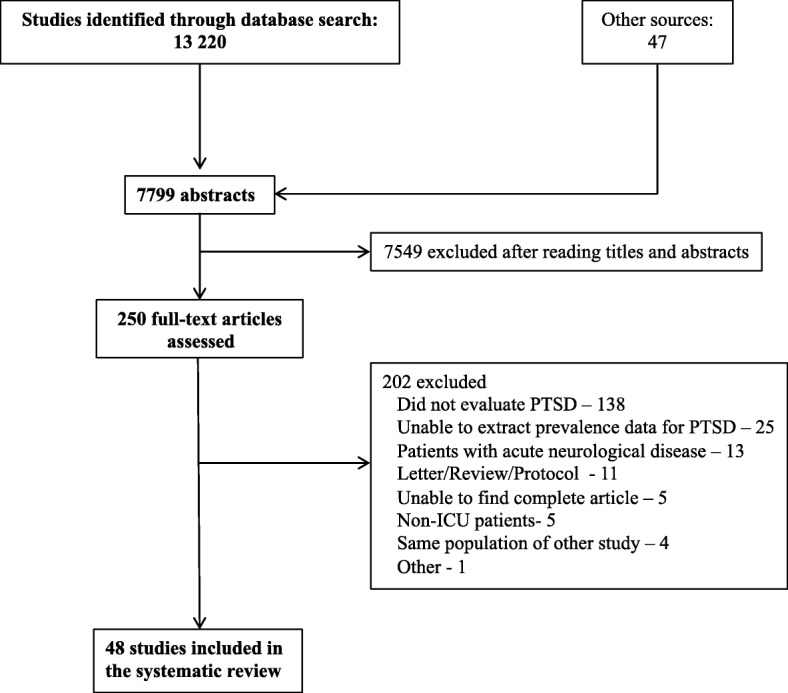
Results: Of 13,267 studies retrieved, 48 were included in this review. Overall prevalence of PTSD symptoms was 19.83% (95% confidence interval [CI], 16.72-23.13; I2 = 90%, low quality of evidence). Prevalence varied widely across studies, with a wide range of expected prevalence (from 3.70 to 43.73% in 95% of settings). Point prevalence estimates were 15.93% (95% CI, 11.15-21.35; I2 = 90%; 17 studies), 16.80% (95% CI, 13.74-20.09; I2 = 66%; 13 studies), 18.96% (95% CI, 14.28-24.12; I2 = 92%; 13 studies), and 20.21% (95% CI, 13.79-27.44; I2 = 58%; 7 studies) at 3, 6, 12, and > 12 months after discharge, respectively.
Conclusion: PTSD symptoms may affect 1 in every 5 adult critical care survivors, with a high expected prevalence 12 months after discharge. ICU survivors should be screened for PTSD symptoms and cared for accordingly, given the potential negative impact of PTSD on quality of life. In addition, action should be taken to further explore the causal relationship between ICU stay and PTSD, as well as to propose early measures to prevent PTSD in this population.
Trial registration: PROSPERO, CRD42017075124 , Registered 6 December 2017.
期刊介绍:
Critical Care is an esteemed international medical journal that undergoes a rigorous peer-review process to maintain its high quality standards. Its primary objective is to enhance the healthcare services offered to critically ill patients. To achieve this, the journal focuses on gathering, exchanging, disseminating, and endorsing evidence-based information that is highly relevant to intensivists. By doing so, Critical Care seeks to provide a thorough and inclusive examination of the intensive care field.





 京公网安备 11010802042870号
京ICP备2023020795号-1
京公网安备 11010802042870号
京ICP备2023020795号-1

 分享
分享
 求助内容:
求助内容: 应助结果提醒方式:
 扫码关注我们
