Magdalena Ines Schacht, Christoph Schomburg, Gregor Bucher
{"title":"six3 acts upstream of foxQ2 in labrum and neural development in the spider Parasteatoda tepidariorum.","authors":"Magdalena Ines Schacht, Christoph Schomburg, Gregor Bucher","doi":"10.1007/s00427-020-00654-9","DOIUrl":null,"url":null,"abstract":"<p><p>Anterior patterning in animals is based on a gene regulatory network, which comprises highly conserved transcription factors like six3, pax6 and otx. More recently, foxQ2 was found to be an ancestral component of this network but its regulatory interactions showed evolutionary differences. In most animals, foxQ2 is a downstream target of six3 and knockdown leads to mild or no epidermal phenotypes. In contrast, in the red flour beetle Tribolium castaneum, foxQ2 gained a more prominent role in patterning leading to strong epidermal and brain phenotypes and being required for six3 expression. However, it has remained unclear which of these novel aspects were insect or arthropod specific. Here, we study expression and RNAi phenotype of the single foxQ2 ortholog of the spider Parasteatoda tepidariorum. We find early anterior expression similar to the one of insects. Further, we show an epidermal phenotype in the labrum similar to the insect phenotype. However, our data indicate that foxQ2 is positioned downstream of six3 like in other animals but unlike insects. Hence, the epidermal and neural pattering function of foxQ2 is ancestral for arthropods while the upstream role of foxQ2 may have evolved in the lineage leading to the insects.</p>","PeriodicalId":50588,"journal":{"name":"Development Genes and Evolution","volume":"230 2","pages":"95-104"},"PeriodicalIF":0.8000,"publicationDate":"2020-03-01","publicationTypes":"Journal Article","fieldsOfStudy":null,"isOpenAccess":false,"openAccessPdf":"https://sci-hub-pdf.com/10.1007/s00427-020-00654-9","citationCount":"15","resultStr":null,"platform":"Semanticscholar","paperid":null,"PeriodicalName":"Development Genes and Evolution","FirstCategoryId":"99","ListUrlMain":"https://doi.org/10.1007/s00427-020-00654-9","RegionNum":3,"RegionCategory":"生物学","ArticlePicture":[],"TitleCN":null,"AbstractTextCN":null,"PMCID":null,"EPubDate":"2020/2/10 0:00:00","PubModel":"Epub","JCR":"Q4","JCRName":"CELL BIOLOGY","Score":null,"Total":0}
引用次数: 15
Abstract
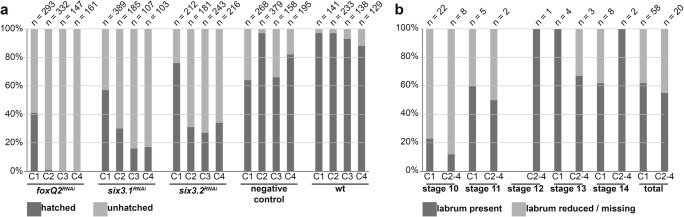
Anterior patterning in animals is based on a gene regulatory network, which comprises highly conserved transcription factors like six3, pax6 and otx. More recently, foxQ2 was found to be an ancestral component of this network but its regulatory interactions showed evolutionary differences. In most animals, foxQ2 is a downstream target of six3 and knockdown leads to mild or no epidermal phenotypes. In contrast, in the red flour beetle Tribolium castaneum, foxQ2 gained a more prominent role in patterning leading to strong epidermal and brain phenotypes and being required for six3 expression. However, it has remained unclear which of these novel aspects were insect or arthropod specific. Here, we study expression and RNAi phenotype of the single foxQ2 ortholog of the spider Parasteatoda tepidariorum. We find early anterior expression similar to the one of insects. Further, we show an epidermal phenotype in the labrum similar to the insect phenotype. However, our data indicate that foxQ2 is positioned downstream of six3 like in other animals but unlike insects. Hence, the epidermal and neural pattering function of foxQ2 is ancestral for arthropods while the upstream role of foxQ2 may have evolved in the lineage leading to the insects.
期刊介绍:
Development Genes and Evolution publishes high-quality reports on all aspects of development biology and evolutionary biology. The journal reports on experimental and bioinformatics work at the systemic, cellular and molecular levels in the field of animal and plant systems, covering key aspects of the following topics:
Embryological and genetic analysis of model and non-model organisms
Genes and pattern formation in invertebrates, vertebrates and plants
Axial patterning, embryonic induction and fate maps
Cellular mechanisms of morphogenesis and organogenesis
Stem cells and regeneration
Functional genomics of developmental processes
Developmental diversity and evolution
Evolution of developmentally relevant genes
Phylogeny of animals and plants
Microevolution
Paleontology.





 京公网安备 11010802042870号
京ICP备2023020795号-1
京公网安备 11010802042870号
京ICP备2023020795号-1

 分享
分享
 求助内容:
求助内容: 应助结果提醒方式:
 扫码关注我们
