{"title":"From \"self-differentiation\" to organoids-the quest for the units of development.","authors":"Gerhard Schlosser","doi":"10.1007/s00427-023-00711-z","DOIUrl":null,"url":null,"abstract":"<p><p>As proposed by Wilhelm Roux in 1885, the key goal of experimental embryology (\"Entwicklungsmechanik\") was to elucidate whether organisms or their parts develop autonomously (\"self-differentiation\") or require interactions with other parts or the environment. However, experimental embryologists soon realized that concepts like \"self-differentiation\" only make sense when applied to particular parts or units of the developing embryo as defined both in time and space. Whereas the formation of tissues or organs may initially depend on interactions with surrounding tissues, they later become independent of such interactions or \"determined.\" Moreover, the determination of a particular tissue or organ primordium has to be distinguished from the spatially coordinated determination of its parts-what we now refer to as \"patterning.\" While some primordia depend on extrinsic influences (e.g., signals from adjacent tissues) for proper patterning, others rely on intrinsic mechanisms. Such intrinsically patterned units may behave as \"morphogenetic fields\" that can compensate for lost parts and regulate their size and proper patterning. While these insights were won by experimental embryologists more than 100 years ago, they retain their relevance today. To enable the generation of more life-like organoids in vitro for studying developmental processes and diseases in a dish, questions about the spatiotemporal units of development (when and how tissues and organs are determined and patterned) need to be increasingly considered. This review briefly sketches this conceptual history and its continued relevance by focusing on the determination and patterning of the inner ear with a specific emphasis on some studies published in this journal.</p>","PeriodicalId":50588,"journal":{"name":"Development Genes and Evolution","volume":" ","pages":"57-64"},"PeriodicalIF":0.8000,"publicationDate":"2024-12-01","publicationTypes":"Journal Article","fieldsOfStudy":null,"isOpenAccess":false,"openAccessPdf":"","citationCount":"0","resultStr":null,"platform":"Semanticscholar","paperid":null,"PeriodicalName":"Development Genes and Evolution","FirstCategoryId":"99","ListUrlMain":"https://doi.org/10.1007/s00427-023-00711-z","RegionNum":3,"RegionCategory":"生物学","ArticlePicture":[],"TitleCN":null,"AbstractTextCN":null,"PMCID":null,"EPubDate":"2023/10/10 0:00:00","PubModel":"Epub","JCR":"Q4","JCRName":"CELL BIOLOGY","Score":null,"Total":0}
引用次数: 0
Abstract
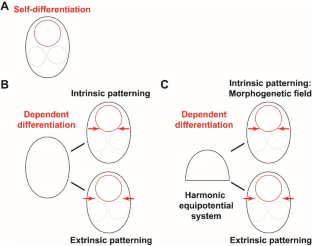
As proposed by Wilhelm Roux in 1885, the key goal of experimental embryology ("Entwicklungsmechanik") was to elucidate whether organisms or their parts develop autonomously ("self-differentiation") or require interactions with other parts or the environment. However, experimental embryologists soon realized that concepts like "self-differentiation" only make sense when applied to particular parts or units of the developing embryo as defined both in time and space. Whereas the formation of tissues or organs may initially depend on interactions with surrounding tissues, they later become independent of such interactions or "determined." Moreover, the determination of a particular tissue or organ primordium has to be distinguished from the spatially coordinated determination of its parts-what we now refer to as "patterning." While some primordia depend on extrinsic influences (e.g., signals from adjacent tissues) for proper patterning, others rely on intrinsic mechanisms. Such intrinsically patterned units may behave as "morphogenetic fields" that can compensate for lost parts and regulate their size and proper patterning. While these insights were won by experimental embryologists more than 100 years ago, they retain their relevance today. To enable the generation of more life-like organoids in vitro for studying developmental processes and diseases in a dish, questions about the spatiotemporal units of development (when and how tissues and organs are determined and patterned) need to be increasingly considered. This review briefly sketches this conceptual history and its continued relevance by focusing on the determination and patterning of the inner ear with a specific emphasis on some studies published in this journal.
期刊介绍:
Development Genes and Evolution publishes high-quality reports on all aspects of development biology and evolutionary biology. The journal reports on experimental and bioinformatics work at the systemic, cellular and molecular levels in the field of animal and plant systems, covering key aspects of the following topics:
Embryological and genetic analysis of model and non-model organisms
Genes and pattern formation in invertebrates, vertebrates and plants
Axial patterning, embryonic induction and fate maps
Cellular mechanisms of morphogenesis and organogenesis
Stem cells and regeneration
Functional genomics of developmental processes
Developmental diversity and evolution
Evolution of developmentally relevant genes
Phylogeny of animals and plants
Microevolution
Paleontology.




 京公网安备 11010802042870号
京ICP备2023020795号-1
京公网安备 11010802042870号
京ICP备2023020795号-1

 分享
分享
 求助内容:
求助内容: 应助结果提醒方式:
 扫码关注我们
