Jade Pattyn, Gitika Panicker, Martina Willhauck-Fleckenstein, Severien Van Keer, Laura Téblick, Zoë Pieters, Wiebren A. A. Tjalma, Veerle Matheeussen, Pierre Van Damme, Tim Waterboer, Elizabeth R. Unger, Alex Vorsters
{"title":"Comparison of a VLP-based and GST-L1-based multiplex immunoassay to detect vaccine-induced HPV-specific antibodies in first-void urine","authors":"Jade Pattyn, Gitika Panicker, Martina Willhauck-Fleckenstein, Severien Van Keer, Laura Téblick, Zoë Pieters, Wiebren A. A. Tjalma, Veerle Matheeussen, Pierre Van Damme, Tim Waterboer, Elizabeth R. Unger, Alex Vorsters","doi":"10.1002/jmv.25841","DOIUrl":null,"url":null,"abstract":"<p>Vaccine-induced human papillomavirus (HPV) antibodies originating from cervicovaginal secretions were recently shown to be detectable in first-void (FV) urine. This presents a novel opportunity for noninvasive sampling to monitor HPV antibody status in women participating in large epidemiological studies and HPV vaccine trials. With a view towards method optimization, this study compared the measurement of HPV antibodies in FV urine using a multiplex L1/L2 virus-like particles (VLP)-based ELISA (M4ELISA) with previously reported results using a glutathione <i>S</i>-transferase (GST)-L1-based immunoassay (GST-L1-MIA). We tested 53 paired FV urine and serum samples from 19- to 26-year-old healthy women, unvaccinated (n = 17) or vaccinated with either the bivalent or quadrivalent HPV-vaccine during adolescence (n = 36). HPV6/11/16/18 antibodies were measured using M4ELISA and compared with GST-L1-MIA results. Inter-assay and inter-specimen correlations were examined using the Spearman's rank test (rs). As expected, lower HPV antibody concentrations were found in FV urine than in serum. Vaccinated women had significantly higher HPV6/11/16/18 antibody levels in both FV urine and serum compared with those unvaccinated (M4ELISA; FV urine <i>P</i> = .0003; serum <i>P</i> ≤ .0001). HPV antibody levels in FV urine and serum showed a significant positive correlation (M4ELISA anti-HPV6/11/16/18, <i>r</i><sub>s</sub> = 0.85/0.86/0.91/0.79, <i>P</i> ≤ .001). Despite assay differences, there was moderate to good correlation between M4ELISA and GST-L1-MIA (FV urine anti-HPV6/11/16/18, <i>r</i><sub>s</sub> = 0.86/0.83/0.89/0.53, <i>P</i> ≤ .0001; serum anti-HPV6/11/16/18, <i>r</i><sub>s</sub> = 0.93/0.89/0.94/0.75, <i>P</i> ≤ .0001). FV urine HPV antibody detection is comparable with both assays, further supporting this noninvasive sampling method as a possible option for HPV vaccine assessment. Approaches to improve the sensitivity and larger studies are warranted to determine the feasibility of FV urine for vaccine-induced HPV antibody detection.</p>","PeriodicalId":16354,"journal":{"name":"Journal of Medical Virology","volume":"92 12","pages":"3774-3783"},"PeriodicalIF":4.6000,"publicationDate":"2020-04-08","publicationTypes":"Journal Article","fieldsOfStudy":null,"isOpenAccess":false,"openAccessPdf":"https://sci-hub-pdf.com/10.1002/jmv.25841","citationCount":"6","resultStr":null,"platform":"Semanticscholar","paperid":null,"PeriodicalName":"Journal of Medical Virology","FirstCategoryId":"3","ListUrlMain":"https://onlinelibrary.wiley.com/doi/10.1002/jmv.25841","RegionNum":3,"RegionCategory":"医学","ArticlePicture":[],"TitleCN":null,"AbstractTextCN":null,"PMCID":null,"EPubDate":"","PubModel":"","JCR":"Q1","JCRName":"VIROLOGY","Score":null,"Total":0}
引用次数: 6
Abstract
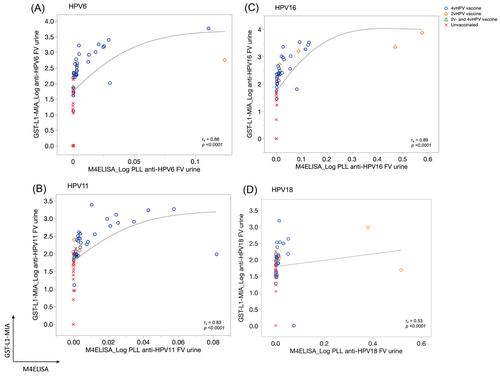
Vaccine-induced human papillomavirus (HPV) antibodies originating from cervicovaginal secretions were recently shown to be detectable in first-void (FV) urine. This presents a novel opportunity for noninvasive sampling to monitor HPV antibody status in women participating in large epidemiological studies and HPV vaccine trials. With a view towards method optimization, this study compared the measurement of HPV antibodies in FV urine using a multiplex L1/L2 virus-like particles (VLP)-based ELISA (M4ELISA) with previously reported results using a glutathione S-transferase (GST)-L1-based immunoassay (GST-L1-MIA). We tested 53 paired FV urine and serum samples from 19- to 26-year-old healthy women, unvaccinated (n = 17) or vaccinated with either the bivalent or quadrivalent HPV-vaccine during adolescence (n = 36). HPV6/11/16/18 antibodies were measured using M4ELISA and compared with GST-L1-MIA results. Inter-assay and inter-specimen correlations were examined using the Spearman's rank test (rs). As expected, lower HPV antibody concentrations were found in FV urine than in serum. Vaccinated women had significantly higher HPV6/11/16/18 antibody levels in both FV urine and serum compared with those unvaccinated (M4ELISA; FV urine P = .0003; serum P ≤ .0001). HPV antibody levels in FV urine and serum showed a significant positive correlation (M4ELISA anti-HPV6/11/16/18, rs = 0.85/0.86/0.91/0.79, P ≤ .001). Despite assay differences, there was moderate to good correlation between M4ELISA and GST-L1-MIA (FV urine anti-HPV6/11/16/18, rs = 0.86/0.83/0.89/0.53, P ≤ .0001; serum anti-HPV6/11/16/18, rs = 0.93/0.89/0.94/0.75, P ≤ .0001). FV urine HPV antibody detection is comparable with both assays, further supporting this noninvasive sampling method as a possible option for HPV vaccine assessment. Approaches to improve the sensitivity and larger studies are warranted to determine the feasibility of FV urine for vaccine-induced HPV antibody detection.
期刊介绍:
The Journal of Medical Virology focuses on publishing original scientific papers on both basic and applied research related to viruses that affect humans. The journal publishes reports covering a wide range of topics, including the characterization, diagnosis, epidemiology, immunology, and pathogenesis of human virus infections. It also includes studies on virus morphology, genetics, replication, and interactions with host cells.
The intended readership of the journal includes virologists, microbiologists, immunologists, infectious disease specialists, diagnostic laboratory technologists, epidemiologists, hematologists, and cell biologists.
The Journal of Medical Virology is indexed and abstracted in various databases, including Abstracts in Anthropology (Sage), CABI, AgBiotech News & Information, National Agricultural Library, Biological Abstracts, Embase, Global Health, Web of Science, Veterinary Bulletin, and others.





 京公网安备 11010802042870号
京ICP备2023020795号-1
京公网安备 11010802042870号
京ICP备2023020795号-1

 分享
分享
 求助内容:
求助内容: 应助结果提醒方式:
 扫码关注我们
