Valentin Nica, Carlos Caro, Jose Maria Páez-Muñoz, Manuel Pernia Leal, Maria Luisa Garcia-Martin
{"title":"Bi-Magnetic Core-Shell CoFe<sub>2</sub>O<sub>4</sub>@MnFe<sub>2</sub>O<sub>4</sub> Nanoparticles for In Vivo Theranostics.","authors":"Valentin Nica, Carlos Caro, Jose Maria Páez-Muñoz, Manuel Pernia Leal, Maria Luisa Garcia-Martin","doi":"10.3390/nano10050907","DOIUrl":null,"url":null,"abstract":"<p><p>In this work, we report the synthesis and characterization of three magnetic nanosystems, CoFe<sub>2</sub>O<sub>4</sub>, CoFe<sub>2</sub>O<sub>4</sub>@ZnFe<sub>2</sub>O<sub>4</sub>, and CoFe<sub>2</sub>O<sub>4</sub>@MnFe<sub>2</sub>O<sub>4</sub>, which were developed as potential theranostic agents for magnetic hyperthermia and magnetic resonance imaging (MRI). These nanosystems have been thoroughly characterized by X-ray Diffraction (XRD), Transmission Electron Miscroscopy (TEM), Dark Field-TEM (DF-TEM), Vibrating Sample Magnetometry (VSM), and inductive heating, in order to elucidate their structure, morphology, and magnetic properties. The bi-magnetic CoFe<sub>2</sub>O<sub>4</sub>@ZnFe<sub>2</sub>O<sub>4</sub> and CoFe<sub>2</sub>O<sub>4</sub>@MnFe<sub>2</sub>O<sub>4</sub> nanoparticles (NPs) exhibited a core-shell structure with a mean average particle size of 11.2 ± 1.4 nm and 14.4 ± 2.4 nm, respectively. The CoFe<sub>2</sub>O<sub>4</sub>@MnFe<sub>2</sub>O<sub>4</sub> NPs showed the highest specific absorption rate (SAR) values (210-320 W/g) upon exposure to an external magnetic field, along with the highest saturation magnetization (Ms). Therefore, they were selected for functionalization with the PEGylated ligand to make them stable in aqueous media. After the functionalization process, the NPs showed high magnetic relaxivity values and very low cytotoxicity, demonstrating that CoFe<sub>2</sub>O<sub>4</sub>@MnFe<sub>2</sub>O<sub>4</sub> is a good candidate for in vivo applications. Finally, in vivo MRI experiments showed that PEGylated CoFe<sub>2</sub>O<sub>4</sub>@MnFe<sub>2</sub>O<sub>4</sub> NPs produce high <i>T</i><sub>2</sub> contrast and exhibit very good stealth properties, leading to the efficient evasion of the mononuclear phagocyte system. Thus, these bi-magnetic core-shell NPs show great potential as theranostic agents for in vivo applications, combining magnetic hyperthermia capabilities with high MRI contrast.</p>","PeriodicalId":18966,"journal":{"name":"Nanomaterials","volume":" ","pages":""},"PeriodicalIF":4.3000,"publicationDate":"2020-05-08","publicationTypes":"Journal Article","fieldsOfStudy":null,"isOpenAccess":false,"openAccessPdf":"https://sci-hub-pdf.com/10.3390/nano10050907","citationCount":"24","resultStr":null,"platform":"Semanticscholar","paperid":null,"PeriodicalName":"Nanomaterials","FirstCategoryId":"88","ListUrlMain":"https://doi.org/10.3390/nano10050907","RegionNum":3,"RegionCategory":"材料科学","ArticlePicture":[],"TitleCN":null,"AbstractTextCN":null,"PMCID":null,"EPubDate":"","PubModel":"","JCR":"Q2","JCRName":"CHEMISTRY, MULTIDISCIPLINARY","Score":null,"Total":0}
引用次数: 24
Abstract
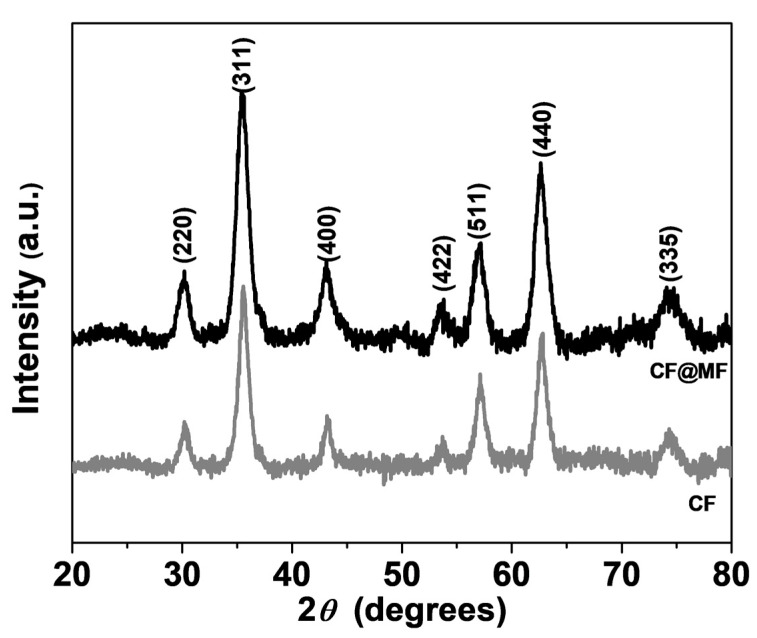
In this work, we report the synthesis and characterization of three magnetic nanosystems, CoFe2O4, CoFe2O4@ZnFe2O4, and CoFe2O4@MnFe2O4, which were developed as potential theranostic agents for magnetic hyperthermia and magnetic resonance imaging (MRI). These nanosystems have been thoroughly characterized by X-ray Diffraction (XRD), Transmission Electron Miscroscopy (TEM), Dark Field-TEM (DF-TEM), Vibrating Sample Magnetometry (VSM), and inductive heating, in order to elucidate their structure, morphology, and magnetic properties. The bi-magnetic CoFe2O4@ZnFe2O4 and CoFe2O4@MnFe2O4 nanoparticles (NPs) exhibited a core-shell structure with a mean average particle size of 11.2 ± 1.4 nm and 14.4 ± 2.4 nm, respectively. The CoFe2O4@MnFe2O4 NPs showed the highest specific absorption rate (SAR) values (210-320 W/g) upon exposure to an external magnetic field, along with the highest saturation magnetization (Ms). Therefore, they were selected for functionalization with the PEGylated ligand to make them stable in aqueous media. After the functionalization process, the NPs showed high magnetic relaxivity values and very low cytotoxicity, demonstrating that CoFe2O4@MnFe2O4 is a good candidate for in vivo applications. Finally, in vivo MRI experiments showed that PEGylated CoFe2O4@MnFe2O4 NPs produce high T2 contrast and exhibit very good stealth properties, leading to the efficient evasion of the mononuclear phagocyte system. Thus, these bi-magnetic core-shell NPs show great potential as theranostic agents for in vivo applications, combining magnetic hyperthermia capabilities with high MRI contrast.
期刊介绍:
Nanomaterials (ISSN 2076-4991) is an international and interdisciplinary scholarly open access journal. It publishes reviews, regular research papers, communications, and short notes that are relevant to any field of study that involves nanomaterials, with respect to their science and application. Thus, theoretical and experimental articles will be accepted, along with articles that deal with the synthesis and use of nanomaterials. Articles that synthesize information from multiple fields, and which place discoveries within a broader context, will be preferred. There is no restriction on the length of the papers. Our aim is to encourage scientists to publish their experimental and theoretical research in as much detail as possible. Full experimental or methodical details, or both, must be provided for research articles. Computed data or files regarding the full details of the experimental procedure, if unable to be published in a normal way, can be deposited as supplementary material. Nanomaterials is dedicated to a high scientific standard. All manuscripts undergo a rigorous reviewing process and decisions are based on the recommendations of independent reviewers.






 京公网安备 11010802042870号
京ICP备2023020795号-1
京公网安备 11010802042870号
京ICP备2023020795号-1

 分享
分享
 求助内容:
求助内容: 应助结果提醒方式:
 扫码关注我们
