Hannah V. Meyer, Timothy J. W. Dawes, Marta Serrani, Wenjia Bai, Paweł Tokarczuk, Jiashen Cai, Antonio de Marvao, Albert Henry, R. Thomas Lumbers, Jakob Gierten, Thomas Thumberger, Joachim Wittbrodt, James S. Ware, Daniel Rueckert, Paul M. Matthews, Sanjay K. Prasad, Maria L. Costantino, Stuart A. Cook, Ewan Birney, Declan P. O’Regan
{"title":"Genetic and functional insights into the fractal structure of the heart","authors":"Hannah V. Meyer, Timothy J. W. Dawes, Marta Serrani, Wenjia Bai, Paweł Tokarczuk, Jiashen Cai, Antonio de Marvao, Albert Henry, R. Thomas Lumbers, Jakob Gierten, Thomas Thumberger, Joachim Wittbrodt, James S. Ware, Daniel Rueckert, Paul M. Matthews, Sanjay K. Prasad, Maria L. Costantino, Stuart A. Cook, Ewan Birney, Declan P. O’Regan","doi":"10.1038/s41586-020-2635-8","DOIUrl":null,"url":null,"abstract":"The inner surfaces of the human heart are covered by a complex network of muscular strands that is thought to be a remnant of embryonic development1,2. The function of these trabeculae in adults and their genetic architecture are unknown. Here we performed a genome-wide association study to investigate image-derived phenotypes of trabeculae using the fractal analysis of trabecular morphology in 18,096 participants of the UK Biobank. We identified 16 significant loci that contain genes associated with haemodynamic phenotypes and regulation of cytoskeletal arborization3,4. Using biomechanical simulations and observational data from human participants, we demonstrate that trabecular morphology is an important determinant of cardiac performance. Through genetic association studies with cardiac disease phenotypes and Mendelian randomization, we find a causal relationship between trabecular morphology and risk of cardiovascular disease. These findings suggest a previously unknown role for myocardial trabeculae in the function of the adult heart, identify conserved pathways that regulate structural complexity and reveal the influence of the myocardial trabeculae on susceptibility to cardiovascular disease. A genome-wide association study shows that myocardial trabeculae are an important determinant of cardiac performance in the adult heart, identifies conserved pathways that regulate structural complexity and reveals the influence of trabeculae on the susceptibility to cardiovascular disease.","PeriodicalId":18787,"journal":{"name":"Nature","volume":"584 7822","pages":"589-594"},"PeriodicalIF":48.5000,"publicationDate":"2020-08-19","publicationTypes":"Journal Article","fieldsOfStudy":null,"isOpenAccess":false,"openAccessPdf":"https://sci-hub-pdf.com/10.1038/s41586-020-2635-8","citationCount":"69","resultStr":null,"platform":"Semanticscholar","paperid":null,"PeriodicalName":"Nature","FirstCategoryId":"103","ListUrlMain":"https://www.nature.com/articles/s41586-020-2635-8","RegionNum":1,"RegionCategory":"综合性期刊","ArticlePicture":[],"TitleCN":null,"AbstractTextCN":null,"PMCID":null,"EPubDate":"","PubModel":"","JCR":"Q1","JCRName":"MULTIDISCIPLINARY SCIENCES","Score":null,"Total":0}
引用次数: 69
Abstract
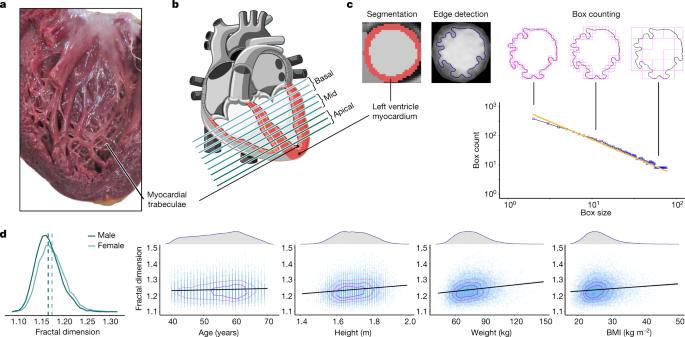
The inner surfaces of the human heart are covered by a complex network of muscular strands that is thought to be a remnant of embryonic development1,2. The function of these trabeculae in adults and their genetic architecture are unknown. Here we performed a genome-wide association study to investigate image-derived phenotypes of trabeculae using the fractal analysis of trabecular morphology in 18,096 participants of the UK Biobank. We identified 16 significant loci that contain genes associated with haemodynamic phenotypes and regulation of cytoskeletal arborization3,4. Using biomechanical simulations and observational data from human participants, we demonstrate that trabecular morphology is an important determinant of cardiac performance. Through genetic association studies with cardiac disease phenotypes and Mendelian randomization, we find a causal relationship between trabecular morphology and risk of cardiovascular disease. These findings suggest a previously unknown role for myocardial trabeculae in the function of the adult heart, identify conserved pathways that regulate structural complexity and reveal the influence of the myocardial trabeculae on susceptibility to cardiovascular disease. A genome-wide association study shows that myocardial trabeculae are an important determinant of cardiac performance in the adult heart, identifies conserved pathways that regulate structural complexity and reveals the influence of trabeculae on the susceptibility to cardiovascular disease.
期刊介绍:
Nature is a prestigious international journal that publishes peer-reviewed research in various scientific and technological fields. The selection of articles is based on criteria such as originality, importance, interdisciplinary relevance, timeliness, accessibility, elegance, and surprising conclusions. In addition to showcasing significant scientific advances, Nature delivers rapid, authoritative, insightful news, and interpretation of current and upcoming trends impacting science, scientists, and the broader public. The journal serves a dual purpose: firstly, to promptly share noteworthy scientific advances and foster discussions among scientists, and secondly, to ensure the swift dissemination of scientific results globally, emphasizing their significance for knowledge, culture, and daily life.



 京公网安备 11010802042870号
京ICP备2023020795号-1
京公网安备 11010802042870号
京ICP备2023020795号-1

 分享
分享
 求助内容:
求助内容: 应助结果提醒方式:
 扫码关注我们
