{"title":"Involvement of oxidative stress-induced annulus fibrosus cell and nucleus pulposus cell ferroptosis in intervertebral disc degeneration pathogenesis","authors":"Run-Ze Yang, Wen-Ning Xu, Huo-Liang Zheng, Xin-Feng Zheng, Bo Li, Lei-Sheng Jiang, Sheng-Dan Jiang","doi":"10.1002/jcp.30039","DOIUrl":null,"url":null,"abstract":"<p>Ferroptosis is a necrotic form of regulated cell death that was associated with lipid peroxidation and free iron-mediated Fenton reactions. It has been reported that iron deficiency had been implicated in the pathogenesis of intervertebral disc degeneration (IVDD) by activating apoptosis. However, the role of ferroptosis in the process of IVDD has not been illuminated. Here, we demonstrate the involvement of ferroptosis in IVDD pathogenesis. Our in vitro models show the changes in protein levels of ferroptosis marker and enhanced lipid peroxidation level during oxidative stress. Safranin O staining, hematoxylin-eosin staining, and immunohistochemical were used to assess the IVDD after 8 weeks of surgical procedure in vivo. Treatment with ferrostatin-1, deferoxamine, and RSL3 demonstrate the role of ferroptosis in <i>tert</i>-butyl hydroperoxide (TBHP)-treated annulus fibrosus cells (AFCs) and nucleus pulposus cells (NPCs). Ferritinophagy, nuclear receptor coactivator 4 (NCOA4)-mediated ferritin selective autophagy, is originated during the process of ferroptosis in response to TBHP treatment. Knockdown and overexpression NCOA4 further prove TBHP may induce ferroptosis of AFCs and NPCs in an autophagy-dependent way. These findings support a role for oxidative stress-induced ferroptosis in the pathogenesis of IVDD.</p>","PeriodicalId":15220,"journal":{"name":"Journal of Cellular Physiology","volume":"236 4","pages":"2725-2739"},"PeriodicalIF":4.0000,"publicationDate":"2020-09-06","publicationTypes":"Journal Article","fieldsOfStudy":null,"isOpenAccess":false,"openAccessPdf":"https://sci-hub-pdf.com/10.1002/jcp.30039","citationCount":"81","resultStr":null,"platform":"Semanticscholar","paperid":null,"PeriodicalName":"Journal of Cellular Physiology","FirstCategoryId":"99","ListUrlMain":"https://onlinelibrary.wiley.com/doi/10.1002/jcp.30039","RegionNum":2,"RegionCategory":"生物学","ArticlePicture":[],"TitleCN":null,"AbstractTextCN":null,"PMCID":null,"EPubDate":"","PubModel":"","JCR":"Q2","JCRName":"CELL BIOLOGY","Score":null,"Total":0}
引用次数: 81
Abstract
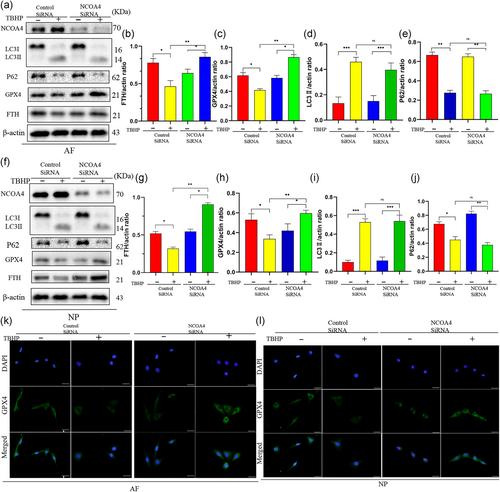
Ferroptosis is a necrotic form of regulated cell death that was associated with lipid peroxidation and free iron-mediated Fenton reactions. It has been reported that iron deficiency had been implicated in the pathogenesis of intervertebral disc degeneration (IVDD) by activating apoptosis. However, the role of ferroptosis in the process of IVDD has not been illuminated. Here, we demonstrate the involvement of ferroptosis in IVDD pathogenesis. Our in vitro models show the changes in protein levels of ferroptosis marker and enhanced lipid peroxidation level during oxidative stress. Safranin O staining, hematoxylin-eosin staining, and immunohistochemical were used to assess the IVDD after 8 weeks of surgical procedure in vivo. Treatment with ferrostatin-1, deferoxamine, and RSL3 demonstrate the role of ferroptosis in tert-butyl hydroperoxide (TBHP)-treated annulus fibrosus cells (AFCs) and nucleus pulposus cells (NPCs). Ferritinophagy, nuclear receptor coactivator 4 (NCOA4)-mediated ferritin selective autophagy, is originated during the process of ferroptosis in response to TBHP treatment. Knockdown and overexpression NCOA4 further prove TBHP may induce ferroptosis of AFCs and NPCs in an autophagy-dependent way. These findings support a role for oxidative stress-induced ferroptosis in the pathogenesis of IVDD.
期刊介绍:
The Journal of Cellular Physiology publishes reports of high biological significance in areas of eukaryotic cell biology and physiology, focusing on those articles that adopt a molecular mechanistic approach to investigate cell structure and function. There is appreciation for the application of cellular, biochemical, molecular and in vivo genetic approaches, as well as the power of genomics, proteomics, bioinformatics and systems biology. In particular, the Journal encourages submission of high-interest papers investigating the genetic and epigenetic regulation of proliferation and phenotype as well as cell fate and lineage commitment by growth factors, cytokines and their cognate receptors and signal transduction pathways that influence the expression, integration and activities of these physiological mediators. Similarly, the Journal encourages submission of manuscripts exploring the regulation of growth and differentiation by cell adhesion molecules in addition to the interplay between these processes and those induced by growth factors and cytokines. Studies on the genes and processes that regulate cell cycle progression and phase transition in eukaryotic cells, and the mechanisms that determine whether cells enter quiescence, proliferate or undergo apoptosis are also welcomed. Submission of papers that address contributions of the extracellular matrix to cellular phenotypes and physiological control as well as regulatory mechanisms governing fertilization, embryogenesis, gametogenesis, cell fate, lineage commitment, differentiation, development and dynamic parameters of cell motility are encouraged. Finally, the investigation of stem cells and changes that differentiate cancer cells from normal cells including studies on the properties and functions of oncogenes and tumor suppressor genes will remain as one of the major interests of the Journal.



 京公网安备 11010802042870号
京ICP备2023020795号-1
京公网安备 11010802042870号
京ICP备2023020795号-1

 分享
分享
 求助内容:
求助内容: 应助结果提醒方式:
 扫码关注我们
