{"title":"A niche in the spotlight: Could external factors critically disturb hair follicle homeostasis and contribute to inflammatory hair follicle diseases?","authors":"Annika Vogt, Andria Constantinou, Fiorenza Rancan, Kamran Ghoreschi, Ulrike Blume-Peytavi, Behazine Combadiere","doi":"10.1111/exd.14212","DOIUrl":null,"url":null,"abstract":"<p>The anatomy of the hair follicle and the dynamics of its barrier provide a special space for interactions between macromolecules and the underlying tissue. Translocation across the hair follicle epithelium and immune recognition has been confirmed for proteins, nucleic acids, engineered particles, virus particles and others. Tissue responses can be modulated by pro-inflammatory stimuli as demonstrated in penetration and transcutaneous immunization studies. Even under physiological conditions, hair follicle openings are filled with exogenous material ranging from macromolecules, engineered particles to natural particles including diverse communities of microbes. The exposed position of the infundibulum suggests that local inflammatory insults could disturb the finely tuned balance and may trigger downstream responses that initiate or facilitate local outbreaks of inflammatory hair diseases typically occurring in close spatial association with the infundibulum as observed in cicatricial alopecia. The question as to how microbial colonization or deposition of contaminants on the surface of the hair follicle epithelium interact with the barrier status under the influence of individual predisposition may help us understand local flare-ups of inflammatory hair diseases. Specifically, learning more about skin barrier alterations in the different types of inflammatory hair diseases and cross-talk with exogenous compounds could give new insights in this less explored aspect of hair follicle homeostasis. Such knowledge may not only be used to develop supportive measures to maintain a healthy scalp. It may have wider implications for our understanding on how external factors influence inflammation and immunological responses in the skin.</p>","PeriodicalId":12243,"journal":{"name":"Experimental Dermatology","volume":"29 11","pages":"1080-1087"},"PeriodicalIF":3.1000,"publicationDate":"2020-10-08","publicationTypes":"Journal Article","fieldsOfStudy":null,"isOpenAccess":false,"openAccessPdf":"https://sci-hub-pdf.com/10.1111/exd.14212","citationCount":"7","resultStr":null,"platform":"Semanticscholar","paperid":null,"PeriodicalName":"Experimental Dermatology","FirstCategoryId":"3","ListUrlMain":"https://onlinelibrary.wiley.com/doi/10.1111/exd.14212","RegionNum":3,"RegionCategory":"医学","ArticlePicture":[],"TitleCN":null,"AbstractTextCN":null,"PMCID":null,"EPubDate":"","PubModel":"","JCR":"Q1","JCRName":"DERMATOLOGY","Score":null,"Total":0}
引用次数: 7
Abstract
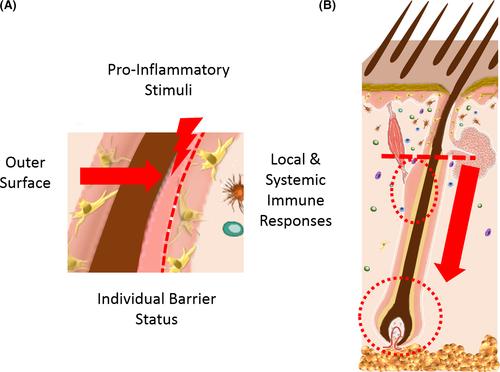
The anatomy of the hair follicle and the dynamics of its barrier provide a special space for interactions between macromolecules and the underlying tissue. Translocation across the hair follicle epithelium and immune recognition has been confirmed for proteins, nucleic acids, engineered particles, virus particles and others. Tissue responses can be modulated by pro-inflammatory stimuli as demonstrated in penetration and transcutaneous immunization studies. Even under physiological conditions, hair follicle openings are filled with exogenous material ranging from macromolecules, engineered particles to natural particles including diverse communities of microbes. The exposed position of the infundibulum suggests that local inflammatory insults could disturb the finely tuned balance and may trigger downstream responses that initiate or facilitate local outbreaks of inflammatory hair diseases typically occurring in close spatial association with the infundibulum as observed in cicatricial alopecia. The question as to how microbial colonization or deposition of contaminants on the surface of the hair follicle epithelium interact with the barrier status under the influence of individual predisposition may help us understand local flare-ups of inflammatory hair diseases. Specifically, learning more about skin barrier alterations in the different types of inflammatory hair diseases and cross-talk with exogenous compounds could give new insights in this less explored aspect of hair follicle homeostasis. Such knowledge may not only be used to develop supportive measures to maintain a healthy scalp. It may have wider implications for our understanding on how external factors influence inflammation and immunological responses in the skin.
期刊介绍:
Experimental Dermatology provides a vehicle for the rapid publication of innovative and definitive reports, letters to the editor and review articles covering all aspects of experimental dermatology. Preference is given to papers of immediate importance to other investigators, either by virtue of their new methodology, experimental data or new ideas. The essential criteria for publication are clarity, experimental soundness and novelty. Letters to the editor related to published reports may also be accepted, provided that they are short and scientifically relevant to the reports mentioned, in order to provide a continuing forum for discussion. Review articles represent a state-of-the-art overview and are invited by the editors.



 京公网安备 11010802042870号
京ICP备2023020795号-1
京公网安备 11010802042870号
京ICP备2023020795号-1

 分享
分享
 求助内容:
求助内容: 应助结果提醒方式:
 扫码关注我们
