Amoura Abou-ElNaga, Farha El-Chennawi, Samar Ibrahim Kamel, Ghada Mutawa
{"title":"The Potentiality of Human Umbilical Cord Isolated Mesenchymal Stem/Stromal Cells for Cardiomyocyte Generation.","authors":"Amoura Abou-ElNaga, Farha El-Chennawi, Samar Ibrahim Kamel, Ghada Mutawa","doi":"10.2147/SCCAA.S253108","DOIUrl":null,"url":null,"abstract":"<p><strong>Background: </strong>The new therapeutic strategy of managing cardiac diseases is based on cell therapy; it highly suggests the use of multipotent mesenchymal stem/stromal cells (MSCs). MSCs widely used in researches are known to be isolated from bone marrow. However, this research seeks to use a human umbilical cord (HUC) as an alternative source of MSCs. Since HUC Wharton's jelly (WJ)-isolated MSCs originate as fetal tissue they are highly preferable for their potential advantages over other adult tissues.</p><p><strong>Methods: </strong>The researchers used enzymatic digestion to establish a primary HUC-WJ-isolated MSC line. Then, flow cytometry was used to characterize MSCs and hematopoietic stem cells (HSCs) markers' expression. In addition, the cardiac differentiation capacity of HUC-WJ-isolated MSCs in vitro was investigated by two protocols. Protocol-1 necessitates the dependence on merely 5-azacytidine (5-Aza), whereas in protocol-2, 5-Aza was supported by basic fibroblast growth factor (BFGF). The comparative study between the two protocols was applied by inspecting the ultrastructure of differentiated cells, measuring RT-PCR mRNA cardiac markers and the quantitative detection of cardiac proteins.</p><p><strong>Results: </strong>HUC-WJ isolated MSCs were expressed by CD90<sup>+ve</sup>, CD105<sup>+ve</sup>, CD106<sup>+ve</sup>, CD45<sup>-ve</sup>, and CD146<sup>-ve</sup>. Remarkable TNNT1, NKX2.5, and Desmin mRNA expression and higher quantitative LDH and cTnI were detected by applying protocol-2. This same protocol-2 induced cardiac morphological features that were revealed by identifying cardiomyocyte-like cells and typical sarcomeres.</p><p><strong>Conclusion: </strong>HUC-WJ is proved to be an ethical and effective source of MSCs induced cardiac differentiation, whereas BFGF supports 5-Aza in MSCs-cardiomyocytes differentiation.</p>","PeriodicalId":44934,"journal":{"name":"Stem Cells and Cloning-Advances and Applications","volume":"13 ","pages":"91-101"},"PeriodicalIF":2.6000,"publicationDate":"2020-11-09","publicationTypes":"Journal Article","fieldsOfStudy":null,"isOpenAccess":false,"openAccessPdf":"https://sci-hub-pdf.com/10.2147/SCCAA.S253108","citationCount":"5","resultStr":null,"platform":"Semanticscholar","paperid":null,"PeriodicalName":"Stem Cells and Cloning-Advances and Applications","FirstCategoryId":"1085","ListUrlMain":"https://doi.org/10.2147/SCCAA.S253108","RegionNum":0,"RegionCategory":null,"ArticlePicture":[],"TitleCN":null,"AbstractTextCN":null,"PMCID":null,"EPubDate":"2020/1/1 0:00:00","PubModel":"eCollection","JCR":"Q4","JCRName":"CELL BIOLOGY","Score":null,"Total":0}
引用次数: 5
Abstract
Background: The new therapeutic strategy of managing cardiac diseases is based on cell therapy; it highly suggests the use of multipotent mesenchymal stem/stromal cells (MSCs). MSCs widely used in researches are known to be isolated from bone marrow. However, this research seeks to use a human umbilical cord (HUC) as an alternative source of MSCs. Since HUC Wharton's jelly (WJ)-isolated MSCs originate as fetal tissue they are highly preferable for their potential advantages over other adult tissues.
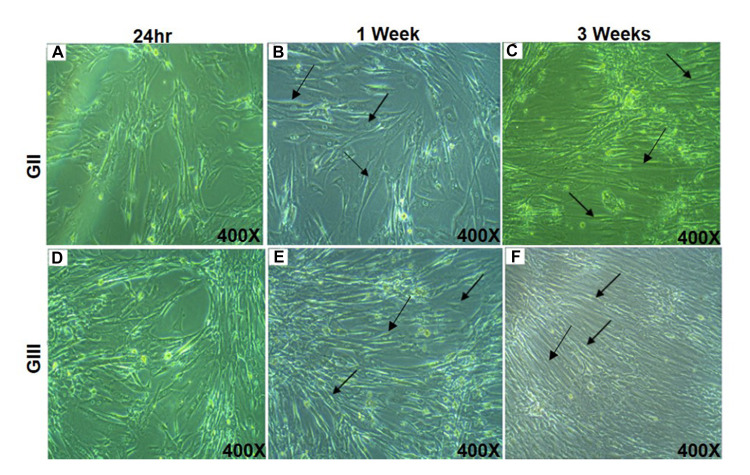
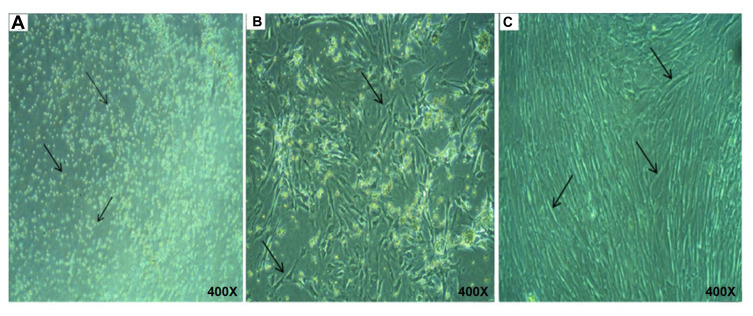
Methods: The researchers used enzymatic digestion to establish a primary HUC-WJ-isolated MSC line. Then, flow cytometry was used to characterize MSCs and hematopoietic stem cells (HSCs) markers' expression. In addition, the cardiac differentiation capacity of HUC-WJ-isolated MSCs in vitro was investigated by two protocols. Protocol-1 necessitates the dependence on merely 5-azacytidine (5-Aza), whereas in protocol-2, 5-Aza was supported by basic fibroblast growth factor (BFGF). The comparative study between the two protocols was applied by inspecting the ultrastructure of differentiated cells, measuring RT-PCR mRNA cardiac markers and the quantitative detection of cardiac proteins.
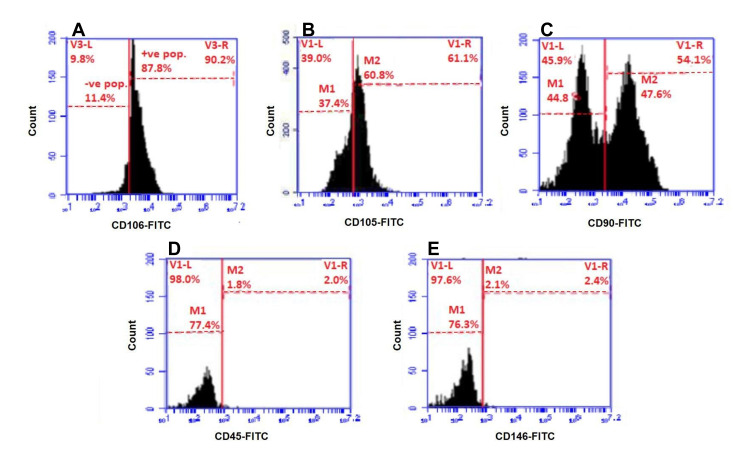
Results: HUC-WJ isolated MSCs were expressed by CD90+ve, CD105+ve, CD106+ve, CD45-ve, and CD146-ve. Remarkable TNNT1, NKX2.5, and Desmin mRNA expression and higher quantitative LDH and cTnI were detected by applying protocol-2. This same protocol-2 induced cardiac morphological features that were revealed by identifying cardiomyocyte-like cells and typical sarcomeres.
Conclusion: HUC-WJ is proved to be an ethical and effective source of MSCs induced cardiac differentiation, whereas BFGF supports 5-Aza in MSCs-cardiomyocytes differentiation.




 京公网安备 11010802042870号
京ICP备2023020795号-1
京公网安备 11010802042870号
京ICP备2023020795号-1

 分享
分享
 求助内容:
求助内容: 应助结果提醒方式:
 扫码关注我们
